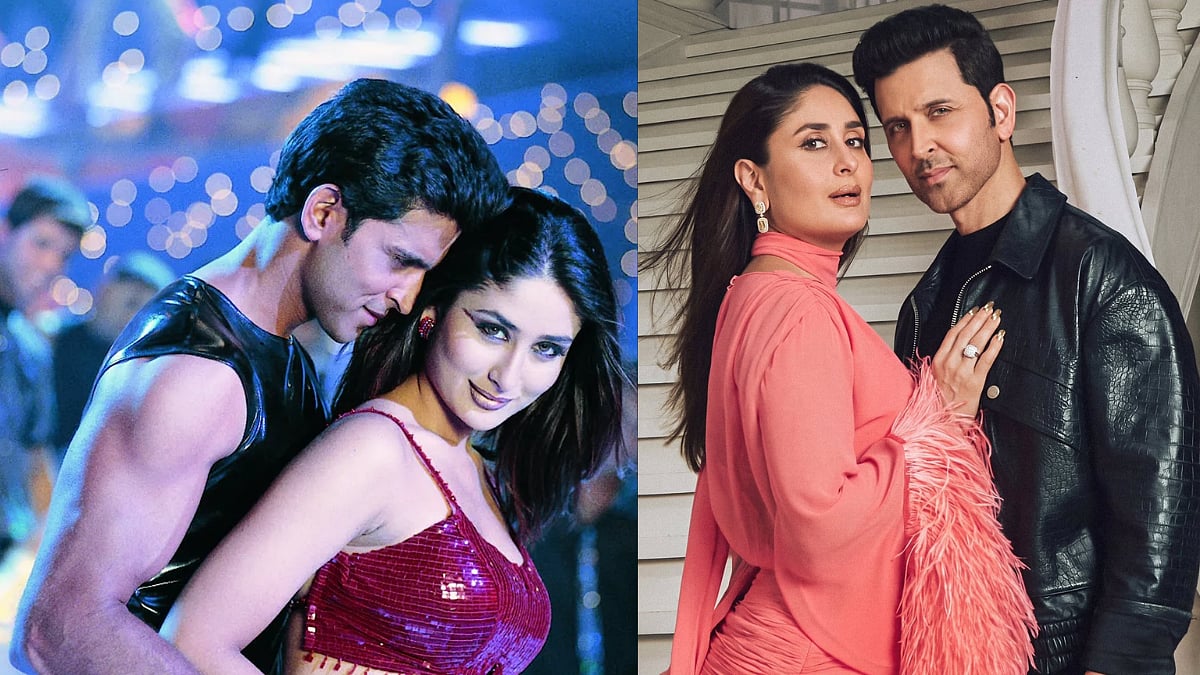
As Karan Johar’s sweeping family drama Kabhi Khushi Kabhie Gham marked its 25th anniversary this December, the film remains an indelible touchstone of Hindi cinema. While audiences fondly recall the grand staircase of the Raichand mansion, the unforgettable musical numbers, and the high-voltage melodrama, the silver jubilee also invites a closer look at one of its central pillars: Hrithik Roshan.
Cast as Rohan Raichand—the earnest younger brother determined to bridge a decade-long familial rift—Roshan stepped onto the sets of K3G at an extraordinary crossroads. Signed for the project before his debut film Kaho Naa... Pyaar Hai had even reached theatres, Roshan found himself transitioning overnight from an anxious newcomer into a nationwide sensation, all while sharing screen space with an unprecedented ensemble of Bollywood’s biggest icons.
Revisiting Roshan’s candid reflections from his early interviews around the film's 2001 release alongside his 25th-anniversary reunion with co-star Kareena Kapoor Khan reveals a portrait of awe, self-doubt, artistic growth, and enduring nostalgia.
Singular Pull of Rohan Raichand
At the time of K3G’s release, Roshan was only four films into his career. Stepping into a multi-starrer anchored by Amitabh Bachchan, Jaya Bachchan, Shah Rukh Khan, and Kajol could easily have felt daunting. Yet, Roshan never measured the opportunity by screen time or solo billing.
Roshan emphasized that the emotional trajectory of the younger Raichand sibling was non-negotiable for him. "Even if I was offered a different role, I would have only agreed to do Rohan," he remarked, making it clear that no other part in the script held the same appeal.
At that early stage in his journey, Roshan had even regarded K3G as one of the finest work he had done. Much of that satisfaction stemmed from the atmosphere cultivated by director Karan Johar. Roshan noted that Johar was among the best people he had encountered in the industry, adding that "working with him is very easy" and that he had "never been so comfortable" on a film set.
In presence of the Titans
Behind the effortless swagger of the grown-up Rohan—who famously breezes into London and outwits Poo with rapid-fire tongue twisters—was a young actor deeply intimidated by the sheer stature of his co-stars. Roshan has spoken openly about the exact moment his composure nearly crumbled on set.
The defining test occurred during the filming of the high-voltage confrontation sequence between Amitabh Bachchan and Shah Rukh Khan. Watching the two stalwarts trade dramatic blows from the sidelines left Roshan spellbound. So overwhelming was their command over the craft that Roshan walked up to them afterwards to express his amazement—only to realise with a jolt that he had to step into the very next frame alongside both of them.
Suddenly gripped by imposter syndrome, Roshan confessed to the legends that watching them perform had left him feeling minuscule and completely at a loss on how to proceed. Recalling that paralysing moment, he admitted, "I felt really small the next scene with both in the same frame... I told them I didn't know how to do it any more after seeing their performances. I was completely lost."
It was Amitabh Bachchan who pulled the young actor back from the brink. Bachchan advised him to shed his self-consciousness and "simply be the character, instead of being me." Roshan took the veteran’s counsel to heart, anchoring himself entirely in Rohan’s perspective—a shift in mindset that immediately unlocked the scene.
Camaraderie on set
Sharing top billing with Shah Rukh Khan carried a deeply personal resonance for Roshan. Long before K3G, Roshan had observed Khan closely from behind the camera while working as an assistant director on his father Rakesh Roshan’s sets. Stepping into K3G as Khan’s onscreen brother was a full-circle moment. "I always wanted to be like Shah Rukh," Roshan candidly shared, praising him as an extraordinarily supportive scene partner and "my best co-star till then," while admitting he would genuinely miss their daily creative rhythm once filming wrapped.
His dynamic with the leading ladies offered an equally compelling study in contrasts:
Kareena Kapoor Khan: Roshan observed that he and Kapoor operated on completely different wavelengths as performers. Describing their contrasting methods, he noted, "Bebo is completely the opposite of me. She remains relaxed while I have to struggle with my lines and concentrate on the scene. She just breezes on to the sets, gives her shot and walks away."
Kajol: Prior to filming, industry whispers had cautioned Roshan that Kajol could be a demanding colleague. His actual experience proved the exact opposite. He found her to be "great fun" and a "fabulous actress," emphasising that the entire cast was wholly committed to elevating every scene without "any ego problems and/or clashes over who was more important."
Jaya Bachchan: Playing mother and son came naturally to the pair, with Roshan noting that he "vibed very well with Jaya Aunty," which grounded their domestic scenes in genuine warmth.
Screen presence
When asked how he managed to hold his own amidst such seasoned heavyweights, Roshan pointed inward rather than outward. Rather than relying on theatricality, he drew upon lived emotion. "I use a lot of my childhood, though I really cannot pinpoint them," he explained, noting that whenever a fictional moment mirrored something from his own life, he tapped into those memories.
For Roshan, true screen presence was never about posturing; it was the natural byproduct of immersion. As he put it, "Screen presence is all about being involved in a scene. If you are focused on the role and concentrate on the character, the presence will be automatically felt." Looking at his own evolution across his first four films, Roshan acknowledged that while he had grown more comfortable with his craft, the bar only kept rising—and "the fight to exceed is still on," a pursuit he believed should never end because it kept him driven.
Returning to Raichand House
A quarter of a century after K3G first lit up cinema halls on December 14, 2001, the bond between Roshan and the film remains vibrantly alive. Ahead of the film’s silver jubilee, Roshan stepped back into Rohan’s shoes alongside Kareena Kapoor Khan and Karan Johar for a special promotional campaign recreating the iconic Raichand mansion for fans. Trading playful callbacks to Poo’s mirror check and Rohan’s famous Chandu ke chacha tongue twister—while reminding Poo that "Raichand House ghar tab banta hai jab sab saath mein ho"—the reunion underscored just how deeply the characters endure in the collective imagination.
What began in 2001 as an intimidating test of nerve alongside cinema’s greatest icons has, twenty-five years later, cemented itself as one of the defining chapters of Hrithik Roshan’s storied journey.
Pop-culture phenomenon
Pic: Pinterest
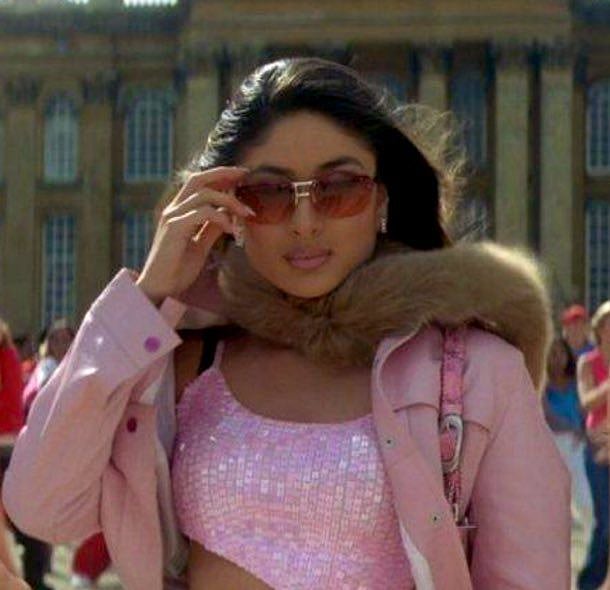
When Karan Johar’s Kabhi Khushi Kabhie Gham arrived in theatres in December 2001, it arrived wrapped in orchestral grandeur, sweeping family melodrama, and an unprecedented assembly of Hindi cinema’s biggest titans. Amidst the towering emotional gravitas of Amitabh Bachchan, Jaya Bachchan, Shah Rukh Khan, and Kajol, a barely 20-year-old Kareena Kapoor Khan walked onto the screen in a pastel backless top, checked her reflection with supreme self-assurance, and introduced Bollywood to Pooja "Poo" Sharma.
Twenty-five years later, K3G has evolved from a blockbuster family drama into a generational language—and Poo sits squarely at its centre. Looking back across a quarter-century of interviews, from her candid reflections during the film's milestone anniversaries to her recent November 2026 silver jubilee reunion with Hrithik Roshan and Karan Johar, Kapoor Khan’s own words reveal how a character once dismissed by some as pure fluff became the defining signature of her 75-film career.
Nobody saw it coming
In 2001, Kapoor Khan was barely a year into her career following her debut in Refugee. Stepping onto a set brimming with legends, neither she nor the makers anticipated that Poo’s unapologetic vanity and rapid-fire English one-liners would outlive almost every other trend of the decade.
Reflecting on the film's enduring legacy, Kapoor Khan admitted that the sheer scale of Poo’s cultural afterlife caught everyone off guard. "We were all so young at that time, whether it was me, Hrithik Roshan, or Karan Johar," she recalled, noting that "nobody thought that this character would become such a big rage." Whenever Kabhi Khushi Kabhie Gham comes up in conversation, she observed, the immediate reaction is rarely about the plot's heavy emotional conflicts—instead, people instantly exclaim, "OMG Poo!" She credits Karan Johar entirely for envisioning a woman so brazen and joyful, calling it one of the finest parts the filmmaker ever penned.
Even as her filmography expanded across critically acclaimed dramas and commercial tentpoles, Kapoor Khan has candidly acknowledged that Poo remains her most indelible calling card. Marking the film's 25-year milestone in November 2026, she marvelled at the devotion of fans who still tell her they have watched the movie over twenty times. "I have done around 75 films and no one has ever remembered me so much in a film," she confessed, recognising that an uninhibited 20-year-old’s comic turn had effectively overshadowed decades of subsequent work.
Over-the-top diva
To casual observers in 2001, Poo looked effortless—a glamorous, high-fashion caricature tossed lightly into a heavy family saga. Yet, Kapoor Khan has consistently pushed back against the notion that playing Poo was easy, arguing that high-wire comedy demands far more precision than conventional melodrama.
In past interviews dissecting her craft, she explained the tightrope walk required to keep Poo endearing rather than grating. "I think it's easier to cry and be emotional, but making people laugh—and being a mainstream actor playing a character that has to be so over-the-top yet so loveable—I think that's very difficult to do," she noted. Her dialogue consisted largely of breezy, throw-away lines that could easily have fallen flat without razor-sharp comic timing and absolute conviction.
At the same time, Kapoor Khan brought an instinctual, almost breezy detachment to the set that famously contrasted with co-star Hrithik Roshan’s intense, methodical preparation. Discussing her early years on the K3G set—including an anecdote shared by Karan Johar about her ability to sob convincingly during a solemn sequence and immediately snap back to normal once the director called cut—Kapoor Khan explained her process as a vital instinct. "You need to have that switch-on, switch-off," she reflected, calling it "a form of self-preservation" that prevents an actor from growing emotionally exhausted between takes.
Living in Poo’s shadow
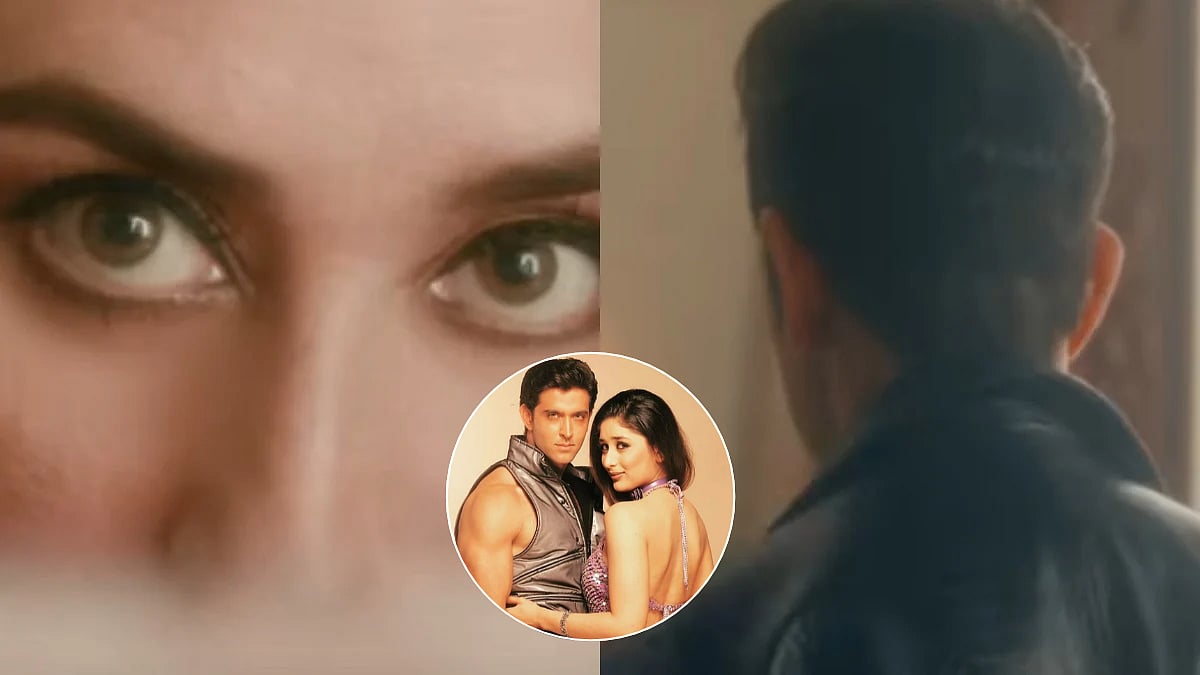
For an actor hungry for reinvention, being synonymous with one iconic persona—alongside Jab We Met’s Geet—became a double-edged sword. Kapoor Khan openly admitted that the shadow of Poo occasionally forced her to fight harder to prove her range. "As an actor, you want to try and do something different every time," she explained. "For me, it is difficult because I've been known for playing Poo and Geet... This thing has been fixed in people's minds. So, that has been a conscious effort that now I want to do different things."
Yet, whenever discussions turn to remaking K3G or passing Poo’s crown to a new generation, Kapoor Khan’s protective instinct takes over. She has stated unequivocally that "nobody else can play Poo, and shouldn't play Poo," viewing the character as an unrepeatable lightning-in-a-bottle moment. Beyond the attitude, she also championed the aesthetic revolution she and designer Manish Malhotra sparked—especially her pastel backless blouse and palazzo ensemble in Bole Chudiyan, which she proudly noted was decades ahead of its time.
Made for the meme era
As Kabhi Khushi Kabhie Gham celebrates its silver jubilee in late 2026, Poo’s reign shows no signs of fading. Reflecting on why Gen Z and millennials treat a 2001 character as their ultimate patron saint of self-love, Kapoor Khan summed up Poo’s timeless appeal during the film’s 25th-anniversary celebrations in November 2026.
"What makes me smile is that a character who seemed so extravagant in 2001 feels perfectly at home in today's pop culture," she said. "She was made for the meme era before we even had one!"
True to form, Kapoor Khan stepped back into Poo’s pink-tinted world in November 2026 alongside Hrithik Roshan and Karan Johar for a special silver jubilee campaign recreating the Raichand mansion. Trading playful barbs with Roshan’s Rohan over who makes the better host—and quipping in classic Poo cadence, "Kaun hain yeh log jo Poo ke ghar aayenge?"—she proved that twenty-five years on, Kareena Kapoor Khan hasn't just outgrown Poo; she has effortlessly claimed her forever.

