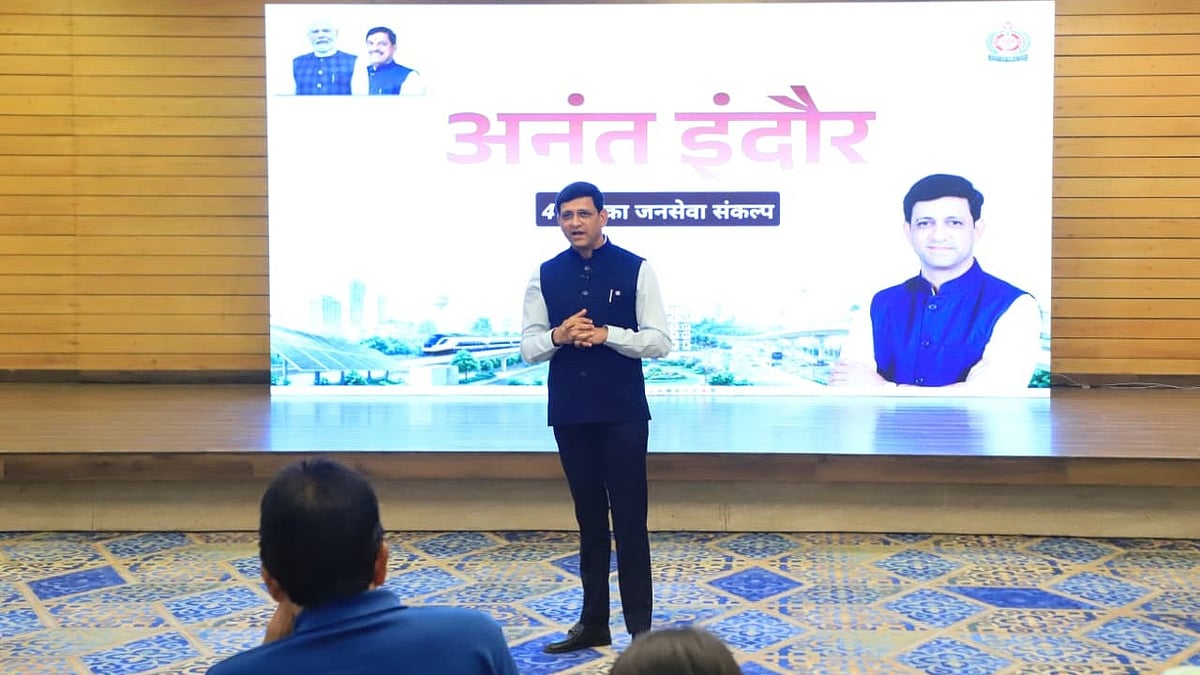
Indore (Madhya Pradesh): Marking the completion of four years of the Indore Municipal Corporation (IMC) council, Mayor Pushyamitra Bhargav presented a comprehensive progress report outlining a strategic shift in urban governance.
The council is pivoting away from short-term physical infrastructure towards building a resilient, sustainable and future-ready 'Anant Indore' - a vision designed to support the city's growth over the next 25 years.
Addressing the media, Mayor Bhargav highlighted the rapid urbanisation of Madhya Pradesh's financial capital. He said the IMC's strategy is anchored around six core pillars - justice, water security, health, green energy, digital governance, and infrastructure and global standing.
Setting targets for the remaining term, Bhargav said his fifth-year focus is clear - to build roads for today and secure water for decades ahead.
"For the fifth year, my focus is clear: build roads for today and secure water for decades ahead," he told reporters.
Sharing the council's four-year report card at a press conference, Bhargav said 23 Master Plan roads are under construction, while work has begun on Narmada Phase IV, which will double the city's water capacity from the existing 450 MLD to 900 MLD.
Bhargav said the IMC's focus over the past four years has been to prepare Indore for the next 20-25 years, considering its rapid expansion.
The number of houses has increased from 3.85 lakh in 2011 to 8.11 lakh in 2026, while the population has nearly doubled from around 22 lakh to 44 lakh.
Narmada Phase IV biggest feat
Bhargav termed Narmada Phase IV the council's biggest achievement and its most important future-oriented project.
The scheme has expanded to nearly Rs 2,800 crore and includes a 1,600-MLD intake well at Jalud, 2.25 lakh new water connections, 40 overhead tanks and new pipelines.
The IMC is raising Rs 700 crore through loans and Rs 1,000 crore through a proposed Blue Bond.
A SCADA system has digitally mapped all 102 tanks, while groundwater stress has led 6,000 borewells to dry up. To promote conservation, 35,000 households received rainwater-harvesting notices, with a 10% property-tax rebate being offered.
Sewage treatment capacity is expected to rise from around 420 MLD to nearly 800 MLD by 2028, including new 350-MLD plants. Another 400-MLD proposal has been submitted under Namami Gange.
The city's 60-MW solar park is operational and aims to reduce the annual Rs 400-crore electricity cost of pumping Narmada water from Jalud. It is currently saving the IMC around Rs 5 crore per month.
Key milestones across the six pillars
Retained the country's cleanest city tag for the eighth consecutive year.
Resolved the 32-year Hukamchand Mill dispute; labourers received Rs 400 crore in dues, while Rs 500 crore remains with the IMC.
First civic body to issue a green bond for a 60-MW solar plant.
Approval received and construction began on 23 Master Plan roads.
Narmada Phase IV aims to scale water supply to 1,500 MLD by 2040 and beyond; sewage treatment capacity will rise from 420 MLD to 800 MLD by 2028.
More than 21 lakh saplings planted, including 21,000 fruit trees near Sirpur Lake.
Cattle shelter land expanded from 20 bighas to 120 bighas, housing 2,800 cattle. An 80-bigha shelter with capacity for 10,000 cattle is being developed at Ashapura, Mhow.
Indore secured Wetland City status alongside Udaipur.
AI scanned more than 70 lakh legacy records, while 35,000 homes received digital address plates.