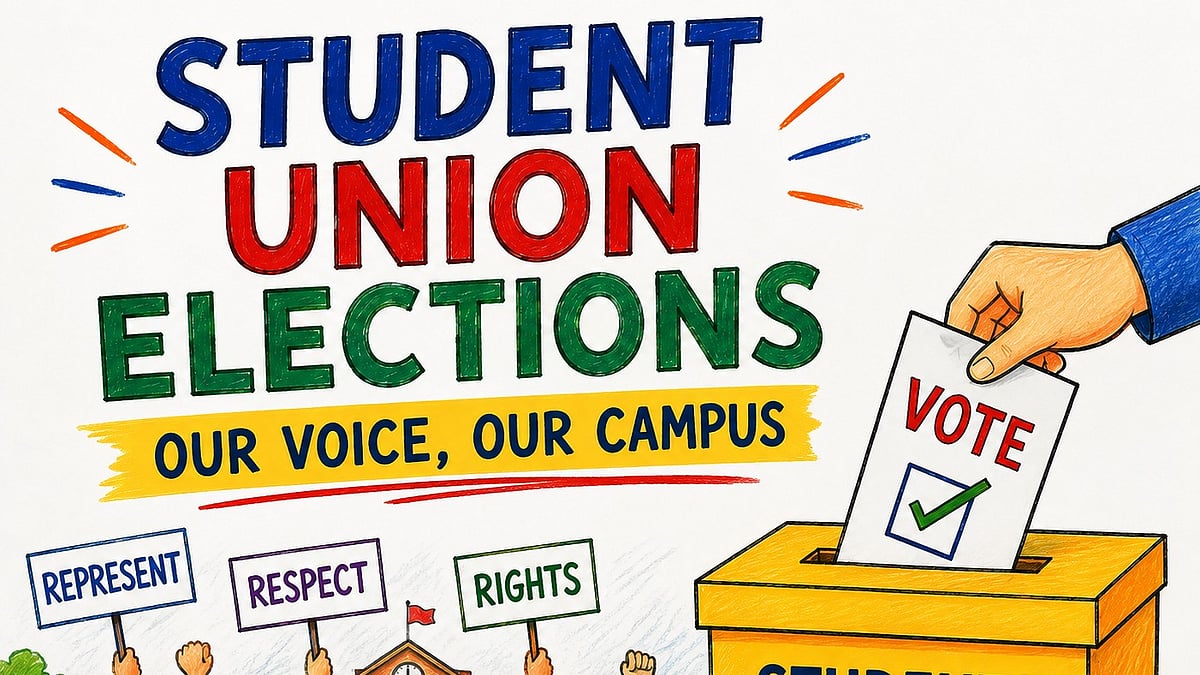
Indore (Madhya Pradesh): Eight years after the last student union elections, campus democracy is set to return to Madhya Pradesh's universities—only after the High Court stepped in.
The Madhya Pradesh High Court's direction to the State government to hold student union elections in all 15 state-run universities has ended an eight-year freeze on campus politics and put the government under pressure to revive elected student bodies in higher education institutions.
The irony is stark: while the formation of student unions continued to feature in academic calendars, the government repeatedly stopped short of actually holding elections.
The prolonged freeze persisted despite repeated demands from student organisations, including the ABVP and NSUI, and the broader framework laid down by the Supreme Court and the University Grants Commission (UGC) for student representation.
Calendars promised unions, campuses got none
For students, the absence of elected unions meant there was no formal representative body to raise collective grievances related to examinations, results and other university issues.
Youth Congress leader Abhijeet Pandey criticised the government over the prolonged absence of student unions, saying such bodies provide an organised channel for interaction between students and university administrations.
Pandey alleged that the government had ignored the Supreme Court's directives and failed to act on the UGC's communication regarding student union elections.
Welcoming the High Court's order, he expressed hope that the State government would now comply with the direction and allow the electoral process to resume.
2011: Elections after decades; 2017: Polls, but no council
Madhya Pradesh's student politics has witnessed only brief phases of electoral activity in recent decades.
After a gap of several decades, student union elections were held in 2011 through the indirect mode, following a UGC communication based on the Supreme Court's directions.
But the process did not continue. No elections were held over the next six years.
They returned in 2017, but even then the exercise remained incomplete as the university-level council was not constituted.
Since then, student union formation has again remained in limbo.
The result: another prolonged period without elected student representatives.
Universities caught in the middle
State universities, including Devi Ahilya Vishwavidyalaya (DAVV), have faced repeated questions over the absence of student union elections. However, the universities themselves have little room to act because permission to conduct the polls rests with the State government.
As a result, a system meant to provide students with elected representatives remained frozen due to the government's decision not to permit the elections.
SC, UGC had already laid down the roadmap
The issue is not new. The Supreme Court, in 2006, directed the implementation of the Lyngdoh Committee recommendations on student union elections.
The UGC guidelines issued in 2007 provided for student representation through direct elections, indirect elections or a hybrid model, with institutions expected to move from nomination-based systems to structured elections within five years.
Where campus conditions were considered unsuitable for free and fair elections, the guidelines allowed institutions to begin with nomination-based representation. However, the stated objective was to eventually transition to a structured electoral model.
The models envisaged included direct parliamentary elections, indirect presidential elections or a hybrid of the two.
Government faces the next test
The High Court's intervention has brought the eight-year freeze on student politics into sharp focus.
For the State government, the challenge is no longer whether student elections should be discussed—it is whether the court's direction will finally translate into ballots, elected unions and a functioning student voice across Madhya Pradesh's state universities.
After years of silence on campus democracy, the High Court has firmly placed the responsibility on the government to act.