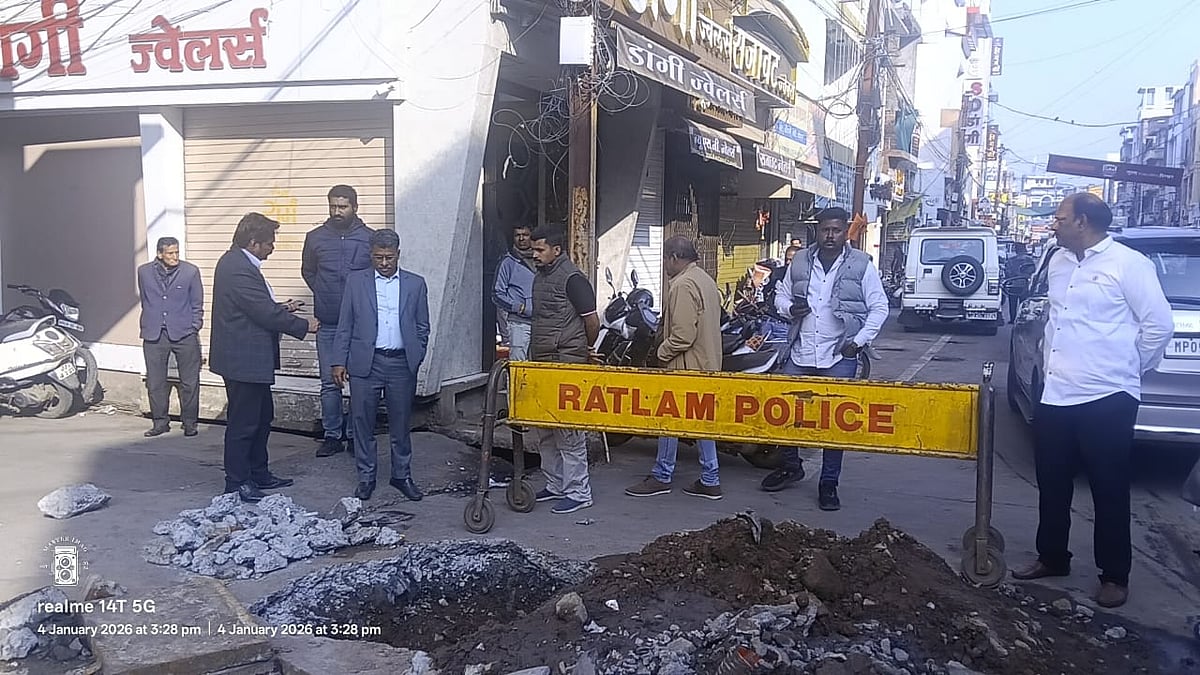
Ratlam (Madhya Pradesh): Additional Commissioner of Urban Administration, Bhopal, Kailash Wankhede, visited Ratlam on Monday and reviewed ongoing repair work on pipelines laid for the city’s drinking water supply system and sewer lines.
During inspection, he examined construction quality, progress timelines and safety measures and issued clear directives to officials for timely completion.
Wankhede said that drinking water must not be contaminated by sewage or any polluted sources. He instructed authorities to ensure uninterrupted availability of pure and safe drinking water to every household. Complaints related to contaminated water, he said, must be addressed immediately with on-ground verification and corrective action.
Ratlam Municipal Corporation Commissioner Anil Bhana, along with senior municipal engineers and staff, accompanied him during the inspection and briefed him on current arrangements.
To strengthen monitoring, a district-level control room has been established in room number 102 of the Collector’s office. The helpline number 07412 270416 will function daily from 7 am to 7 pm to monitor water quality in rural and urban schemes to prevent diseases.
Contaminated water supply raises alarm in Dhar
Dhar: A memorandum was submitted to the Collector through the ADM by District Congress spokesperson and councillor Ajay Manoharsingh Thakur, highlighting a serious case of contaminated drinking water supply in Dhar. He demanded an immediate investigation into the town’s water system and strict action against those responsible.
Thakur alleged that sewage-mixed water is being supplied through the only filter plant on Padaliya Road, which has reportedly remained non-functional for over a year, even 15 days after a similar incident in Indore. He further claimed that water tanks have not been cleaned, old and damaged pipelines continue to be used and purification is being carried out by untrained staff. According to him, untreated water from local ponds is being supplied, leading to the spread of waterborne diseases. Thakur warned that if corrective measures are not taken promptly, Dhar could face a serious situation similar to the Indore incident.
Collector orders ward-wise drinking water inspection
Mandsaur: Collector Aditi Garg directed municipal council to form teams in every ward to ensure thorough inspection of all drinking water sources. She stressed that safe drinking water is the administration’s top priority, during a weekly inter-departmental review meeting held at the Municipal Council auditorium. The meeting reviewed drinking water supply, sanitation, water quality and source conditions across the district. The Collector ordered regular cleaning of tanks, pipelines and wells. She asked for strict monitoring to prevent mixing of drainage and drinking water lines and immediate action on complaints of contaminated water. She also instructed that 100 percent of the population must be provided safe drinking water, with monthly water testing in coordination with the Public Health Engineering Department.
Water Samples collected in Niwali
Sendhwa: To ensure the supply of clean and safe drinking water, extensive collection of water samples is being carried out under the “Water Supply Quality Monitoring” programme at Niwali Janpad Panchayat in Barwani district. With the support of the Public Health Engineering Department, drinking water sources in villages are being tested. Out of 37 gram panchayats, random samples have been collected from 31 so far. A total of 128 samples were taken from handpumps, tap water schemes, tubewells and wells. Of these, 45 samples have been sent for testing, while the remaining will be dispatched soon to prevent waterborne diseases and ensure quality standards.
