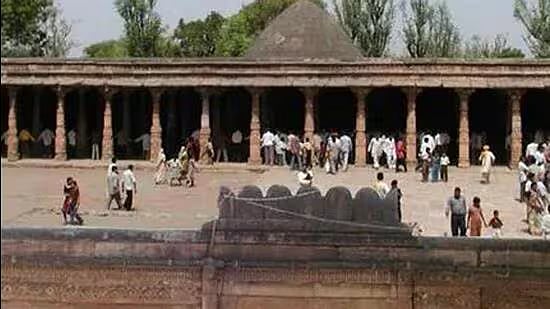
Indore (Madhya Pradesh): A temple retains its religious and legal status even after its demolition, giving devotees the right to worship at the site, a Hindu petitioner argued on Wednesday before the Madhya Pradesh High Court during the hearing in the disputed Bhojshala complex case in Dhar district.
Even after a temple is demolished or its idols are destroyed, the deities remain present there in an "indirect or invisible form", the Hindu side asserted.
The Hindu community considers Bhojshala, a 11th-century monument, a temple dedicated to Goddess Saraswati, while the Muslim side claims it is the Kamal Maula Mosque. The Indore Bench of the High Court is hearing four petitions and a writ appeal since April 6 on the religious nature of the disputed complex, currently protected by the Archaeological Survey of India (ASI).
On the third day of the hearing, Vishnu Shankar Jain, the lawyer representing the Hindu Front for Justice, continued to present arguments before Justices Vijay Kumar Shukla and Alok Awasthi. Jain reiterated that as per historical records and scientific evidence, the Saraswati temple existed on the premises earlier than the mosque; therefore, Hindus should be granted the right to worship there.
He claimed the temple, built in 1034 by Raja Bhoj of the Parmar dynasty, was demolished in 1305 on the orders of Alauddin Khilji. Citing religious rights guaranteed under Article 25 of the Constitution, he said, "After the attacks by invaders like Khilji, the rights of Hindu deities and their devotees were eclipsed. As soon as the Constitution came into force in 1950, these rights were restored."
Jain argued that an idol is not always necessary for worship, referring to the Narmada and Ganga rivers and the Kamadgiri mountain. This argument is crucial as the Hindu side claims the Saraswati idol from the temple is currently in a London museum.
Citing the Supreme Court judgment in the Ayodhya case, Jain said idols are recognised as juristic persons and their sacred purpose remains intact even if the structure is destroyed. He refuted the Muslim side's claim that the complex is a Waqf property, stating a "valid Waqf" was never established. "Islamic law itself does not permit the construction of a mosque after the demolition of a temple," Jain said.

