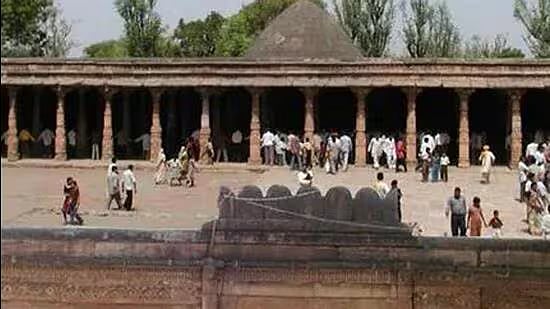
Dhar (Madhya Pradesh): The disputed structure at the Bhojshala complex in Dhar district is not a Waqf property and merely offering namaz at any place does not give it the legal status of a mosque, a Hindu petitioner argued before the Madhya Pradesh High Court on Tuesday.
The Hindu community considers Bhojshala, a monument believed to date back to the 11th century, a temple dedicated to Goddess Saraswati, while the Muslim side claims that it is Kamal Maula Mosque. The Indore bench of the High Court is hearing four petitions and a writ appeal since April 6 on the religious nature of the disputed complex, currently protected by the Archaeological Survey of India (ASI).
On the second day of the hearing, advocate Vishnu Shankar Jain of the Hindu Front for Justice told the bench of Justices Vijay Kumar Shukla and Alok Awasthi that a Saraswati temple, established by Raja Bhoj of the Parmar dynasty of Dhar in 1034 AD, existed within the premises which were known as Bhojshala in historical and revenue records.
Citing books by Indian and foreign authors, texts published by the ASI, and other sources, Jain claimed that the temple was demolished and the current disputed structure was erected using its remains. He argued that no mosque originally existed at the site, and merely offering namaz at any place does not legally make it a mosque.
According to Islamic law, a piece of land must be voluntarily declared to be a Waqf for the construction of a mosque, Jain said. He argued that Bhojshala has been a protected monument since 1909 and the disputed structure is not a Waqf property.
As per Hindu scriptures, as soon as an idol is consecrated in a temple, the site becomes the property of the deities, and once a temple is established, it remains a temple forever, the lawyer further said. Even if a temple is demolished or its idol is removed, the site legally remains the property of the deities, he said.
"Even if a temple is demolished, it does not lose its essential properties as a temple. Therefore, only Hindus should be granted the right to worship within the Bhojshala complex," Jain argued.

