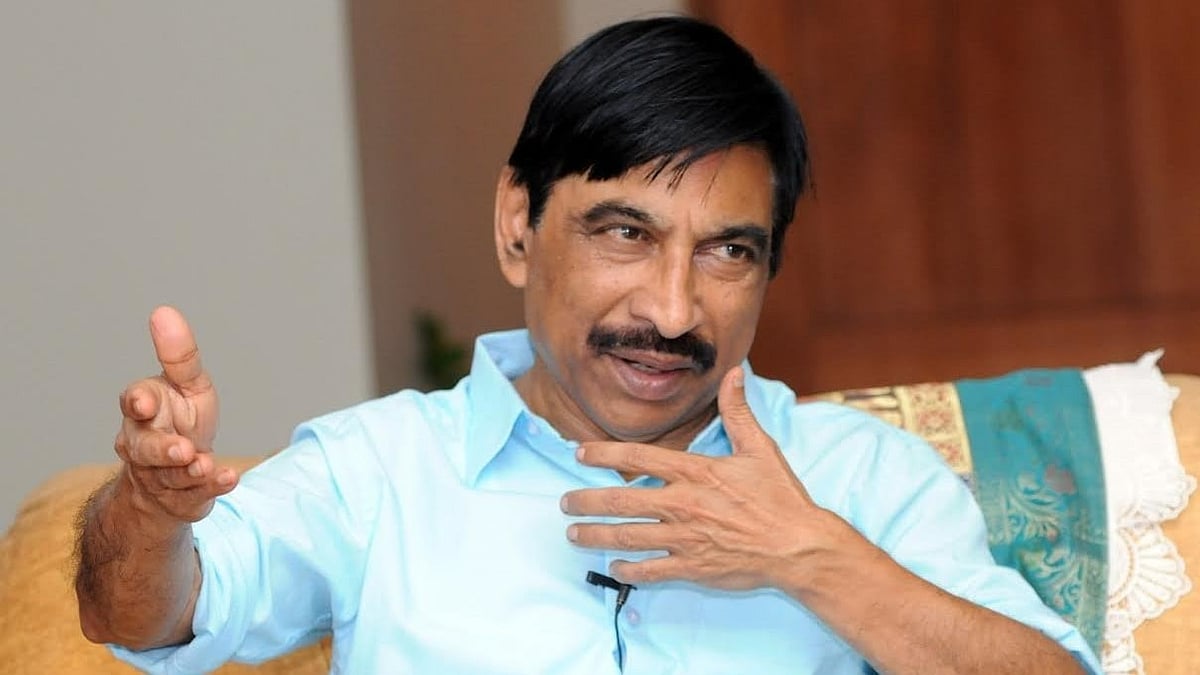
Indore (Madhya Pradesh): Renowned archaeologist KK Muhammed claimed that the now-disputed Bhojshala complex in Dhar was originally a temple of Saraswati Devi, and it was later converted into a mosque.
During an interview with PTI, he elaborated on the history of the 11th century monument, which is observed as Saraswati Temple by Hinuds and Kamal Maula mosque by the Muslims, stressing the importance of mutual understanding between communities.
In the video, he is heard saying, “Pehle Saraswati mandir tha, phir use Islamic monument mein convert kiya gaya” (It was first a Saraswati temple, later it was converted into an Islamic monument). He also referred to historical and legal aspects, noting, “1991 ke law mein religious aspects clear hain” (The 1991 law clearly defines the religious nature of sites).
Watch the video below :
Speaking about the post-Independence scenario, he said, “1947 mein agar mandir tha to mandir hi rahega, agar masjid thi to masjid hi rahegi” (If it was a temple in 1947, it will remain a temple, and if it was a mosque, it will remain a mosque). He emphasized that whatever decision the court gives should be accepted by all. “Court jo bhi nirnay de, use manna chahiye” (Whatever decision the court gives must be accepted).
On questions regarding Mathura and Kashi, he said, “Jitna Muslim ke liye Madina hai, waise hi Hindu ke liye Mathura aur Kashi hain” (Just as Madina is important for Muslims, Mathura and Kashi are equally important for Hindus).
He added that both communities should sit together and take decisions collectively, in order make the country strong and one.
Devotees at Bhojshala on Basant Panchami
Meanwhile, thousands of Hindu devotees thronged the Bhojshala complex on Friday to offer prayers to Goddess Saraswati on Basant Panchami. Special arrangements were made for havan and mantra recitation, continuing until sunset.
Since the festival coincided with Jumma, the Muslim community was scheduled to offer Friday prayers from 1 pm to 3 pm in a separate area, following the Supreme Court’s order.
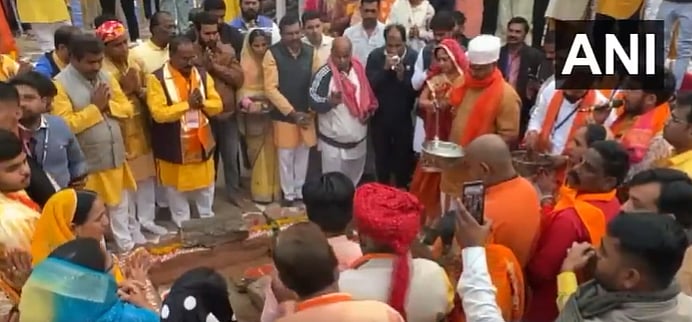
The apex court had allowed Hindu worship from sunrise to sunset and instructed the administration to ensure robust arrangements for peace and security.
Heavy police deployment and administrative oversight kept the situation calm throughout the day, and devotees from both communities followed the timings set by the court.

