Indore (Madhya Pradesh): When people think of healing herbs, the Himalayas usually come to mind. However, Madhya Pradesh may quietly be one of India’s richest “green pharmacies”, with forest biodiversity records and research documentation indicating more than 1,000 medicinal plant species across its forest regions, including the Indore forest circle.
Forest biodiversity compilations and research institutions such as the State Forest Research Institute (SFRI), Jabalpur, note that the state’s forests support a wide range of medicinal and ethnobotanical species, forming an ecological base for traditional tribal and rural healthcare systems that continue to operate alongside modern medicine.
Officials describe Madhya Pradesh as a key centre of dry deciduous forest biodiversity, where medicinal plants are not confined to protected reserves but are widely distributed across forest landscapes, village commons and tribal forest corridors.
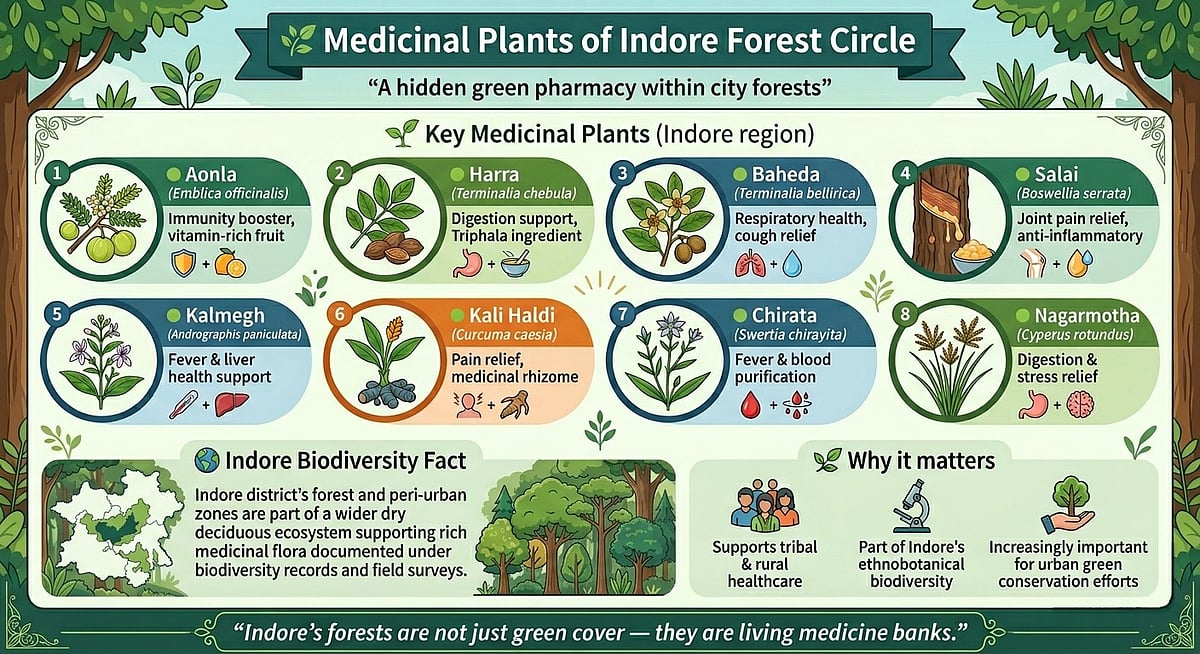
Among the lesser-known but locally significant medicinal species found in Madhya Pradesh are Aonla (Emblica officinalis), Harra (Terminalia chebula), Baheda (Terminalia bellirica), Salai (Boswellia serrata), Kalmegh (Andrographis paniculata), Kali Haldi (Curcuma caesia), Chirata (Swertia chirayita) and Nagarmotha (Cyperus rotundus). These plants are widely used in Ayurveda, fever treatments, digestive care and anti-inflammatory formulations.
According to biodiversity documentation, Madhya Pradesh hosts around 2,000–5,000 plant species, depending on classification scope, with medicinal and aromatic plants forming a significant proportion of this diversity. Research institutions also note that the state’s forests are part of India’s central forest belt, acting as an ecological transition zone between multiple forest types, contributing to high plant diversity and adaptation.
A major biodiversity hotspot within the state, the Satpura landscape alone contains over 1,300 recorded plant species, including several medicinal and rare endemic flora, according to forest ecosystem studies.
Officials highlight that unlike Himalayan regions known for alpine medicinal herbs, Madhya Pradesh’s biodiversity is defined by dry deciduous forest species adapted to heat, monsoon cycles and central Indian soil conditions, making its medicinal flora ecologically distinct.
The state also holds one of India’s largest continuous forest covers, with forest types ranging from sal-dominated tracts to mixed teak forests, supporting wildlife corridors as well as medicinal plant regeneration systems.
Conservation experts warn that despite this richness, medicinal plant populations face increasing pressure from habitat fragmentation, overharvesting and changing land-use patterns, raising concerns about the sustainability of both biodiversity and traditional knowledge systems.
Officials say this makes awareness among young people critical, especially those preparing for administrative services, as future policy decisions will directly influence forest governance and resource protection.
Ecology Is Not Separate From Governance
Chief Conservator of Forests (CCF) P.N. Mishra said, “Biodiversity should not be viewed only as wildlife protection but as a foundation of ecological stability.”
He added that plant diversity directly supports soil health, water cycles, climate regulation and rural livelihoods, stating that “even small ecological components collectively sustain larger environmental systems.”
Future Officers Must Understand Forests Early
Ranger Sangeeta Thakur said involving MPPSC aspirants in biodiversity discussions was intentional, noting that many participants would later enter administrative roles.
She added that early exposure to ecological systems helps ensure that environmental considerations are integrated into governance decisions in the future, particularly in forest-rich states like Madhya Pradesh.
Classroom in the field on biodiversity
A two-day biodiversity awareness programme organised by the Forest Department in Indore concluded on Sunday, bringing together college students and MPPSC aspirants for interactive discussions on plant diversity, conservation, and ecological governance.
Unlike conventional training formats, officials described it as a “real-world classroom on biodiversity,” with direct dialogue between participants and forest officers.
The programme also featured competitions:
Painting: Garima Bansal, Harshita
Speech: Kuldeep Chaturvedi, Satish Mishra, Shubham Patidar
Quiz: Pooja Sharma, Rohit Senani, Mansaram