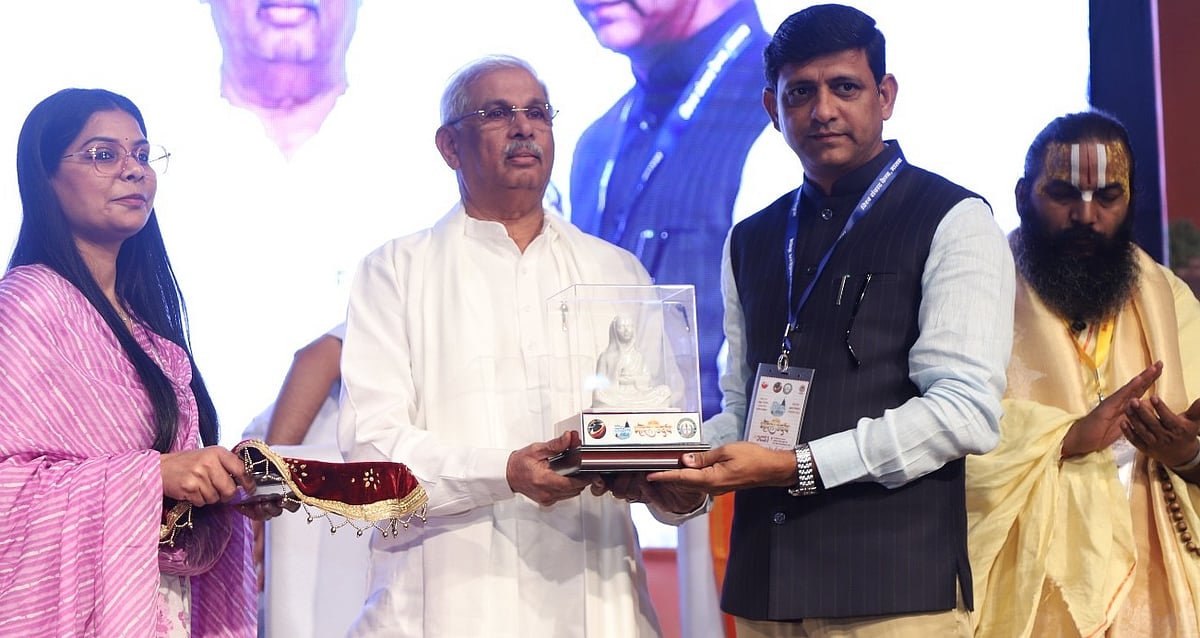
Indore (Madhya Pradesh): The way India responds to terrorist attacks has changed, and instead of lighting candles, the country now relies on BrahMos missiles. “Now, instead of candles, we have BrahMos in our hands. This difference becomes visible when self-awareness awakens. This is ‘Bharat Uday’ (Rising India),” said Kerala Governor Rajendra Arlekar.
He was addressing the gathering while inaugurating the three-day literary festival Narmada Sahitya Manthan at the DAVV auditorium here on Friday. The theme of the festival is ‘Bharat Uday’ (Rise of India).
A large number of intellectuals from across the country are participating in the brainstorming sessions. On the first day, senior thinkers and scholars shared their views across seven sessions.
Referring to the terrorist attack in Pahalgam, Arlekar said, “The attack did not target only the 26 people who were killed; it attacked all of us. You witnessed how the government responded—Operation Sindoor was carried out.” He added that earlier, after terrorist attacks, people would light candles in the evening as a mark of tribute and return home, but the atmosphere in the country has now changed.
The Governor further claimed that nearly 250 years ago, the British and Hyder Ali, the then de facto ruler of Mysore, had stopped the celebration of the Mahamagh Mela on the banks of the Nila River in Kerala. “After a gap of 250 years, the Mahamagh Mela has resumed in Kerala this year. Devotees from across the country are participating in large numbers. A new era of self-awareness and self-awakening has begun in India,” he said.
Addressing the first session, RSS Madhya Kshetra Sanghchalak Purnendu Saxena said that what India could not achieve over centuries now appears achievable in the coming decades. He noted that today’s youth do not want to be confined to modern education and technology alone, but are also turning towards the Vedas, Upanishads, and Indian philosophy to find the purpose of life. This, he said, is a positive sign and reflects that India’s future is in safe hands.

Abhay Mahajan, head of the Deendayal Research Institute, said that the vision of a resurgent India is incomplete without the development of villages. “The soul of India resides in its villages. The nation’s true identity lies there, and nation-building must begin from villages,” he asserted. Anurag Sharma and Budhinath Mishra also addressed the sessions.
Saffron flag rising in Ayodhya signifies awakening of India
Acharya Mithilesh Nandini Maharaj, head of Hanumat Peeth, Ayodhya, said that the consecration of the idol of Ramlala in Ayodhya is not merely the installation of an idol, but the consecration of India itself. “The saffron flag rising on the horizon in Ayodhya signifies the true awakening of India. Rama is the foundation of Dharma—the same Rama who bows before Parashurama also takes up arms to vanquish Ravana,” he said.
