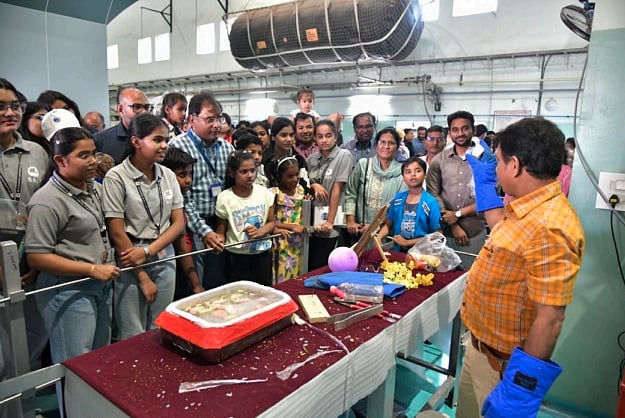
Indore (Madhya Pradesh): The second day of the two-day mega event National Science Day (NSD-2026) at the Raja Ramanna Centre for Advanced Technology was dedicated to college students, offering in-depth exposure to advanced scientific research and cutting-edge technologies.
More than 500 students from 21 colleges, along with invited guests and family members of employees, visited the exhibitions and laboratories. The programme began with an address by Dr Alpana Rajan, Associate Director, Physics and Technology Development Group, and Chairperson of the Organising Committee. She highlighted the importance of bridging classroom learning with real-world scientific research.
Considering the strong academic background of the participants, senior scientist Dr SK Ray delivered a lecture on Synchrotron Radiation and Its Applications. He explained how synchrotron radiation is used in engineering applications, protein crystallography, X-ray imaging, soft X-ray absorption spectroscopy, small- and wide-angle X-ray scattering, photoelectron spectroscopy, nanomaterials research, X-ray fluorescence and extended X-ray absorption fine structure spectroscopy.
The lecture gave students an understanding of how advanced light sources are enabling breakthroughs across multiple scientific disciplines.
Over 40 live demonstrations spark curiosity
Following the formal sessions on both days, students were guided by volunteers to explore more than 40 live demonstrations and laboratory exhibits.
These interactive displays were designed to clear common misconceptions and stimulate scientific curiosity. The exhibits transformed complex scientific principles into hands-on experiences. Major attractions included:
Indus Accelerator Complex: A film presentation and live CCTV visuals of India’s synchrotron radiation sources, Indus-1 and Indus-2.
Advanced Engineering and Physics Models: A working model of a maglev train demonstrating magnetic levitation principles.
High-Pressure Water Jet Technology: A manufacturing setup capable of cutting solid materials using water pressurised up to 4,000 bar.

