Indore (Madhya Pradesh): Various measures have been introduced in the new Income Tax Act, which will be implemented from April 1, to curb the circulation of black money. Under the Income Tax Act, 1961, strict taxes were imposed on undisclosed income to check black money.
In the new tax regime, the effective income tax rate on such income will be approximately 78%, including 60% tax, with the remainder comprising surcharge and cess. No deductions or loss adjustments will be allowed against this income.
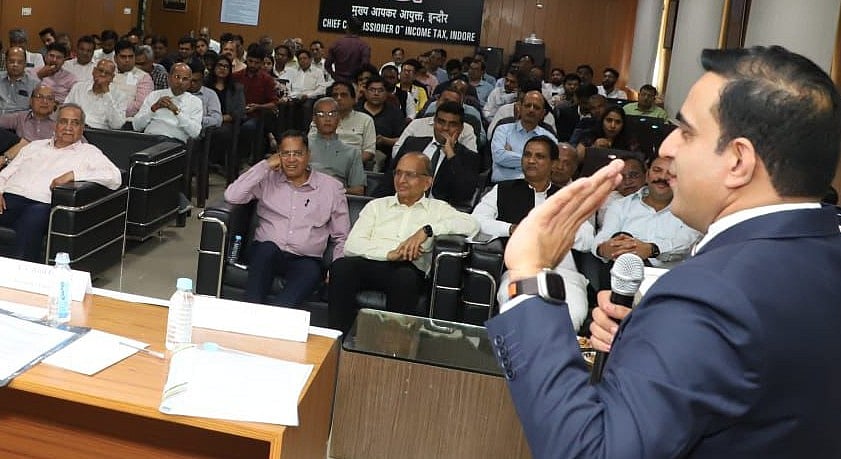
Experts from the Income Tax domain expressed these views at a seminar held here on Thursday. The seminar was organised by the Madhya Pradesh Tax Consultants Association (MPTCA), Indore zone.
The objective of the seminar was to explain the important provisions of the new Act.
The keynote speaker at the seminar was advocate and chartered accountant Rohit Kapoor from Amritsar. The chief guest was MP Shankar Lalwani, while senior chartered accountant Anil Garg chaired the session.
Kapoor said the Income Tax Department faces several practical difficulties while applying certain sections of the Act. In many cases, business-related cash sales, stock differences or cash deposits are treated as undeclared income and taxed under these sections, leading to disputes for taxpayers.
According to Kapoor, taxpayers should systematically maintain account books, stock registers, cash books and other documents to clearly establish the true source of income. He said the Income Tax Officer should invoke these provisions only in cases where income is proven to be derived from an undeclared source.
He also explained that in property transactions, if the sale price is lower than the value determined for stamp duty, the Income Tax Department may treat the stamp duty value as the basis for calculating income. Similarly, if a property is purchased at a price lower than the prescribed limit, the buyer may incur income tax liability.
Session chairman Anil Garg advised builders and developers to ensure proper documentation, transparent accounting and timely compliance with income tax provisions in real estate transactions. He said this would help avoid tax disputes and increase transparency and trust in the real estate sector.
TDS provisions decriminalised: Lalwani
MP Shankar Lalwani said India is rapidly progressing towards becoming one of the world's largest economies, and the Government of India has made efforts to bring flexibility and simplicity to tax administration through the new Income Tax Act 2025 and Budget 2026.
He said the new Act would reduce difficulties faced by taxpayers and the Income Tax Department.

ACT PROVISIONS
The new Income Tax Act 2025, taking effect from April 1, 2026, strengthens anti-black money measures by enabling tax authorities to conduct digital searches and scrutinize,,cryptocurrencies, and undisclosed foreign assets.
The Act focuses on high-value evasion, with strict 30% taxes and penalties up to 90% on unreported income, while offering relief for minor non-disclosures
Digital Search Powers: The IT Department can access digital records (emails, apps) only during authorized search/survey operations, not for routine checks, focusing on major tax evasion.
Foreign Asset Threshold: Effective retrospectively from Oct 1, 2024, prosecution is not initiated for failure to disclose foreign assets (excluding immovable property) if the aggregate value is < ?20 lakh.
Virtual Digital Assets: Cryptocurrencies are formally classified and taxed, bringing them under the purview of tax investigations.
Stricter Penalties: The Black Money Act remains stringent, with 30% tax on undisclosed foreign income/assets, plus up to 90% penalty.

