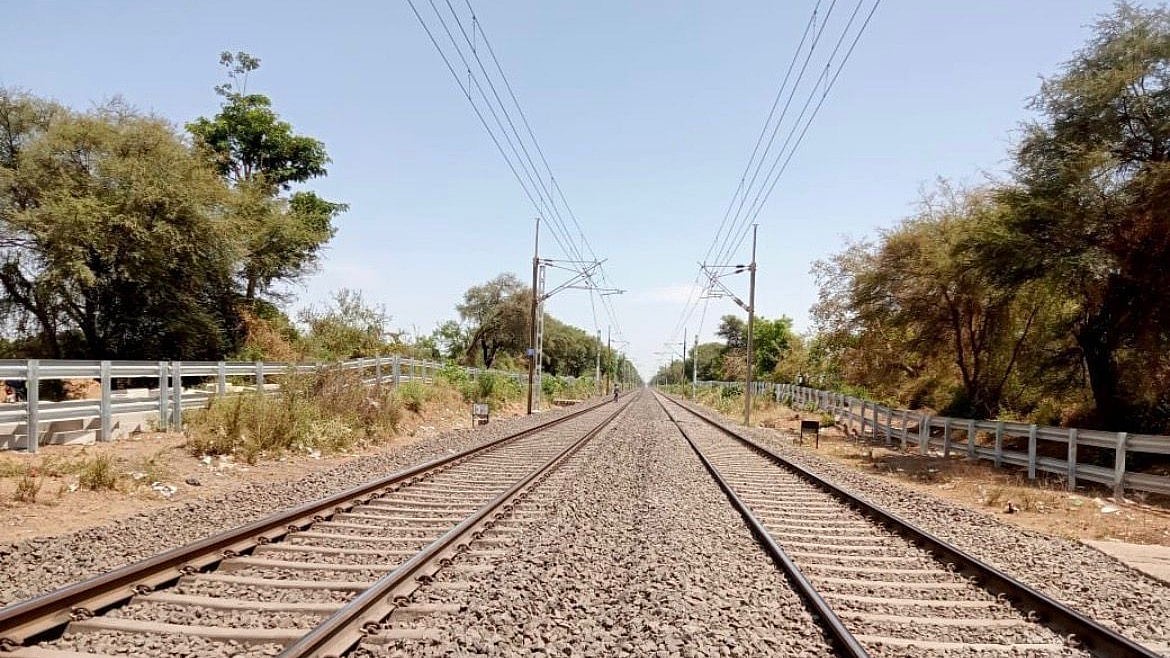
Indore (Madhya Pradesh): To enhance passenger convenience and improve train speed, safety and security, Indian Railways is undertaking extensive work on trackside fencing, boundary walls and safety fencing.
As part of this initiative, the railway track from Mhow to Ujjain via Dewas is being fenced. This is also essential as the Railways plans to introduce high-speed trains such as Vande Bharat from Mhow and the city in the near future.
Mukesh Kumar, PRO of the Ratlam Division of the Railways, informed that the work is being carried out in two phases.
The Nagda–Godhra rail section of the Ratlam Division is a crucial part of the Mumbai–Delhi semi-high-speed rail corridor, which is being developed under Mission Raftaar to support train speeds of up to 160 km per hour.
Under this project, work was undertaken to secure approximately 98 kilometres of the Nagda–Godhra rail section with boundary walls at designated locations. This work has now been completed, ensuring safer train operations and providing security for livestock owners.
In addition, construction of safety fencing and boundary walls has commenced at designated locations on the Chandariya–Mandsaur, Mandsaur–Ratlam, Mandsaur–Indore, Indore–Mhow–Khandwa, Nagda–Bhopal, and Ujjain–Dewas–Indore rail sections of the Ratlam Division. Boundary wall construction is proposed over a total length of more than 501 kilometers across these sections.
During last year, approximately 127 kilometres of boundary wall were constructed, while in the current financial year 2025–26, about 80 kilometres of construction has already been completed.
The Vande Bharat train is currently operating on Indore–Dewas–Ujjain–Bhopal rail section. Keeping safety and security in mind, boundary wall construction on this important route is progressing rapidly.
Once boundary walls are completed across all identified areas of the Ratlam Division, the movement of domestic and wild animals onto railway tracks will be prevented, trains will be able to operate uninterrupted at maximum permissible speeds, farmers’ livestock will be protected, and overall train operations will become safer. This will also improve punctuality.

