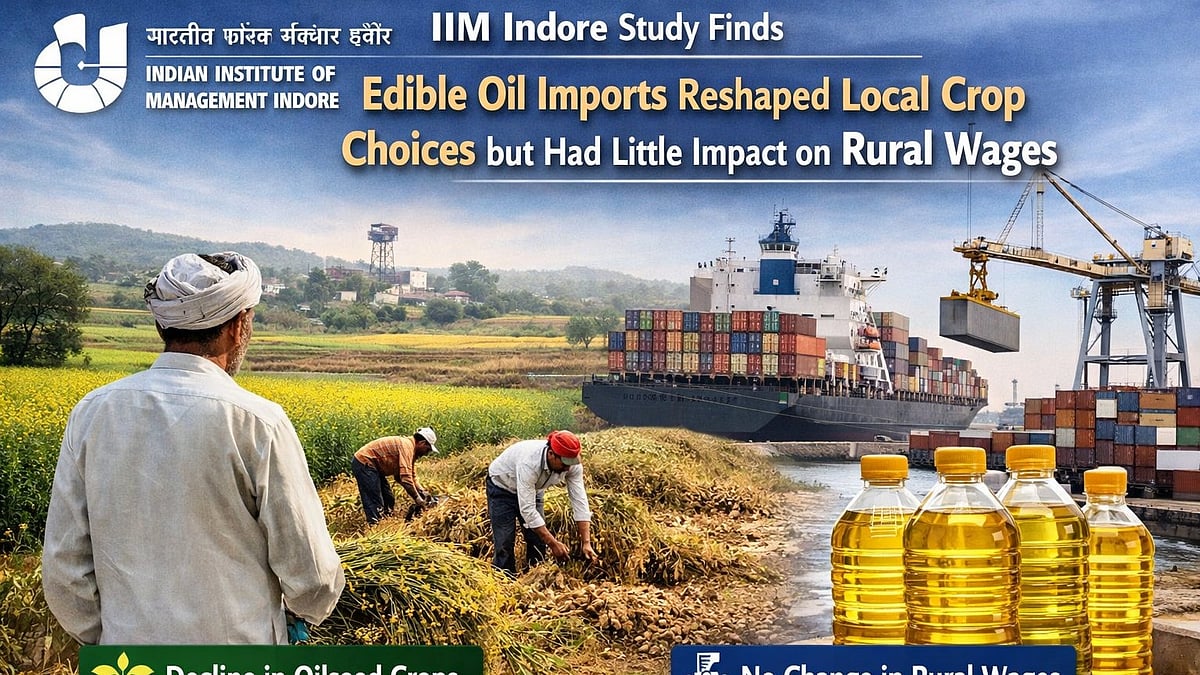
Indore (Madhya Pradesh): A study by researchers at the Indian Institute of Management Indore (IIM Indore) has found that India’s surge in edible oil imports following trade liberalisation in the 1990s significantly affected local crop production patterns and edible oil prices but did not meaningfully change rural wages or agricultural employment.
The research, titled Spatial Effects of Import Competition: Edible Oils in India and published in the journal Agricultural Economics, was co-authored by Prof Sutirtha Bandyopadhyay. It examines how rising imports altered agricultural markets across India over nearly two decades.
Before the 1990s, India largely followed near-autarkic policies that restricted edible oil imports. After trade liberalisation, imports surged and came to meet a large share of domestic demand.
Although the domestic edible oil processing sector employs relatively few workers, it relies heavily on oilseeds grown by farmers. Oilseed crops including mustard, groundnut, sesame and cottonseed occupy about 14% of India’s cultivated land, making them among the most important crops after staple cereals such as rice and wheat.
Many of these oilseeds are grown in dryland and arid regions, where farm incomes are often low and vulnerable to price shocks.
District-level analysis
The study analysed data from 1993-94 to 2011-12, building a district-level panel covering 257 districts across 14 major states, including Madhya Pradesh, Rajasthan, Gujarat, Maharashtra, Karnataka, Tamil Nadu and Punjab.
To track the local impact of trade shocks, researchers constructed a measure of trade exposure based on the share of agricultural land devoted to oilseeds in each district.
Because many oilseed crushers in India operate as small-scale units serving local markets due to government regulations, regions with larger oilseed cultivation were expected to face stronger competition from imported edible oils.
Strong price effects, limited labour impact
The findings showed that global edible oil prices were transmitted more strongly to local markets in districts that specialised in oilseeds, confirming the researchers’ theoretical expectations.
However, the study found no statistically significant differences in wages, employment levels or consumption among landless agricultural workers in areas more exposed to import competition.
Researchers suggest that farmers adjusted their cropping patterns, shifting away from oilseeds as global prices fell due to imports. Districts with higher oilseed cultivation saw a reduction in oilseed acreage relative to other crops.
These adjustments may have helped absorb the economic shock, limiting its impact on rural labour markets.
Policy implications
The study concludes that import competition significantly influenced edible oil prices and farm production decisions, but its effects on wages and employment were limited.
According to the researchers, the findings highlight how the local structure of agricultural production plays a critical role in shaping the impact of global trade policies.
At a time when agricultural trade remains a major issue in international negotiations, the study suggests that the consequences of trade liberalisation depend not only on national policy but also on regional farming patterns and market conditions.