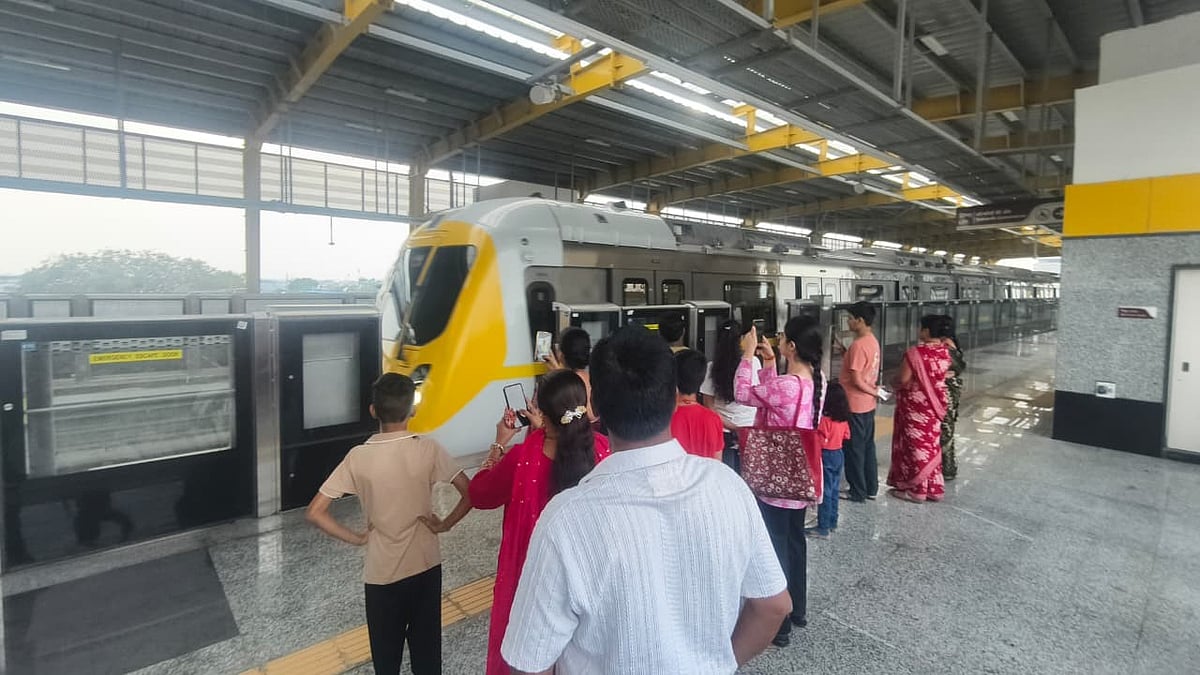
Indore (Madhya Pradesh): The Indore Metro has completed a month of commercial operations, but ridership and revenue remain far below potential. In 30 days, around 75,000 passenger journeys generated nearly Rs 30 lakh, while electricity expenditure roughly crossed Rs 35 lakh. Staff and maintenance costs could push total operating expenses beyond Rs 50 lakh.
With two trainsets, one stationed at each terminal, the Metro makes roughly 1,540 to 1,550 complete round trips monthly under the current timetable, translating into 3,080 to 3,100 one-way train movements. With 75,000 passenger journeys, average occupancy works out to about 24 passengers per movement.
Each Metro train can carry around 300 passengers. This means only about 8% capacity utilisation, leaving approximately 276 passenger spaces vacant per one-way journey.
Daily ridership averaged around 2,500 during the 30-day period. However, passenger journeys crossed 21,000 in the previous week alone, indicating higher weekend and leisure travel rather than regular commuting.
Fare revenue averaged approximately Rs 40 per passenger journey, against electricity expenditure exceeding Rs 46 per journey. Thus, for every Rs 100 earned through fares, the Metro spends more than Rs 116 on electricity alone, excluding staff, maintenance, security and station management expenses.
The Metro began operations up to Malviya Nagar on Sept 6. Ridership reportedly touched around 6,000 passengers daily during the opening phase but subsequently declined to nearly 2,000 on regular days. Holidays, however, recorded around 5,000 passengers.
RIDERSHIP AT A GLANCE
Parameter
Figure
Passengers in 30 days
75,000
Average passengers/day
2,500
Passengers in previous week
21,000+
Average passengers in previous week
3,000+/day
Opening/initial daily ridership
Around 6,000
Regular-day ridership after launch
Around 2,000
Holiday ridership
Around 5,000
Train capacity
Around 300 passengers
Average passengers per one-way trip
Around 24
Capacity utilisation
Around 8%
Vacant capacity per average trip
Around 276 seats/spaces
+BOX 2
FINANCIAL PICTURE
Parameter
Approx. figure
Passenger revenue in 30 days
Rs 30 lakh
Electricity expenditure
Over Rs 35 lakh
Revenue per passenger journey
~Rs 40
Minimum electricity cost/passenger
Over Rs 46.7
Electricity bill exceeds fare revenue by
Over Rs 5 lakh
Fare recovery against electricity cost
Below 86%
MAJOR CHALLENGES
The 17-km elevated corridor currently in operation has also faced challenges related to connectivity, parking, and fare affordability. Parking is available only at a few stations, while passengers also feel fares are relatively high for the limited network.
But officials are planning a monthly pass scheme to encourage regular commuters and add that digital wallet recharge already offer discount benefits.