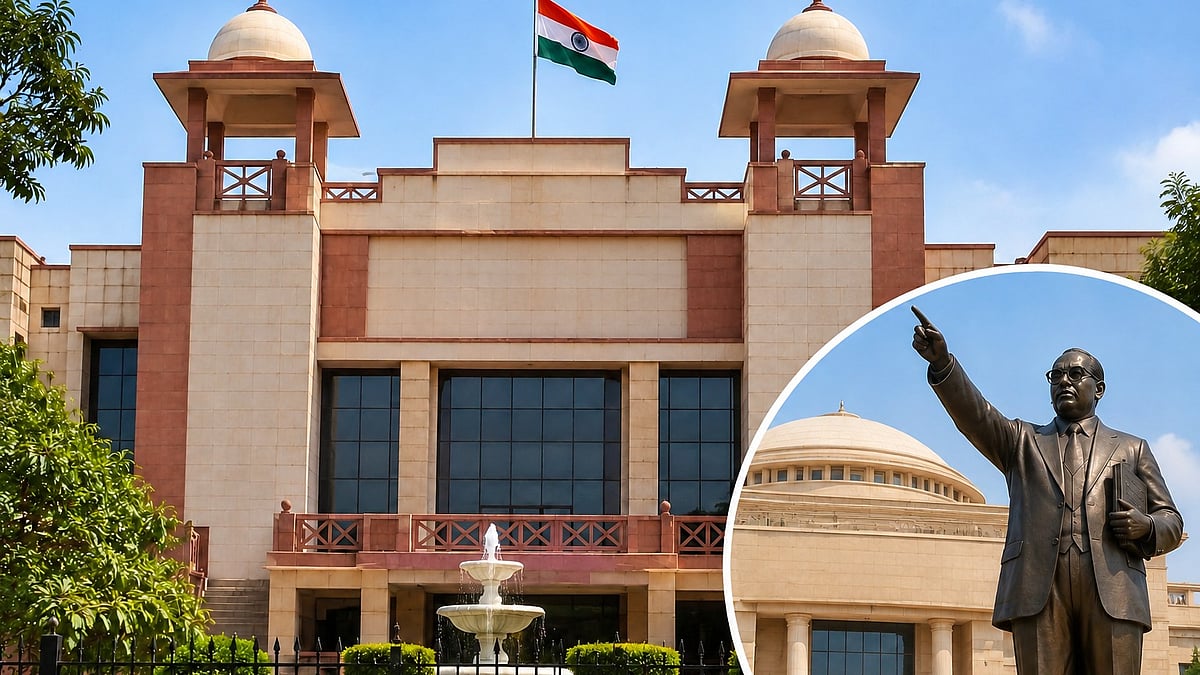
Indore (Madhya Pradesh): The Indore bench of the Madhya Pradesh High Court has quashed orders passed by the competent authority in connection with a complaint against the Dr Babasaheb Ambedkar Memorial Society, holding that the authority must first verify compliance with the statutory requirements before proceeding with an inquiry under the MP Societies Registration Act, 1973.
The society manages the Bhim Janmabhoomi Smarak in Mhow, a memorial dedicated to Bharat Ratna Dr BR Ambedkar at his birthplace.
Justice Pavan Kumar Dwivedi heard a writ petition filed by the society through its secretary, challenging orders dated February 6 and September 10.
The dispute arose after certain members, dissatisfied with the society’s management, approached the Office of Firms and Societies with an application under Section 32 of the MP Societies Registration Act, 1973. Following an earlier direction by the High Court in 2025, a formal complaint was filed by Prakash Wankhede.

The society raised a preliminary objection, contending that the complaint did not meet the threshold prescribed under Section 32(2). It pointed out that, out of its 24 members, the application lacked the support of at least one-third of the total membership or a majority of the governing body, as required by the provision.
The authority rejected the objection, observing that it was appropriate to decide the matter on merits, and reiterated this position in a subsequent order.
The High Court noted that Section 32 provides two distinct routes for initiating an inquiry: the Registrar may act on their own motion (suo motu), or an application may be made by the requisite number of members or governing body representatives.
The court observed that, as the proceedings had originated from a complaint and not a suo motu action, the authority was required to record its satisfaction that the statutory threshold under Section 32(2) had been met before proceeding to consider the matter on merits.
Allowing the petition, the High Court quashed the orders dated February 6 and September 10 and remitted the matter to the competent authority. The authority must reconsider the preliminary objection concerning the maintainability of the complaint after granting a proper hearing to all concerned parties.