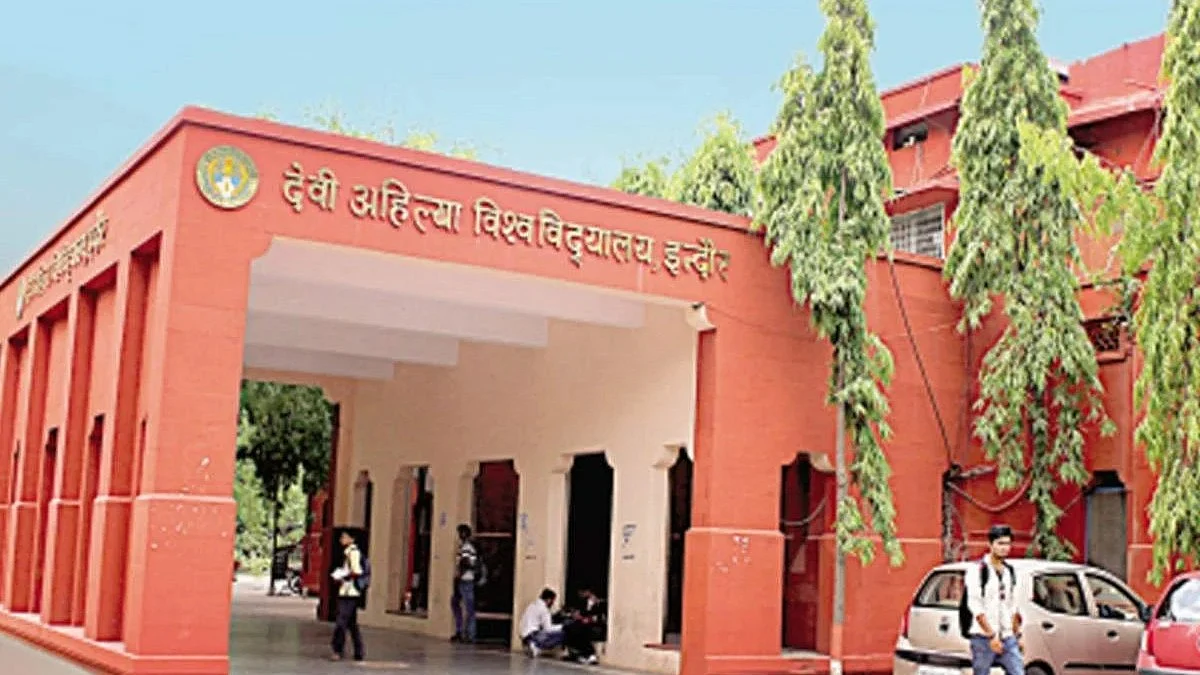
Indore (Madhya Pradesh): In a major academic expansion, Devi Ahilya Vishwavidyalaya (DAVV) is set to introduce a range of new integrated, undergraduate and postgraduate programmes from the 2026-27 academic session, significantly increasing opportunities for students and aligning its curriculum with evolving industry demands.
According to university officials, proposals for 10 new integrated courses across seven departments have already received approval from their respective Boards of Studies. The proposals will now be placed before the university’s Executive Council for final clearance. Once approved, these programmes will be incorporated into the university’s admission process for the upcoming academic year.
The introduction of these courses is expected to increase the university’s intake capacity by 515 seats. Officials stated that the programmes have been carefully designed to meet the needs of various industry sectors, ensuring that students graduate with relevant and employable skills.
New courses in pharmacy and management
The School of Pharmacy will introduce both undergraduate and postgraduate programmes, including MPharm and MBA in Pharmacy. The MPharm programme has already received formal approval from the Pharmacy Council of India and will be offered with an intake of 15 seats.
Meanwhile, the MBA in Pharmacy programme has been approved by the All India Council for Technical Education and will admit 60 students through CUET-PG.
In addition, the existing BPharm programme, introduced three years ago, will see an increase in capacity from 60 to 100 seats.
Engineering and technology programmes
The Institute of Engineering and Technology (IET) will offer three new courses: BTech in Electronics and Telecommunication, BTech in Industrial Production, and MBA in Technical Management. Each programme will have an intake of 60 students.
The School of Computer Science is also launching a BTech programme in Cyber Security, with 60 seats approved.
Integrated MSc courses to attract students
For the first time, DAVV will introduce integrated MSc programmes in Mathematics, Physics and Statistics. These departments previously did not offer undergraduate-level courses, and the integrated structure aims to attract students directly after Class 12.
Each MSc integrated programme will have 40 seats. Officials clarified that the existing two-year MSc courses will continue without any changes.
Biotechnology department adds new options
The School of Biotechnology is introducing two new programmes in line with the National Education Policy. A one-year MSc in Biotechnology will be launched with an intake of 15 seats, while a two-year MSc in Bioinformatics will admit 40 students.
Admission process yet to be finalised
The university plans to begin these courses from the next academic session, subject to final approval by the Executive Council. Afterwards, an admission committee meeting will be held to determine the selection process for each programme. Some courses will be included under CUET, while others may follow non-CUET admission procedures.
Vice-Chancellor Prof Rakesh Singhai confirmed that the university is committed to expanding academic offerings in line with modern educational and industry requirements.

