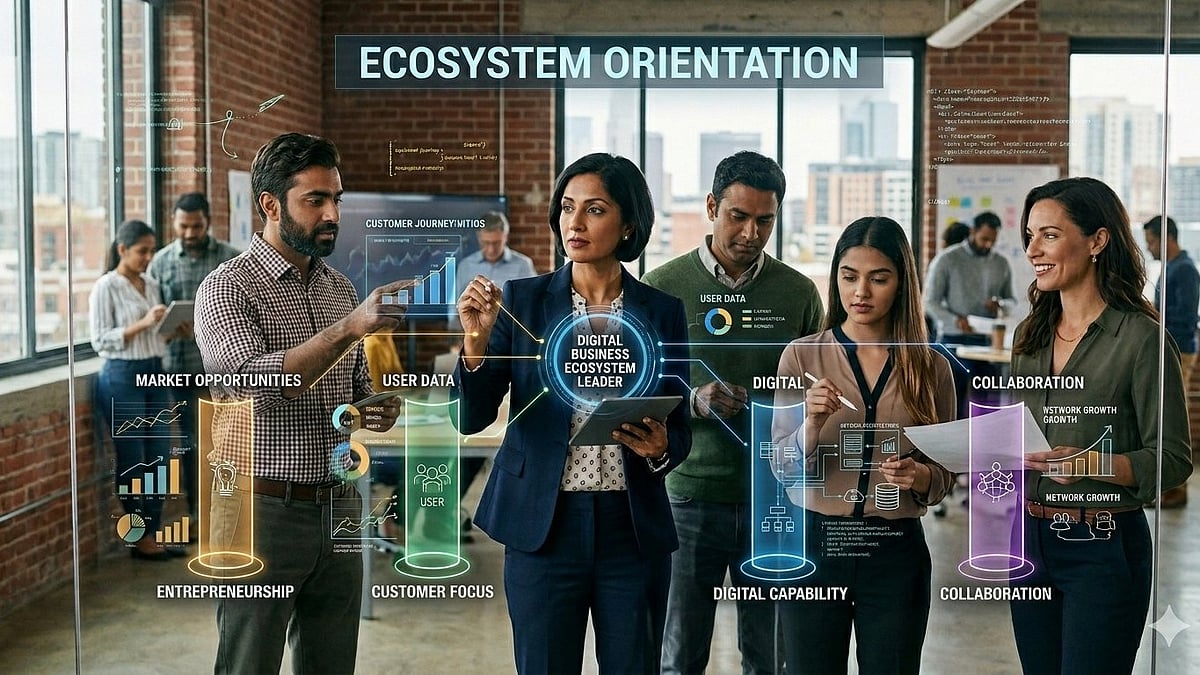
Indore (Madhya Pradesh): A new study by the Indian Institute of Management Indore (IIM-I) has found that established companies in emerging economies can successfully lead digital business ecosystems by adopting what researchers describe as an ecosystem orientation, a strategic blend of entrepreneurial thinking, customer focus, digital integration and collaborative partnerships.
Published in the International Journal of Information Management, the study was co-authored by Kamal Sharma and examines how incumbent firms, unlike born-digital startups, can transform themselves into ecosystem orchestrators in rapidly evolving digital markets.
The research draws on semi-structured interviews with senior executives and ecosystem experts across India, Malaysia and Vietnam. It argues that firms can build a higher-order organisational capability, termed ecosystem orientation, by integrating four major strategic approaches: entrepreneurial orientation, market orientation, digital orientation and collective strategy orientation.
According to the findings, firms that combine these orientations are better equipped to identify emerging business opportunities, respond to changing customer expectations, adopt digital technologies and collaborate effectively with external stakeholders to generate shared value.
The study highlights the critical role of leadership vision in driving successful ecosystem orchestration. Senior management teams were found to play a central role in encouraging collaboration beyond traditional organisational boundaries, aligning partners around common goals and steering digital transformation efforts.
The researchers also found that environmental uncertainty and institutional gaps in emerging economies can act as catalysts for innovation and collaboration. Rather than viewing infrastructural or regulatory limitations solely as barriers, firms can leverage these conditions to build new ecosystem-based business models.
The study examined digital ecosystems across sectors including agriculture, healthcare, cloud services and financial services. It found that many firms are shifting away from traditional build or buy approaches towards build or partner strategies that emphasise trust-based collaboration, co-creation and equitable value sharing.
The authors say the findings carry important implications for business leaders navigating digital transformation. Managers are encouraged to move beyond firm-centric strategies and embrace ecosystem-centric thinking that prioritises interdependence and collaboration with external partners.
For executives, the research underscores the need to cultivate leadership styles that support experimentation, agility and calculated risk-taking while fostering transparent and mutually beneficial relationships across ecosystem participants.
The study concludes that digital business ecosystem orchestration is becoming increasingly important as industries grow more interconnected through technology. Firms capable of integrating multiple strategic orientations into a cohesive ecosystem approach, the authors argue, will be better positioned to compete and thrive in dynamic global markets.