Indore (Madhya Pradesh): While Anganwadi infrastructure has shown signs of improvement, data from February to May 2026 reveals worrying gaps in nutrition delivery, child health indicators and service coverage across 1,839 Anganwadi centres.
The figures show that thousands of eligible beneficiaries are still missing out on regular nutrition support despite the centres’ near-full operational status.
According to the May 2026 report, all 1,839 Anganwadi centres remained open for at least 15 days, while 1,837 centres operated for 21 days. However, the reach of the Supplementary Nutrition Programme (SNP) declined. Out of 1,61,766 eligible beneficiaries in May, only 1,00,793 received SNP benefits for at least 15 days, while just 83,145 received nutrition support for 21 days.
The decline becomes more visible when compared with previous months. In February, 1,21,980 beneficiaries received SNP for at least 15 days; this dropped to 1,19,665 in March, then declined to 1,08,202 in April and reached 1,00,793 in May. This means nearly 21,000 fewer beneficiaries received at least 15 days of nutrition support within four months.
Similarly, SNP coverage for at least 21 days also witnessed fluctuations. February recorded 1,06,263 beneficiaries receiving regular nutrition support, which fell to 98,628 in March, then sharply to 71,249 in April, before improving to 83,145 in May. However, the May figure still remained far below February levels.
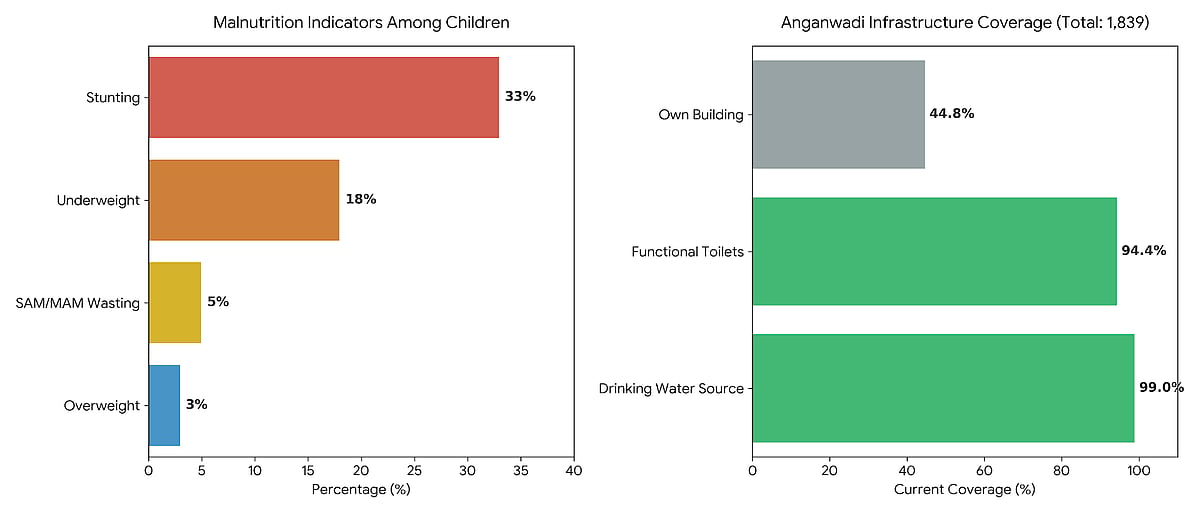
Another concern emerging from the report is the child’s nutritional status. Growth monitoring data show that despite 99% measurement coverage among children aged 0–5 years, malnutrition indicators remained largely unchanged. Around 33% of children were reported severely or moderately stunted during all four months, while underweight cases remained around 17–18%. Wasting, including Severe Acute Malnutrition (SAM) and Moderate Acute Malnutrition (MAM), stayed at 5%.
The total number of beneficiaries also declined gradually. Registered beneficiaries reduced from 1,88,088 in March to 1,87,107 in April and further to 1,85,982 in May. Children aged 0–6 months also declined from 11,709 in March to 10,252 in May, while lactating mothers reduced from 11,685 to 10,249 during the same period.
Infrastructure data shows improvement, but gaps continue. Of the 1,839 centres, only 824 have their own buildings, meaning more than half still operate without dedicated government-owned premises. Functional toilets increased slightly to 1,736, and drinking water availability reached 1,820 centres, but complete infrastructure coverage remains pending.
Home visits also showed inconsistency. Visits to pregnant women increased from 6,992 in April to 8,163 in May, but remained lower compared to earlier combined coverage numbers recorded in March.
Although Aadhaar verification reached 99.93% and Health ID creation crossed 90%, the data suggest that digital progress has not completely translated into stronger ground-level nutrition outcomes. The continuous presence of stunting, underweight children and falling SNP coverage indicates that service delivery remains a major challenge.
However, in response to the gaps reflected in the data, district administration officer Rajneesh Sinha attributed the decline in SNP coverage to the irregular availability of Take Home Ration (THR) packets throughout the month. “The THR packets were not received for the entire month, which affected the figures. After the supply was received, distribution was carried out among beneficiaries,” Sinha said.
On the continuing concern over malnutrition, where around 33% children remain stunted and 18% underweight despite regular monitoring, Sinha said the department is currently concentrating more on severely underweight children. “At present, our focus is on severely underweight children and efforts are being made to improve their nutritional status,” he added.