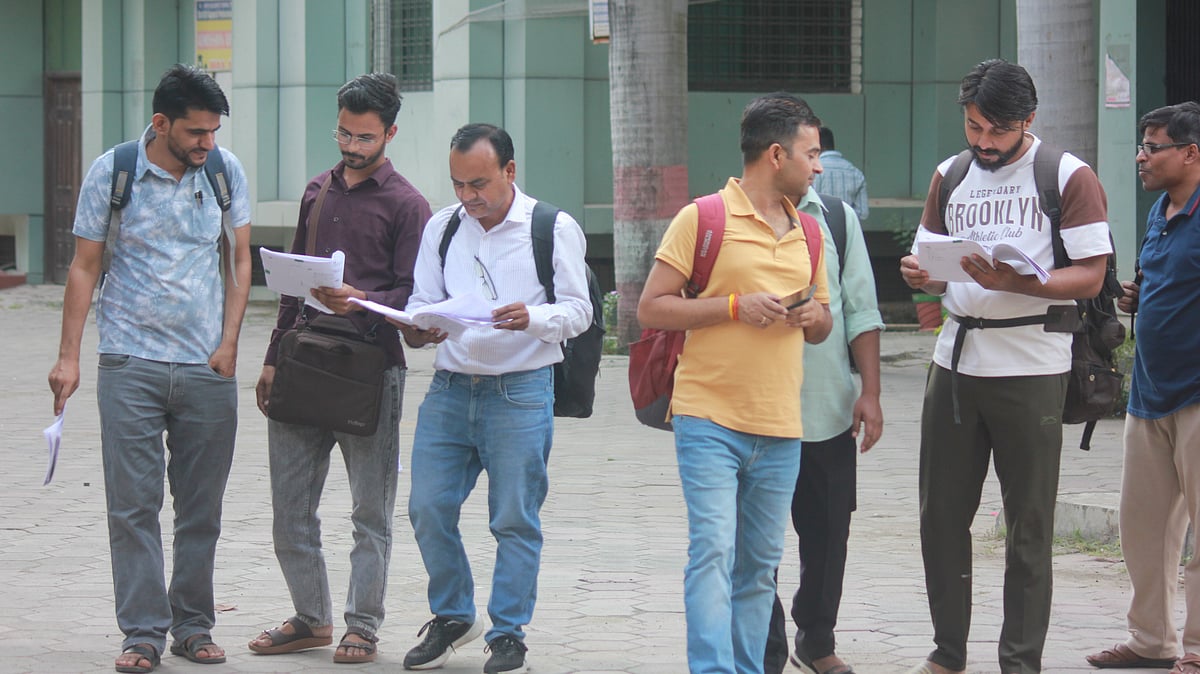
Indore (Madhya Pradesh): Madhya Pradesh Public Service Commission (MPPSC) on Sunday conducted the third phase of the Assistant Professor Examination-2025 for filling 399 vacant posts in government colleges. The examination covered four subjects: History (56 posts), Mathematics (107), Physics (120) and Chemistry (116).
Of nearly 12,000 candidates who applied, around 7,000 appeared, recording an attendance of 58% across 30 exam centres.
To ensure transparency and prevent cheating, the MPPSC introduced a three-layer checking system.
Candidates underwent admit card and photo ID verification, metal-detector screening, biometric verification and admit card scanning.
CCTV cameras and hand-held metal detectors were also used at the centres. Officials said no case of cheating was reported.
The first paper, General Studies, was held from 10 am to 11 am and comprised 50 questions carrying 150 marks.
The subject-specific paper was conducted from 1 pm to 4 pm, with 100 questions carrying 300 marks. The examination was therefore held for a total of 450 marks.
The General Studies paper tested both factual knowledge and conceptual understanding. With 50 questions to be attempted in an hour, candidates also faced a time-management challenge.
The syllabus covered history, geography, science, current affairs and other areas.
The subject-specific paper was considered the key test for selection, as each question carried significant marks and even minor errors could affect the merit position.
Education expert Aditya Mehta said the papers were relatively easy. Candidates with strong factual knowledge could score well in General Studies, while those with a clear understanding of basic concepts were likely to benefit in the subject-specific paper.
Candidates are now awaiting the results and merit list, which will determine selection for the 399 posts.