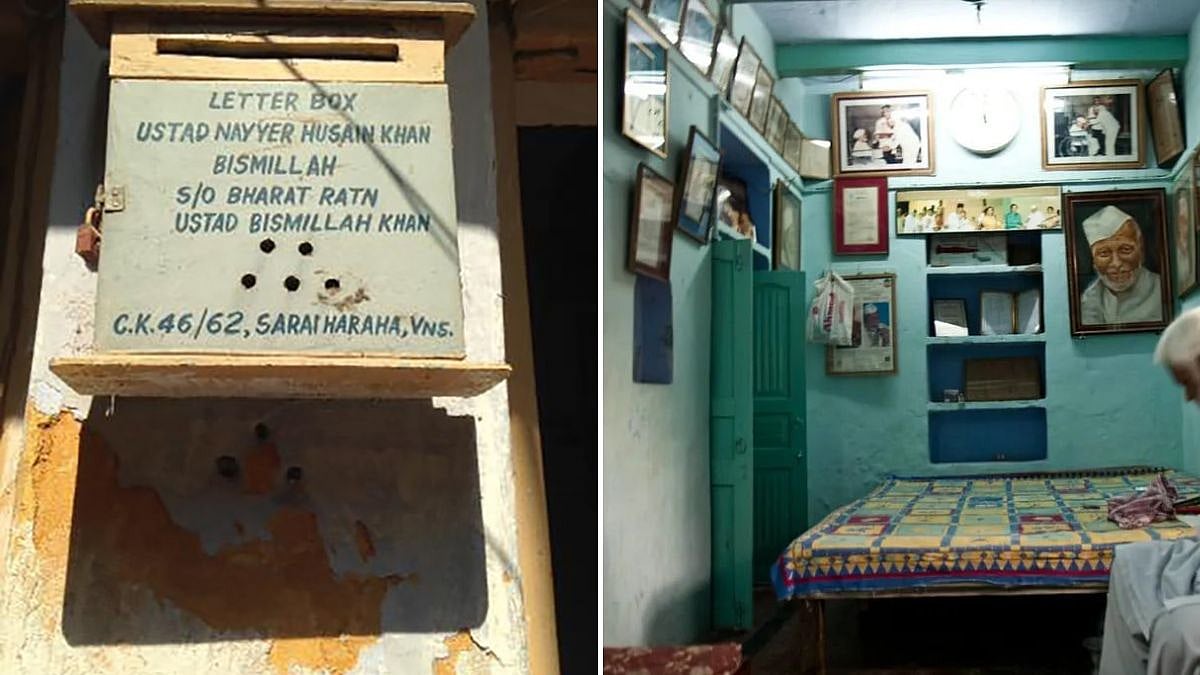
Varanasi is busy showcasing its ancient glory to the world, but in the process it risks losing the very heritage that gives the holy city its unique identity.
Demolition Of Bismillah Khan's Ancestral Home Raises Concerns
The demolition of the ancestral house of Bharat Ratna Ustad Bismillah Khan in Bhikha Shah Gali, in the Chowk area, has once again brought the conflict between redevelopment and heritage conservation into focus. The nearly 90-year-old structure is being pulled down for reconstruction, raising concerns over the loss of another physical link to the city's rich cultural past.
Bismillah Khan was not merely a celebrated musician. He took the shehnai from traditional ceremonial settings to the international concert stage. His music was inseparable from Varanasi and its temples, ghats and Ganga-Jamuni cultural traditions.
Varanasi Development Authority Clarifies Demolition Is Family's Decision
Although the Varanasi Development Authority (VDA) has clarified that the demolition is being undertaken by the family and not the administration, the episode raises a larger question: why has a city that celebrates its heritage failed to evolve an effective mechanism to preserve properties associated with its cultural icons?
The maestro's grandson, Mohammed Sibtain, has said that the house was in a dilapidated condition and the family decided to rebuild it. He maintained that the family plans to establish a museum dedicated to the legendary musician in the new structure.
Municipal Corporation Says Family Rejected Earlier Museum Proposal
However, the Municipal Corporation has said it had earlier approached the family with a proposal to convert a portion of the house into a museum and develop the approach road around the musician's life and contribution. According to its public relations officer, Sandeep Srivastava, the family did not agree to the proposal.
The controversy is not new. A similar dispute erupted in 2020 when a portion of the same house was demolished. At the time, concerns were raised about the property's possible commercial use and demands were made to preserve it as part of the country's cultural heritage.
Varanasi's Heritage Extends Beyond Temples And Ghats
The latest episode highlights a larger problem facing Varanasi. The city's heritage is not confined to temples and ghats. It also lives in its narrow lanes, centuries-old houses, traditional music establishments, artisan workshops and courtyards. These are repositories of collective memory that cannot be recreated once destroyed.
In recent years, extensive redevelopment, particularly around the Kashi Vishwanath temple corridor, has transformed parts of the city. While the projects have improved infrastructure and access for pilgrims, concerns persist over the impact on the old city's architectural character and traditional neighbourhoods.
Akhilesh Yadav And Congress Criticise Demolition
Samajwadi Party president Akhilesh Yadav criticised the demolition, calling it an insult to the country's shared cultural heritage. A Congress delegation also visited the house and demanded concrete measures to protect the maestro's legacy.
The family has promised a museum, but questions remain over its funding, management, accessibility and preservation of original memorabilia and architectural elements. A newly constructed museum cannot necessarily replace the historical value of the original house.
The government needs a comprehensive heritage conservation policy, including an inventory of historically significant properties, financial assistance for restoration and protection of homes associated with eminent personalities.
“The demolition may be a family decision, but preserving Varanasi's cultural inheritance is a collective responsibility. A city that aspires to showcase its civilisation to the world must ensure that it does not destroy the physical memories of that civilisation in the name of development,” says Ramesh Singh a resident of Sonarpura in Varanasi.
Level up your brain the fun way. Play daily games and quizzes on FPJ Smart!

