Lucknow: A new scientific expedition has opened an extraordinary window into Earth’s deep past at Salkhan Fossil Park in Sonbhadra, where some of the planet’s oldest life traces lie in plain sight on ancient rock beds.
A team from the Birbal Sahni Institute of Palaeosciences in Lucknow has begun a detailed study of stromatolites, the layered structures built by primitive cyanobacteria more than a billion years ago. The visit is part of an MoU between the UP Eco-Tourism Development Board and BSIP, Tourism and Culture Minister Jaiveer Singh said.
Supported by the Kaimur forest division, BSIP’s Centre for Promotion of Geoheritage and Geotourism documented stromatolite formations believed to be around 1.4 billion years old. Scientists said these structures represent the earliest biological signatures that marked Earth’s shift from an inert planet to one capable of sustaining life.

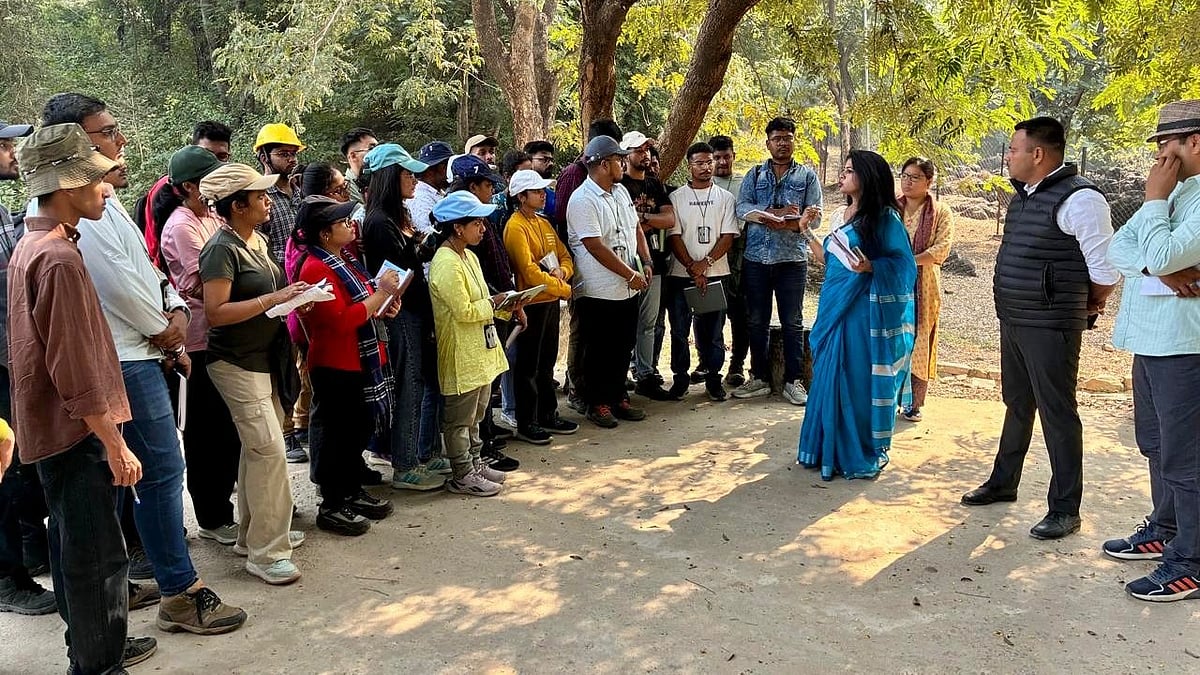
Leading the study, Dr Shilpa Pandey explained to forest staff and local visitors that what appears to be patterned stone is actually a biological archive recording some of the earliest ecosystems. She engaged with villagers and tourists to underline why the formations at Salkhan are globally significant and why careful protection is essential.
Dr Sanjay Singh, another member of the team, conducted a walkthrough for university students, describing how stromatolites formed, their role in shaping early atmospheres and why such fossils are rare across the world. The session aimed to inspire young learners to explore Earth sciences and understand the importance of preserving geoheritage.
Minister Jaiveer Singh said Salkhan Fossil Park, set in the rugged landscape of Sonbhadra, is among India’s most valuable geological heritage assets. The UP Eco-Tourism Development Board has recently installed interpretive signages, fencing, a nature trail, rest points and drinking water facilities to improve visitor access while safeguarding the fragile fossil beds.

The park has already earned global visibility. In June 2025, Salkhan was added to UNESCO’s Tentative List under the Natural Heritage category. The state is now working to push its nomination to the UNESCO World Heritage List, which would bring international recognition to what scientists describe as one of the world’s most remarkable prehistoric sites.

