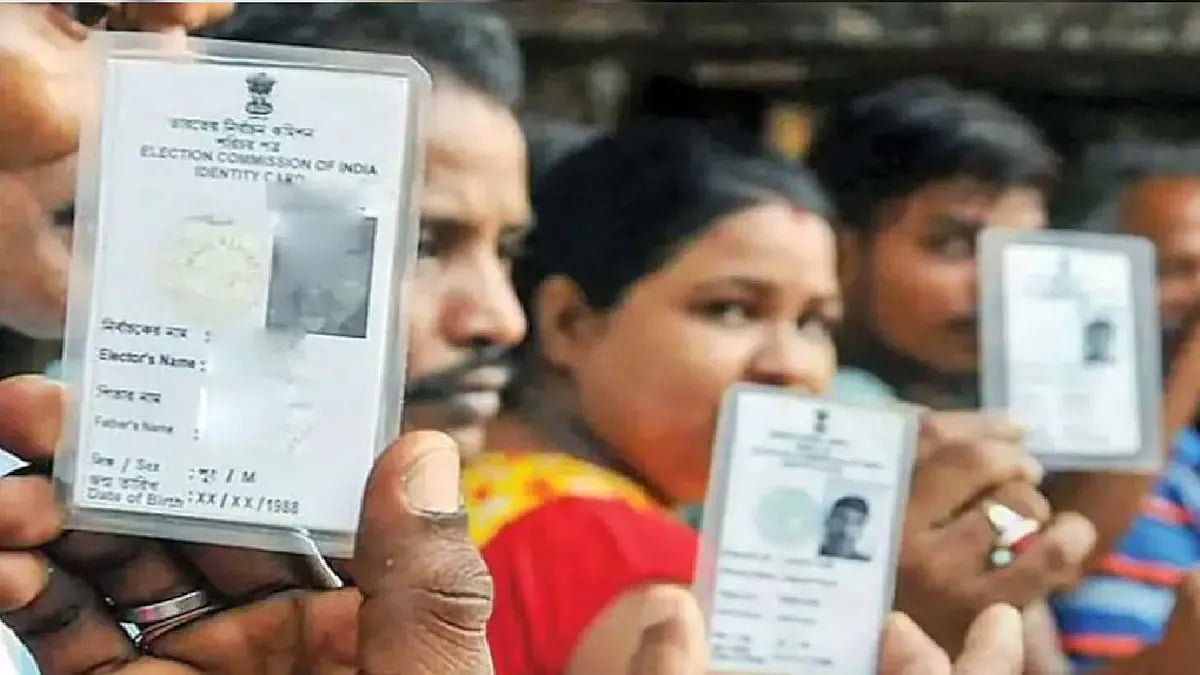
Lucknow: The Uttar Pradesh State Election Commission on Friday responded to questions raised by the Samajwadi Party over alleged errors in the voter list, saying that incorrect or identical house numbers in electoral rolls are a common and long-standing issue and not the result of the ongoing Special Intensive Revision (SIR).
In a post on X, the Commission said that cases where unrelated voters are shown with the same house number in the electoral roll exist across many polling stations and assembly constituencies. It clarified that this “unsatisfactory situation” did not arise due to the SIR, as no voter details were modified during the enumeration phase of the revision exercise. The Commission said such discrepancies have existed for decades.
Explaining the reasons, the Commission said that in many villages houses do not have formal numbers, while in urban areas several houses also lack standard numbering. As a result, notional numbers are often entered in voter lists. In cities, it is common to see “0” or “00” recorded in place of house numbers. Municipalities also maintain ward-wise registers in which notional house numbers are allotted for tax purposes, which sometimes leads to duplication in electoral rolls.
The Commission cited a recent case from Milak municipality in Rampur district, where two different families living in separate municipal wards were found to have the same house number in the assembly voter list. The matter came to light after it was reported prominently in a newspaper. Although the families belonged to different wards, their notional house numbers in ward registers were identical. Since their votes were listed at the same booth and the part had only one section without a ward number mentioned, both addresses appeared the same in the electoral roll.
.jpg)
Also Watch:
The Commission said improper division of voter list parts into adequate and clearly demarcated sections was one of the reasons behind such anomalies. To correct this, all Electoral Registration Officers have been instructed to ensure that polling areas are divided into sufficient, well-marked sections. This, the Commission said, will help booth level officers during revisions and elections, make it easier to locate voters while distributing slips, and reduce instances of unrelated voters being shown with identical house numbers.
It has also directed that while entering house numbers in the database, the name of the street, lane or locality should be recorded to clearly indicate the area in which the house is located. BLO supervisors have been made responsible for carefully scrutinising voter lists of all booths in their jurisdiction, identifying such errors and ensuring they are corrected in time so that the final electoral roll is free from these discrepancies.
The Commission’s clarification came after the Samajwadi Party raised concerns over a decline in voter numbers and incorrect addresses in the electoral rolls.
