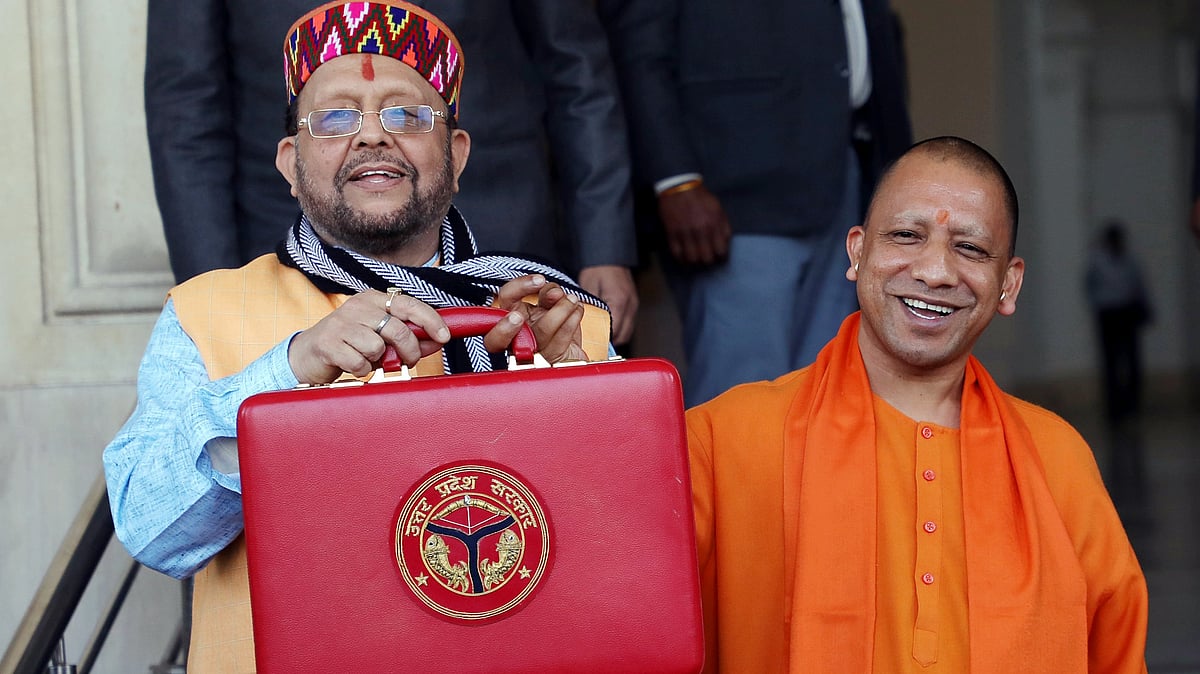
Lucknow: The Uttar Pradesh government on Monday presented its Economic Survey 2025-26, setting out an investment-led growth roadmap aimed at positioning India’s most populous state as a $1 trillion economy over the medium term.
The survey, presented by Finance Minister Suresh Khanna, is the first such annual economic document released by the state in line with the Union government’s practice and seeks to provide a data-backed view of Uttar Pradesh’s macroeconomic trajectory, fiscal health and sectoral performance.
The survey estimates the state’s Gross State Domestic Product to have grown at a compound annual growth rate of 10.8 percent, doubling from Rs 13.30 lakh crore in 2016-17 to Rs 30.25 lakh crore in 2024-25. For 2025-26, the economy is projected to expand to Rs 36 lakh crore. The document also points to an investment pipeline of over Rs 50 lakh crore in industrial proposals, indicating sustained private sector interest.
A key pillar of the state’s investment strategy, the survey said, is the government’s “Triple S” framework of safety, stability and speed. The policy architecture is aimed at improving the law and order environment, ensuring regulatory certainty and compressing approval timelines through single-window digital platforms such as Nivesh Mitra. The survey cited memorandums of understanding worth Rs 2.94 lakh crore signed at the World Economic Forum 2026 as an indicator of improving global investor perception of Uttar Pradesh.
Infrastructure continues to be positioned as the growth enabler. The state is pitching itself as India’s expressway hub, with 22 expressways at various stages, including seven operational and three under construction. Uttar Pradesh also has the country’s largest rail network and is scaling up its aviation ecosystem with a target of 24 airports, including five international airports. The Jewar International Greenfield Airport is projected to become a key logistics and cargo gateway for north India.
On the industrial front, the survey notes that the number of registered factories has crossed 30,000, nearly doubling over the past few years. Industrial gross value added has grown by 25 percent, the fastest among major states. The state is pursuing a cluster-led industrial strategy, positioning Lucknow as an artificial intelligence hub, Kanpur as a drone manufacturing and testing centre and Noida as a major IT and electronics manufacturing base.
Agriculture remains a key growth pillar, with Uttar Pradesh retaining its lead in food grain, sugarcane, potato and milk production. The survey highlights improved cash flows to farmers through higher and faster sugarcane payments and expansion of irrigated area to 2.76 crore hectares. The proposed state Seed Policy is aimed at improving productivity and reducing input risks for farmers.
From a fiscal standpoint, the survey underscores a sharp expansion in the state’s resource envelope. The state budget has more than doubled in nine years to Rs 8.33 lakh crore for 2025-26, while own tax revenues have risen 2.5 times to Rs 2.09 lakh crore. The debt to GSDP ratio is pegged at 28 percent, lower than the national average, providing headroom for capex-led growth, the report said.
The survey also tracks gains in income levels and financial inclusion. Per capita income in the state has doubled to Rs 1,09,844 in 2024-25 and is targeted at Rs 1,20,000 in 2025-26. Uttar Pradesh accounts for the highest number of Ayushman Bharat beneficiaries at 5.46 crore and Jan Dhan account holders at 10.22 crore, strengthening the consumption base and formal financial penetration.
On trade and digital public infrastructure, Uttar Pradesh has climbed to fourth place in the Export Preparedness Index 2024 and ranks first among landlocked states. The state’s use of digital platforms for governance has expanded, with top rankings in e-Prosecution and large-scale deployment of direct benefit transfers to over 3.12 crore PM-Kisan beneficiaries.

Also Watch:
The survey flags energy transition and urbanisation as medium-term growth drivers and risks. The share of solar power in the state’s installed capacity has increased from 23 percent to 27 percent,
while the proposed Lucknow State Capital Region and plans for 100 new townships are aimed at managing urban expansion, with the urban population projected to reach 35.8 percent by 2046.
Taken together, the Economic Survey positions Uttar Pradesh as an increasingly investment-friendly market with improving infrastructure depth, fiscal headroom and sectoral diversification. For investors and industry, the state’s ability to convert large MoUs into on-ground capex and jobs will be a key monitorable over the next few years.
