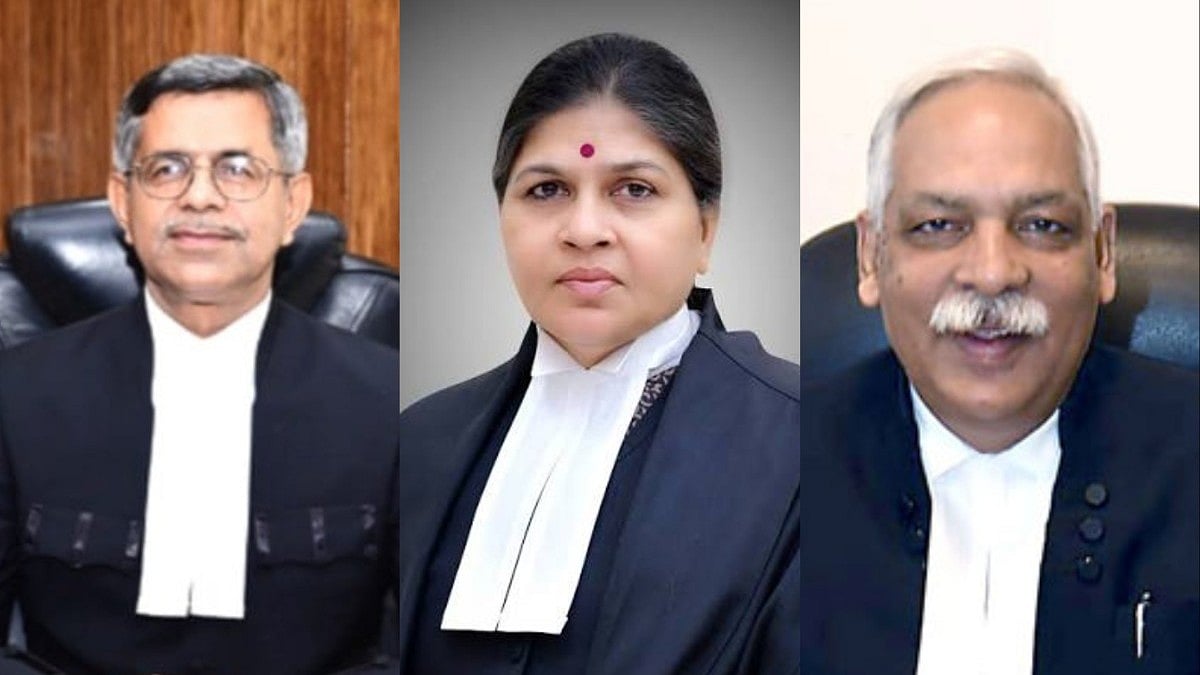
New Delhi: What happens when judges ranked fourth, fifth and sixth in the all-India seniority of High Court judges are recommended for the Supreme Court, while judges senior to them do not figure in the latest recommendation?
That is the question drawing attention after the Supreme Court Collegium on September 28 recommended Justices Sunita Agarwal, Devendra Kumar Upadhyaya and Aparesh Kumar Singh Chief Justices of the Gujarat, Delhi and Telangana High Courts respectively for elevation to the apex court. According to The Indian Express, the three recommended judges stand fourth, fifth and sixth in the overall seniority of High Court judges.
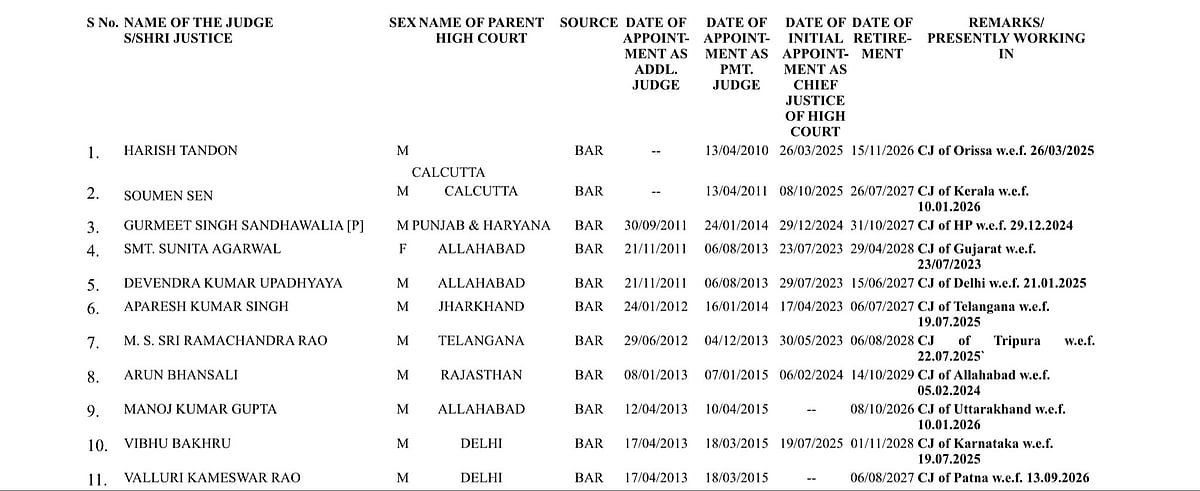
The sequence has put seniority at the centre of the latest judicial appointments discussion. But India's judicial history suggests that seniority, while an important consideration, has not always operated as an automatic or exclusive criterion for elevation to the Supreme Court.
Importantly, the September 28 Collegium resolution announces the three recommendations but does not publicly provide a detailed explanation for why these names were preferred in this particular sequence.
Seniority Matters, But Is It The Only Criterion?
The answer from previous Collegium decisions is that seniority has been considered alongside other factors.
A prominent example is the 2019 recommendation of Justice Sanjiv Khanna. At the time, Khanna was ranked 33rd in the combined all-India seniority of High Court judges. Justice Dinesh Maheshwari, who was recommended alongside him, was ranked 21st. The Collegium's resolution said it had considered the names of Chief Justices and senior puisne judges across the High Courts and concluded that Khanna and Maheshwari were suitable for elevation.
The same episode also recorded the factors considered by the Collegium, including seniority, merit and integrity.
The example is relevant to the present debate because it demonstrates that a judge's position on the seniority list has not historically functioned as an automatic entitlement to elevation.
At the same time, the 2019 decision generated criticism over how the Collegium reached its conclusion. Those were views expressed by commentators and critics at the time and should not be treated as the Collegium's own reasoning.
The 2026 Recommendation: What We Know
The three judges recommended on September 28 have different parent High Courts.
Justice Sunita Agarwal, Chief Justice of the Gujarat High Court, has the Allahabad High Court as her parent court. Justice Devendra Kumar Upadhyaya, Chief Justice of the Delhi High Court, is also from the Allahabad High Court. Justice Aparesh Kumar Singh, Chief Justice of the Telangana High Court, has Jharkhand as his parent High Court.
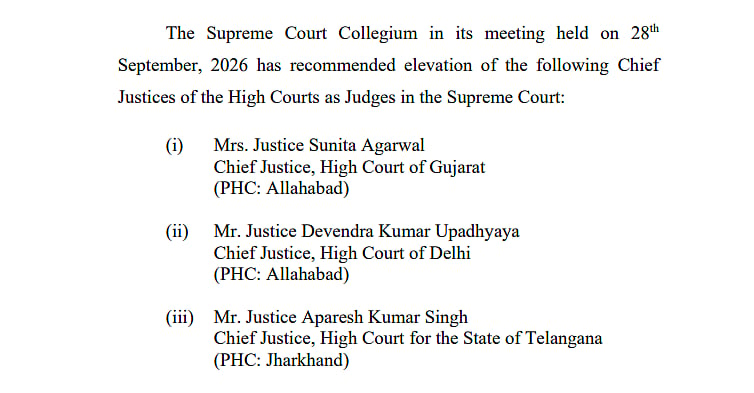
The two Allahabad-origin judges are currently Chief Justices of Gujarat and Delhi. Justice Singh is heading the Telangana High Court.
If all three recommendations are approved, Justice Agarwal would become the third woman judge on the Supreme Court. The apex court's strength would rise to 37 sitting judges against a sanctioned strength of 38.
Regional Representation Has Featured Before
During earlier debates over judicial appointments, seniority, merit and representation from different High Courts have all been included in the discussion. The Supreme Court's Collegium has also, in previous resolutions, referred to the need to consider representation while making recommendations.
The 2019 Sanjiv Khanna recommendation again illustrates the point. While the Collegium considered the combined all-India seniority list, it also referred to merit and integrity while making its recommendation.
Supersession Is Not New To India's Judiciary
The debate over seniority is considerably older than the present Collegium system.
In 1973, Justice A N Ray was appointed Chief Justice of India, superseding Justices J M Shelat, K S Hegde and A N Grover, who were senior to him. The appointment came immediately after the Supreme Court's Kesavananda Bharati judgment, and the three superseded judges subsequently resigned.
In 1977, Justice M H Beg was appointed CJI over Justice H R Khanna. Khanna had been the sole dissenter in the ADM Jabalpur case during the Emergency and subsequently resigned after being superseded.
These cases involved selection of the Chief Justice of India rather than elevation from a High Court to the Supreme Court. They are therefore historical examples of departure from seniority conventions, rather than direct precedents for the present Collegium recommendation.
The distinction matters.
From A Seniority List To A National Bench
The Supreme Court is a national court drawing judges from different High Courts and legal backgrounds. That makes the question of how appointments should balance seniority with other considerations a recurring feature of judicial debates.
A purely seniority-based system would make elevation comparatively straightforward: judges would move according to their position on the list.
The present system allows the Collegium to consider a broader set of factors. But the flexibility also creates a corresponding demand for transparency, particularly when a judge lower on the seniority list is recommended over a senior colleague.
That is why the current 4-5-6 sequence is noteworthy without necessarily being unprecedented.
Recommendation, Not Final Appointment
The September 28 decision is a Collegium recommendation and not, by itself, a final appointment. The recommendations will now be processed under the established procedure for appointments to the Supreme Court.
For now, the most striking feature is the sequence: 4, 5 and 6 have been recommended, while the three judges above them have not figured in this recommendation.

