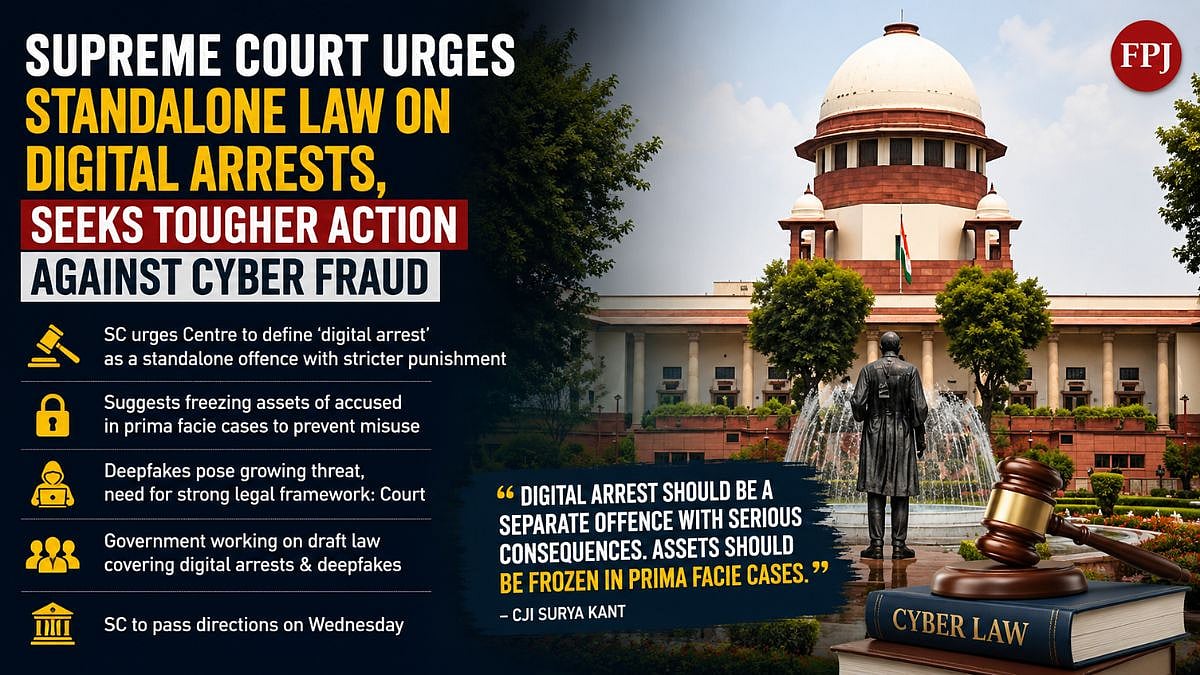
New Delhi, July 28, 2026: The Supreme Court on Tuesday urged the Union government to formally define "digital arrest" in criminal law and make it a standalone offence carrying stricter punishment.
The top court also suggested that once there is a prima facie case based on reasoned evidence, the assets of those involved in such scams should be frozen to prevent further misuse, Bar & Bench reported.
A Bench comprising Chief Justice of India (CJI) Surya Kant, Justice Joymalya Bagchi, and Justice V Mohan was hearing a suo motu case on digital arrest scams and other online frauds.
The proceedings indicated that the judiciary believes existing legal provisions may no longer be sufficient to deal with rapidly evolving cyber crimes, signalling the need for a stronger legal framework.
A Push For Stronger Cyber Laws
During the hearing, Attorney General for India R Venkataramani informed the Court that an Inter-Departmental Committee (IDC) is finalising a comprehensive report to identify gaps in the current system.
Responding to the submission, CJI Kant asked whether the government should formally define digital arrest under penal laws, noting that such crimes involve elements of extortion and robbery.
He suggested that digital arrest be treated as a separate offence with serious consequences and that courts should be empowered to freeze the assets of those against whom a prima facie case has been established.
Justice Bagchi also drew attention to the growing threat posed by deepfakes, saying they can be used for cheating and impersonation. Stressing the need for legislative action, he observed that while courts could address existing offences, they could not create new crimes under Article 142 of the Constitution.
Solicitor General Tushar Mehta told the Court that the government is already working on a draft law that will deal with both digital arrests and deepfakes.
Scam Prompted Supreme Court Action
The suo motu proceedings began in October 2025 after a senior citizen couple informed the Supreme Court that they had been cheated of Rs 1.5 crore between September 1 and 16 by fraudsters posing as officials of the Central Bureau of Investigation (CBI), Intelligence Bureau, and the judiciary.
The scammers allegedly contacted the couple through phone and video calls and showed forged Supreme Court orders to force them into transferring money by threatening them with arrest.
Taking note of media reports that similar frauds had been reported across several States, the Supreme Court sought responses from the Union government and the CBI, while also requesting assistance from the Attorney General for India.
In December 2025, the Court ordered a CBI probe into the issue and called for coordinated action across the country. In April this year, WhatsApp informed the Court that it had banned more than 9,400 accounts linked to digital arrest scams in India over a 12-week period beginning in January 2026.
On Tuesday, Venkataramani told the Court that the CBI is currently investigating around 20 major digital fraud cases involving losses of Rs 10 crore or more, while other cases are being handled by the respective State police forces.
Measures To Combat Cyber Fraud
He also highlighted various security measures being adopted by banks and sought several directions from the Court. These included asking the Reserve Bank of India (RBI) to formally implement a standard operating procedure for temporarily placing debit holds on bank accounts suspected to be money mule accounts used in cyber-enabled frauds.
The Attorney General also requested directions to all States, Union Territories, and law enforcement agencies to quickly operationalise the Grievance Redress Module and the Money Restoration Module and ensure the speedy disposal of cases involving the freezing of bank accounts linked to cyber fraud.
Also Watch:
He further sought directions to High Courts to ensure that people first use the grievance redress mechanism before approaching the courts and urged all States to expedite the establishment of State Cyber Crime Coordination Centres.
The Supreme Court said it would pass directions in the matter on Wednesday, with the hearing underscoring the growing urgency for a legal and institutional response to increasingly sophisticated cyber frauds that continue to target unsuspecting citizens.
To get details on exclusive and budget-friendly property deals in Mumbai & surrounding regions, do visit: https://budgetproperties.in/

