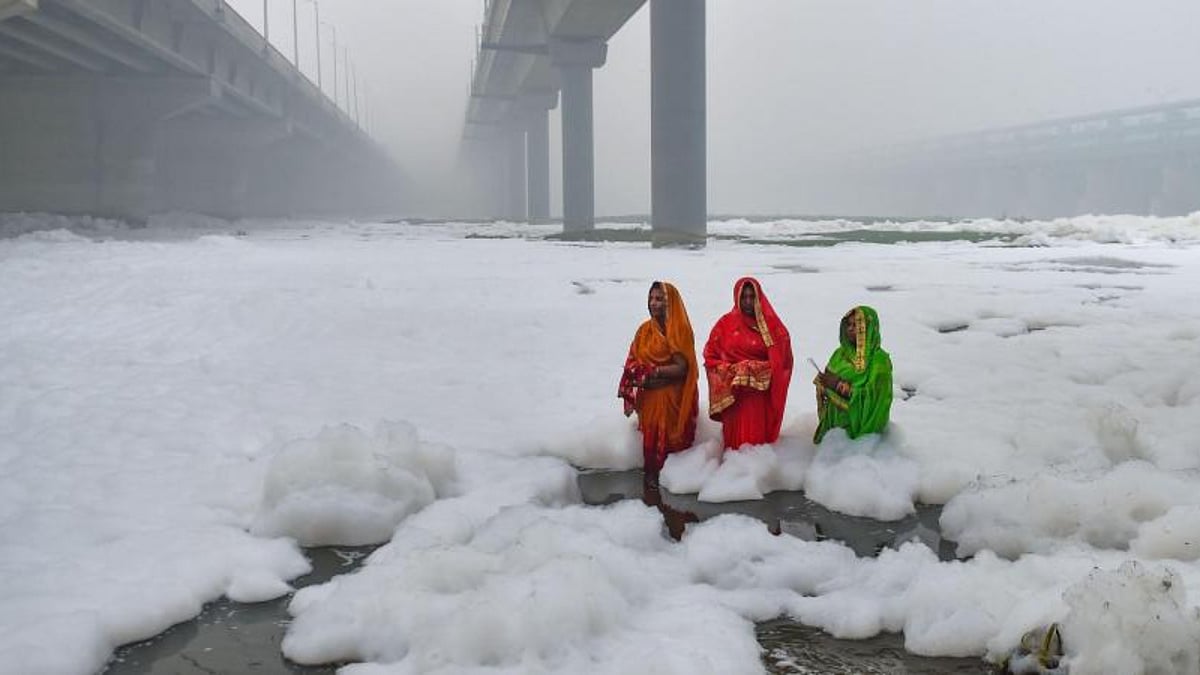
The Supreme Court has expressed serious concern over the worsening pollution in the Yamuna, observing that the river’s condition has continued to deteriorate despite huge amounts of money being spent on cleaning it. The court said the poor state of the river reflected failures in civic administration across towns, cities and villages along its banks.
A bench of Justices Manoj Misra and Manmohan noted that 520 drains discharge wastewater into the Yamuna, contributing to its deteriorating condition. The court observed that the river’s pollution reflected broader problems in waste management and civic administration, making it clear that spending money on cleaning projects alone would not solve the crisis, Live Law reports.
States To Face Penalties For Rising Pollution
The Supreme Court directed the Central Pollution Control Board (CPCB) to monitor water quality at points where the Yamuna and major drains enter and exit each state, Union Territory and district. The move aims to identify where pollution levels increase and hold the authorities concerned responsible.
The court warned that states, Union Territories and districts could face penalties if water quality deteriorates while the river passes through their jurisdiction. It also asked the CPCB to develop a formula for calculating environmental compensation, which states may recover from polluters and negligent officials after conducting an inquiry.
Sewage Treatment Alone Won’t Save Yamuna
The court stressed that industrial pollution and untreated sewage must be stopped at their source. It observed that simply constructing more sewage treatment plants (STPs) would not be enough to restore the river’s health.
The observations underline a major concern in the Yamuna clean-up efforts. Without preventing untreated waste from entering the river, additional treatment infrastructure may do little to improve water quality. The court’s directions place greater emphasis on preventing pollution rather than relying only on cleaning measures.
Delhi’s Yamuna Action Plan Under Scrutiny
The Supreme Court also flagged discrepancies in the Yamuna Action Plan, particularly regarding encroachments on water bodies and wetlands in Delhi’s Zone ‘O’.
While the plan claimed that 35 water bodies and wetlands in the zone were free from encroachments, an annexure submitted by the Delhi Government identified all 35 as encroached upon. The court also noted that none of Delhi’s 37 existing sewage treatment plants complied with all prescribed standards, raising serious questions about the effectiveness of the city’s wastewater treatment system.
One River, Shared Responsibility
The court invoked the doctrine of Common But Differentiated Responsibilities, emphasising that states sharing the Yamuna must treat it as a single, continuous ecosystem rather than separate stretches of water.
It said responsibility for protecting the river should be shared according to each state’s contribution to pollution and its capacity to address the problem. The approach recognises that pollution in one stretch of the river can affect areas downstream, making coordination between states essential.
Smart Meters, Live Data And Surprise Inspections
To strengthen monitoring, the Supreme Court directed all sewage treatment plants, Common Effluent Treatment Plants (CETPs) and government-commissioned biogas plants to install tamper-proof smart energy meters within one month.
The court also ordered treatment plants to upload live data on their operations and the quality of their discharge. The CPCB must conduct surprise inspections every quarter to verify compliance, while environmental compensation can be recovered for each day of non-compliance.
Delhi’s Zone ‘O’ Must Remain Green
The Supreme Court called for protecting Delhi’s Zone ‘O’ as a green zone and directed the removal of existing structures in accordance with the law.
It also emphasised that occupants must be rehabilitated wherever they are legally entitled to such relief. The directions seek to protect the environmentally sensitive area while ensuring that action against encroachments follows legal procedures.
CPCB Gets Wider Powers To Monitor Pollution
Recognising the extensive monitoring, investigation, technical and regulatory responsibilities assigned to the CPCB, the court directed all central and state ministries, departments, authorities and government bodies to provide the board with necessary administrative, logistical, technical and operational support without delay.
Public and private agencies operating or maintaining wastewater, solid waste and effluent treatment infrastructure must provide CPCB officials and designated third-party agencies with unrestricted access to their premises, installations and records at all hours.
This includes teams from Indian Institutes of Technology (IITs), National Institutes of Technology (NITs) and accredited laboratories engaged in inspections, surprise sample collection, wastewater volume audits, sensor verification and technical assessments.
Police Assistance And Full Data Access Ordered
The court directed all departments, authorities, concessionaires and plant operators concerned to cooperate with the CPCB and provide complete access to technical and operational data. They must also ensure that their monitoring systems are integrated with the CPCB’s centralised monitoring system within the deadlines set by the court.
The Supreme Court further directed Commissioners of Police, District Magistrates and Superintendents of Police across the Yamuna basin states and Union Territories to provide executive magistrate support and armed police assistance whenever requested by the CPCB for inspections.

Senior Officers To Coordinate Clean-Up Efforts
The court ordered Chief Secretaries of all Yamuna basin states and Union Territories, along with Secretaries of the central ministries concerned, to nominate senior officers as nodal officers within two weeks of the order.
These officers must be of at least Special Secretary rank and will serve as the main points of contact for the CPCB. Their responsibilities will include coordinating between departments, removing administrative obstacles, ensuring timely submission of compliance reports and securing prompt action on the board’s requests.
The Supreme Court’s directions signal a shift towards stricter accountability in efforts to clean the Yamuna. With penalties, continuous monitoring and surprise inspections now central to the approach, the effectiveness of the measures will depend on how seriously the authorities implement them.
Level up your brain the fun way. Play daily games and quizzes on FPJ Smart!

