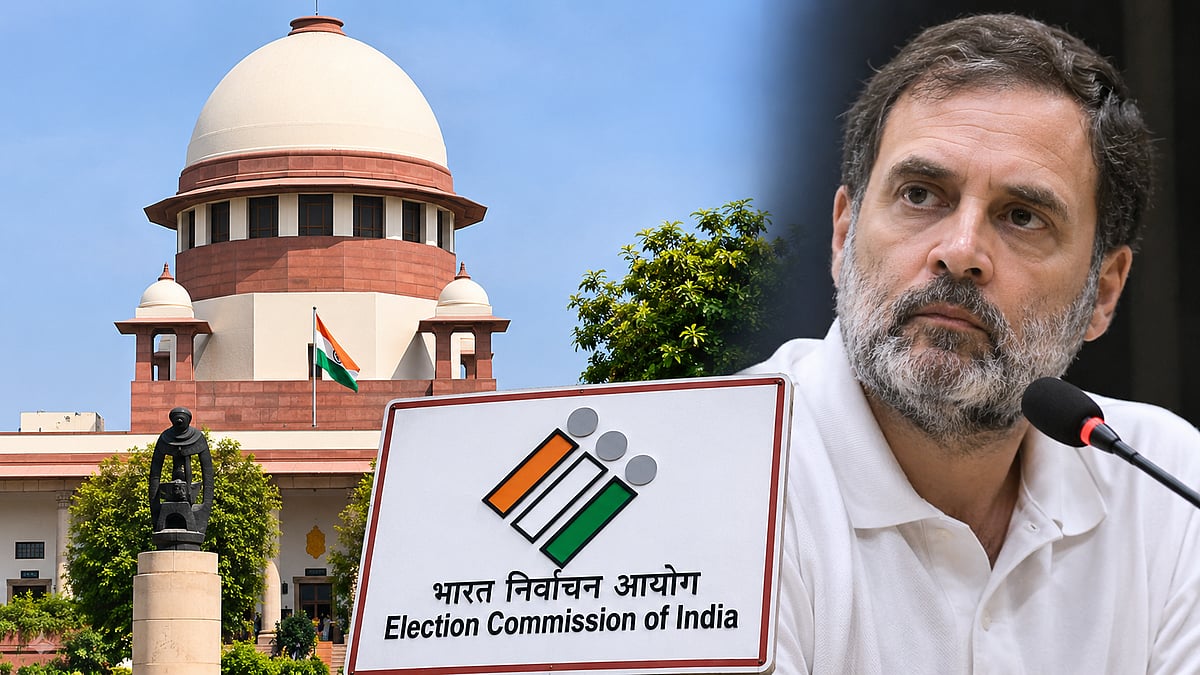
The Supreme Court on Tuesday asked the Election Commission of India (ECI) to respond to an application filed by Congress leader Rahul Gandhi and other INDIA bloc leaders seeking permission to put 48 written questions to the poll body over its decisions during the Special Intensive Revision (SIR) of electoral rolls.
The petitioners have questioned whether Chief Election Commissioner Gyanesh Kumar took key decisions without the knowledge or approval of Election Commissioners Sukhbir Singh Sandhu and Vivek Joshi. They have also sought official records to verify the ECI’s claim that all three members unanimously approved decisions relating to the SIR. The court will hear the matter on December 9, Live Law and Bar & Bench report.
Supreme Court Gives ECI Time To Respond
A bench comprising Chief Justice of India Surya Kant and Justices Joymalya Bagchi and V Mohana heard the application. Senior advocate Kapil Sibal, appearing for Gandhi, submitted that the ECI had relied on claims of unanimous decisions in its affidavits without providing the relevant dates, file notings, meeting records or details of how those decisions were taken.
Senior advocate Harish Salve, representing the ECI, told the court that the poll body had serious reservations about the application. “We have something to say about that. There is very serious prejudice,” Salve said.
The Chief Justice allowed the ECI to file its objections. “Whatever it is, you may file your reply. You can raise your objections,” he said.
“We will examine the interrogatories issue and then take a call,” the Chief Justice added. The court made it clear that it would consider the ECI’s objections before deciding whether the petitioners could serve the 48 interrogatories.
Why Gandhi Wants Answers Under Oath
The application seeks permission to serve interrogatories, which are formal written questions requiring answers under oath. The petitioners want the Chief Election Commissioner and the two Election Commissioners to clarify how important decisions concerning the SIR were approved.
The ECI filed a counter-affidavit on October 26 and a supplementary affidavit on November 14, both affirmed by Deputy Election Commissioner Bhanu Prakash Yeturu. The poll body maintained that the three-member Commission had unanimously approved the SIR decisions.
However, the petitioners argued that these claims were not supported by the underlying official records. They want to know whether the affidavits were approved during a meeting, through circulation of files or by electronic communication. They have also sought the dates and records of approval by each Commissioner.
The questions go to the heart of the dispute over collective decision-making within the Election Commission. While the ECI maintains that its decisions were unanimous, the petitioners argue that the absence of supporting records makes it difficult to examine those claims.
Questions Over Nationwide SIR Decision
A major part of the application concerns three SIR orders issued on June 24, 2025, October 27, 2025, and May 14, 2026. The ECI has maintained that all three orders were approved unanimously.
The petitioners have sought the file numbers, dates, meeting details and records showing how each order was approved. They also want to know whether any Commissioner expressed disagreement, suggested changes or recorded reservations before the decisions were finalised.
The June 24, 2025, order is particularly important because it referred to the Commission’s decision to begin the SIR across the country. The petitioners have pointed to an apparent contradiction between this claim and an order of the ECI’s First Appellate Authority under the Right to Information (RTI) Act, which reportedly stated that no decision had been taken to initiate a nationwide SIR in 2025.
They have also asked whether the relevant decision file existed when the Central Public Information Officer stated on August 27, 2025, that no information about such a decision was available.
Did Election Commissioners Raise Objections?
The opposition leaders have sought details of occasions when Election Commissioners Sandhu and Joshi recorded objections, dissents or reservations concerning the SIR, ECINET, Form 6 or appeals filed before courts.
They want the ECI to disclose the number of such occasions between February 19, 2025, and October 26, 2026, along with the relevant official records.
The petitioners have also asked whether the decisions were taken unanimously or by majority. These details could help establish whether the Commission followed a collective decision-making process or whether individual members had raised concerns that were not reflected in its affidavits.
Form 6 Changes And Voter Deletions Under Scrutiny
Another set of questions concerns the additional declaration introduced on the online Form 6 application page. The petitioners want to know who authorised the declaration, when it was introduced and whether the Commission approved the change.
They have sought details of any objections raised by ECI members and the number of Form 6 applications that were rejected, kept pending or left unprocessed because of the declaration or voter-mapping requirements.
The ECI has maintained that the additional declaration did not amount to an amendment of statutory Form 6. The petitioners, however, want official records showing how the decision was taken.
The application also seeks state-wise and Union Territory-wise figures on voters whose names were excluded from draft or final electoral rolls. The petitioners want the ECI to specify the reasons for exclusion, including death, shifting of residence, absence, duplication or ineligibility.
Who Had Access To Electoral Roll Data?
The petitioners have raised questions about the functioning of ECINET and access to the electoral roll database. They want to know whether entries were added, deleted or modified without orders from Electoral Registration Officers.
The application specifically seeks information on bulk deletions, system-level changes, de-duplication and data-migration operations. It also asks whether private contractors or vendors had permission to modify electoral roll data.
Another question concerns whether ECINET allowed Electoral Registration Officers to restore entries that had been omitted or deleted during the SIR. If the facility was unavailable at any stage, the petitioners want the ECI to disclose the period of unavailability and when the facility became operational.
They have also sought details of a proposal by Election Commissioner Vivek Joshi to audit access to the electoral roll database. The application asks whether the proposal was placed before the Commission, when it was considered and what decision was taken.
Questions On Form 7 And Election Appeals
The application also seeks information on objections filed through Form 7, including those submitted by individuals and Booth Level Agents. The petitioners want details of cases involving false or non-existent objectors and action taken under Section 31 of the Representation of the People Act.
They have also asked for the number of appeals filed before Appellate Tribunals in West Bengal by or on behalf of the ECI or its officers against orders passed by judicial officers allowing the inclusion of voters.
The questions extend to the methods used for obtaining urgent approvals within the ECI. The petitioners want to know whether approvals were communicated through WhatsApp, personal email or other electronic means.
The application further requests that if the ECI claims privilege over any official record, it should be required to specify the grounds for withholding that record so the court can decide whether the claim is justified.
Petitioners Cite Privacy Judgment
The opposition leaders have relied on the Supreme Court’s Constitution Bench judgment in Justice KS Puttaswamy (Retd) v Union of India to support their request for interrogatories.
They have argued that when important facts relating to a constitutional challenge are available only to an authority operating a technological system, the court can require that authority to answer specific questions.
The application invokes provisions of the Supreme Court Rules, 2013, to seek permission to put the 48 questions across 10 categories to the ECI. It was filed through advocate-on-record Prasanna S.
What Led To The Latest Court Hearing?
The Supreme Court issued notice to the ECI on October 15 on a petition filed by Gandhi and other INDIA bloc leaders challenging aspects of the Commission’s functioning during the SIR.
The petition seeks disclosure of records relating to the decision to undertake the nationwide revision and scrutiny of the Commission’s internal decision-making process. It also raises concerns over alleged large-scale voter deletions and irregularities during the exercise.
Also Watch:
Apart from Gandhi, the petitioners include Congress president Mallikarjun Kharge, Trinamool Congress leader Saugata Roy, Samajwadi Party chief Akhilesh Yadav, Rashtriya Janata Dal leader Tejashwi Prasad Yadav, Shiv Sena (UBT) leader Sanjay Raut, Communist Party of India (Marxist) leader MA Baby, Communist Party of India leader D Raja, Jharkhand Mukti Morcha leader Mahua Majhi, Nationalist Congress Party (Sharad Pawar) leader Supriya Sule and Indian Union Muslim League leader ET Muhammed Basheer.
Viduthalai Chiruthaigal Katchi president Thol Thirumavalavan and National Conference MP Sajjat Ahmad Kichloo subsequently joined the petition.
Why The December 9 Hearing Matters
The next hearing will determine whether the opposition leaders can formally question the ECI on the records behind its SIR decisions.
The dispute is not limited to the revision of electoral rolls. It also raises questions about transparency, accountability and how decisions affecting millions of voters are documented within the country’s election authority.
For now, the ECI maintains that the decisions were taken unanimously, while the petitioners are seeking records to test that claim. The Supreme Court has not ruled on the allegations or the request for interrogatories and will consider the poll body’s objections on December 9.

