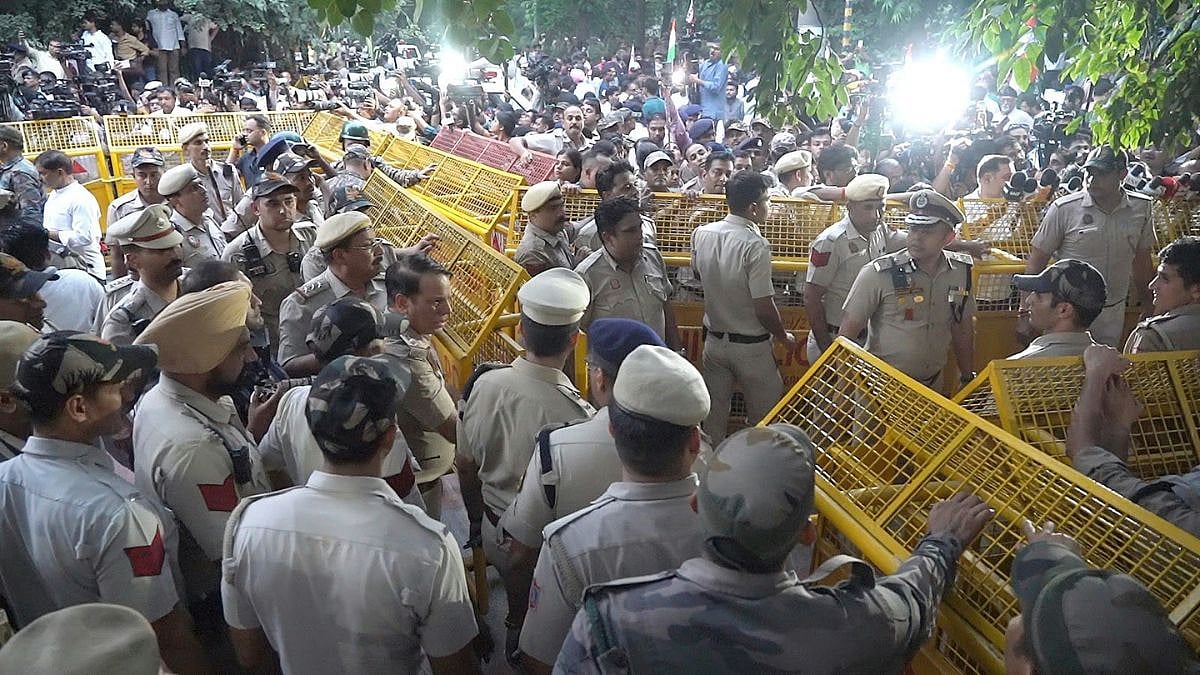
The Supreme Court on Thursday issued notice to the Centre on a petition challenging the Delhi Police’s decision to remove Jantar Mantar from the list of designated protest sites in the national capital. The court said it would examine whether the authorities had properly considered the reasons for the decision and the effectiveness of the site as a place for public demonstrations.
A bench comprising Chief Justice of India Surya Kant and Justice Joymalya Bagchi was hearing a petition filed by advocate Swaty Singh against the standing order issued on October 11. The order removed Jantar Mantar as a designated protest venue and identified three alternative locations for demonstrations, Live Law and Bar & Bench report.
Did Police Act On Court’s Observations?
During the hearing, the Supreme Court questioned whether the decision was influenced by its earlier observations or whether the authorities had independently examined the matter. The bench sought to know whether sufficient thought had gone into assessing Jantar Mantar’s importance and effectiveness as a common protest site.
The question gained significance because the Delhi Police had informed the Delhi High Court on October 13 that the decision followed the Supreme Court’s October 9 order. However, Solicitor General Tushar Mehta, appearing for the Centre, clarified on Thursday that the court’s earlier decision was not the basis for removing Jantar Mantar as a protest venue.
Centre Cites Committee Report
Mehta informed the bench that a committee had been constituted well before the court’s earlier order and had submitted a detailed report recommending the change. He maintained that the authorities had recorded reasons for their decision.
“The Court’s judgment is not the basis of the decision. The committee was constituted much before. The committee has given a detailed report,” Mehta told the bench.
Right To Protest At Centre Of Debate
Senior Advocate Mukta Gupta, appearing for the petitioner, argued that the fundamental right to peaceful protest could not be weakened by shifting demonstrations to locations where protesters might struggle to make themselves heard.
Referring to the Supreme Court’s 2018 judgment in Mazdoor Kisan Shakti Sangathan v. Union of India, Gupta submitted that a protest venue must be close enough to the relevant authorities for demonstrators to communicate their grievances effectively. She also argued that New Delhi was not meant for a select few.
Court Wants Answers Before Deciding
Justice Bagchi observed that the issue also needed to be considered in the context of technology. He noted the petitioner’s argument that Jantar Mantar should remain a protest site because of its proximity to important government establishments.
The bench said it would first examine the Centre’s response before deciding whether further intervention was necessary. Justice Bagchi observed, “We are issuing notice. We are getting a response from them. After the response, if we are not satisfied, the law will follow its course.”
Plea To Restore Jantar Mantar
Senior Advocate Gopal Sankaranarayanan also urged the Supreme Court to restore Jantar Mantar’s status as a designated protest site without delay. He submitted that the denotification had purportedly been carried out on the court’s directive.
The bench, however, declined to take an immediate decision on restoring the site and said the authorities should first be allowed to explain their reasons. Chief Justice Kant observed that the matter required consideration, which was why the court had issued notice.
Three New Protest Sites Identified
The October 11 standing order, issued by Delhi Commissioner of Police Anurag Kumar, removed Jantar Mantar from the list of designated protest venues following recommendations made by a committee constituted by the Union Ministry of Home Affairs.
The order designated Ramlila Ground, Burari Ground and CBD Ground in East Delhi as alternative locations for protests and demonstrations. The decision has since been challenged before both the Delhi High Court and the Supreme Court.
Also Watch:
Petition Raises Constitutional Concerns
In her petition, Swaty Singh argued that relocating protests to distant locations could weaken the fundamental rights guaranteed under Articles 19(1)(a) and 19(1)(b) of the Constitution, which protect freedom of speech and expression and the right to assemble peacefully.
The petition acknowledged that the government could regulate public demonstrations in the interest of public order. However, it argued that such restrictions could not effectively prevent citizens from exercising their constitutional rights.
Why Protest Location Matters
The petition stressed that the right to protest was not limited to gathering at a particular physical location. It also involved communicating grievances, expressing disagreement and drawing the attention of public authorities and society to issues requiring action.
According to the petitioner, the proximity of a protest venue to government institutions, its accessibility to the public and its visibility to the intended audience could directly influence the effectiveness of a demonstration. The argument raises a larger question about whether providing alternative venues is sufficient if those locations reduce the impact of public protests.
Unclear Rules For New Venues
The petition also questioned the absence of revised Standard Operating Procedures (SOPs) for accessing the three newly designated protest sites. It argued that removing Jantar Mantar with immediate effect, without providing a complete framework for using the alternative venues, created uncertainty for citizens seeking to organise demonstrations.
The petitioner pointed out that peaceful protests could arise in response to sudden government decisions and could not always be planned well in advance. Leaving the rules governing access to the new venues for a later stage, the plea argued, could make the exercise of the right to protest more difficult.
Also Watch:
A Test Of Protest Rights
The dispute goes beyond the question of where demonstrations can take place in Delhi. At its heart is the balance between the government’s authority to regulate public gatherings and citizens’ right to make their voices heard in places where their concerns can reach decision-makers.
For now, the Supreme Court has sought the Centre’s explanation rather than ordering the restoration of Jantar Mantar as a protest site. Its examination of the decision-making process and the effectiveness of the alternative venues will be central to how the challenge proceeds.

