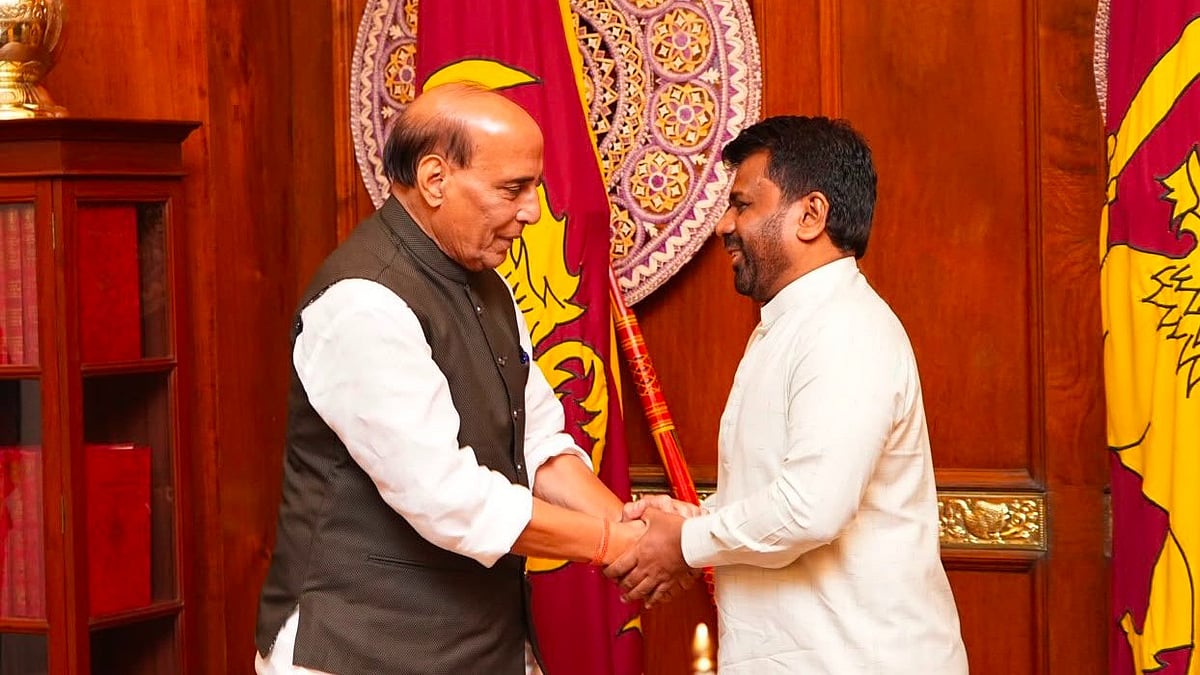
Sri Lankan President Anura Kumara Dissanayake has assured India that Colombo will not allow its territory to be used for activities that could threaten New Delhi’s security interests, reaffirming the island nation’s commitment to maintaining close defence and security ties with India.
Dissanayake made the assurance on Wednesday, September 9, during a meeting with Indian Defence Minister Rajnath Singh in Colombo. Singh is on a three-day official visit aimed at strengthening bilateral defence and maritime cooperation.
According to India’s Ministry of Defence, Dissanayake said Sri Lanka “would never allow its territory to be used for activities inimical to India’s security interests.” He also recalled his earlier interactions with Prime Minister Narendra Modi.
India, Sri Lanka deepen defence ties
The assurance came as the two countries stepped up defence cooperation, with India and Sri Lanka signing or exchanging three agreements and MoUs. One of the agreements focuses on upgrading and modernising L70 air-defence guns previously supplied by India and currently operated by the Sri Lankan Air Force. The two sides also agreed to strengthen cooperation between their National Cadet Corps and National Defence Colleges.
Singh and Dissanayake also virtually inaugurated three Bailey bridges constructed by the Indian military in Sri Lanka. The Sri Lankan President thanked India for its assistance following Cyclone Ditwah under Operation Sagar Bandhu, as well as for a wider rehabilitation package extended to the island nation.
Dissanayake reiterates earlier assurances
Dissanayake’s latest remarks are consistent with assurances he has given India since taking office. During External Affairs Minister S Jaishankar’s visit to Sri Lanka in October 2024, he conveyed similar commitments. He reiterated the position during his first foreign visit to India in December 2024, when he assured Prime Minister Modi that Sri Lanka would not allow its territory to be used in any manner detrimental to India’s interests.
Sri Lanka's strategic importance
The issue is particularly significant for India because of Sri Lanka’s strategic location in the Indian Ocean. New Delhi has closely watched the presence of foreign research and surveillance vessels in Sri Lankan waters, particularly those linked to China. The Chinese-operated Hambantota port has been a particular focus of India’s security concerns due to its proximity to India.
While Dissanayake’s government has sought to maintain balanced relations with both India and China, it has also stressed Sri Lanka’s sovereignty and its traditional policy of non-alignment.
The latest assurance, coupled with the new defence agreements and infrastructure cooperation, underlines the continued importance both countries place on their strategic, maritime and security partnership.

