Former Election Commissioner Ashok Lavasa has remarked that the special intensive revision process is “full of infirmities” and has mooted the idea of constituting a commission of inquiry to assess whether the mass deletion of voters affected election outcomes.
In an exclusive interview with ‘The Free Press Journal’, Lavasa said that if a link between discrepancies in voter lists in certain constituencies in West Bengal and the poll outcome is established, then fresh elections would be warranted.
The former poll panel member made the comments in the backdrop of the opposition’s demand to nullify the Assembly elections held after the Election Commission of India (ECI) began the Special Intensive Revision of electoral rolls.
"Phases one and two (of SIR) are complete, and elections have been held on their rolls,” Lavasa said. “Phase three, covering roughly 49 to 50 crore people, is incomplete, with only draft rolls prepared. The Supreme Court or the ECI could pause and scrap it and revert to the earlier rolls, which remain legally valid until new ones are prepared. Routine revision could continue, removing those who have moved, died or been duplicated, provided notice and a proper inquiry precede any deletion.”
‘Remaining Bengal Cases Would Take 12 Years’
Lavasa pointed to West Bengal, where 60 lakh people flagged for logical discrepancies were placed under adjudication. “The ECI knew elections were close and that adjudication could not finish in time, so it adopted a procedure that could not be completed. The Supreme Court appointed about 700 judicial officers, who found 33 lakh of the 60 lakh wrongly flagged and restored them. About 27 lakh remained excluded.”
The former EC member further noted that of the 27.6 lakh people affected, 22.5 lakh have appealed. “The appellate tribunal has decided only 1.26 lakh cases, and 93 per cent of those were found wrongly deleted. At this pace, the remaining cases would take about 12 years.”
He urged the Supreme Court to consider a commission of inquiry to assess how mass deletions affected results in individual constituencies in West Bengal. “If a link is established, fresh elections there would be warranted,” he said.
Concerns About SIR Process
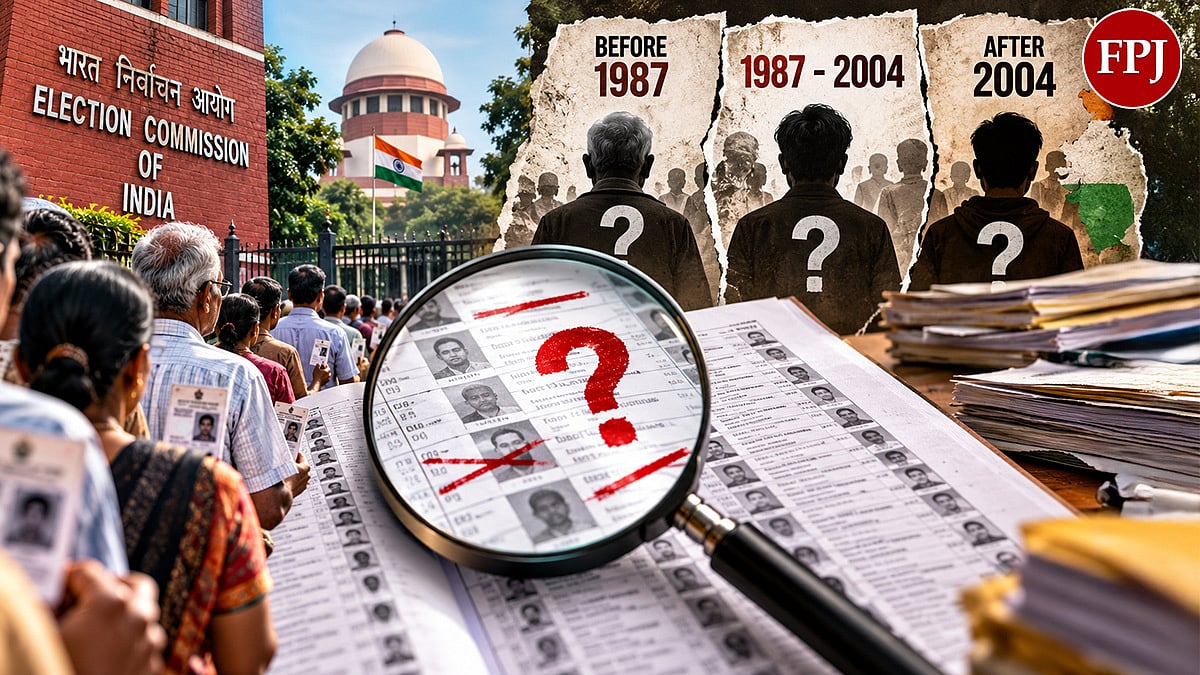
Lavasa said the SIR is “full of infirmities” citing several examples. When the exercise began in Bihar, the existing roll of 7.89 crore electors had already been prepared through the prescribed process. The ECI’s June 24, 2025 notification, nevertheless, divided voters into three groups: those born before 1987, those born between 1987 and 2004, and those born after 2004. Law makes no such division and the ECI had never done so before. The ECI also treated those on the 2003 reference roll as presumptively citizens, implying that anyone added later had questionable citizenship, a principle it had never explicitly used to classify voters.
Lavasa also criticised the “logical discrepancy” and mapping systems. A voter on the roll for 20 years should not lose the right to vote because a name is spelt differently from 2002, or because the voter was missing from the 2002 roll but has been registered for 15 years.
Such errors, he said, can be fixed through Form 8, and clerical mistakes made during data entry, such as transliteration between Marathi, Hindi and English, should not disenfranchise voters. Lavasa added that asking applicants for details of parents, grandparents and relatives “has no bearing on their right to vote”.
Questions About EC Functioning
Lavasa said the Supreme Court’s demand that the ECI produce its decision-making record on changes to Form 6 has exposed deep questions about how the poll body works. “The form 6 became controversial because people deleted during the SIR were told to file it to return to the electoral rolls.”
On September 26, the ECI issued a press note admitting the changes. It said two versions of Form 6 were in use, one for SIR states and one for non-SIR states, and that the Supreme Court had upheld the SIR version. At the latest hearing, the Chief Justice reportedly remarked that the court had approved no changes to Form 6.
Lavasa called the ECI’s claim “not substantiated.” He noted that the May 27, 2006 judgment it relies on speaks of residual authority in paragraph 152, but the dissenting commissioners objected after that ruling. He asked whether the Commission ever discussed their objections or told them it treated the judgment as approval. The ECI withdrew the declaration form on October 1, which shows its stand has shifted repeatedly.
Lavasa said it is “inconceivable” in normal circumstances for the Chief Election Commissioner to decide unilaterally. But one commissioner wrote as late as August that the changes were illegal, suggesting the full Commission never approved them. “He also cited complaints in other communications that no minutes or agenda were issued for over a year and that the Commission did not meet for four months,” Lavasa said.
Under the 2023 Act, decisions are to be taken unanimously where possible and otherwise by majority. Without minutes, Lavasa asked, how could anyone know whether a decision was unanimous, a majority, or opposed by a dissenter? “This raises grave misgivings about the Commission's working.”
EROs’ Struggle for Access
Lavasa raised concerns that Electoral Registration Officers (EROs) and Booth Level Officers (BLOs) have been denied access to the system, which one of the dissenting commissioners also objected to. He called this an obstacle to legal duties.
The former Election Commission cited the example of Goa, where EROs said notices were issued under their signatures without their knowledge, and a Maharashtra chief electoral officer who raised several objections.
He also cited reports that 11 of West Bengal’s 18 appellate tribunals could not operate the system efficiently, and an ERO in Goa who sent eight emails in a week without resolution.
“I cannot tell whether the glitches were by design or default, but that a genuine technical fault should not last so long. Centralising data is not wrong but the law makes the ERO responsible, and technology must not stop that officer from performing the function.”
Amend Appointment Panel
On the appointment of election commissioners, Lavasa said the panel the Supreme Court envisaged, the Prime Minister, the Chief Justice of India and the Leader of Opposition, could not be accused of thinking alike. Replacing the Chief Justice with a Union Cabinet minister makes the third member’s role “completely ineffective” since a minister is unlikely to disagree with the Prime Minister. “Even if appointees are efficient and impartial, the process leaves a perception of bias.”
Lavasa urged the government to broaden the panel with one or two members unconnected to it, though not necessarily the Chief Justice. “This would improve the image of both the Commission and the government.”

