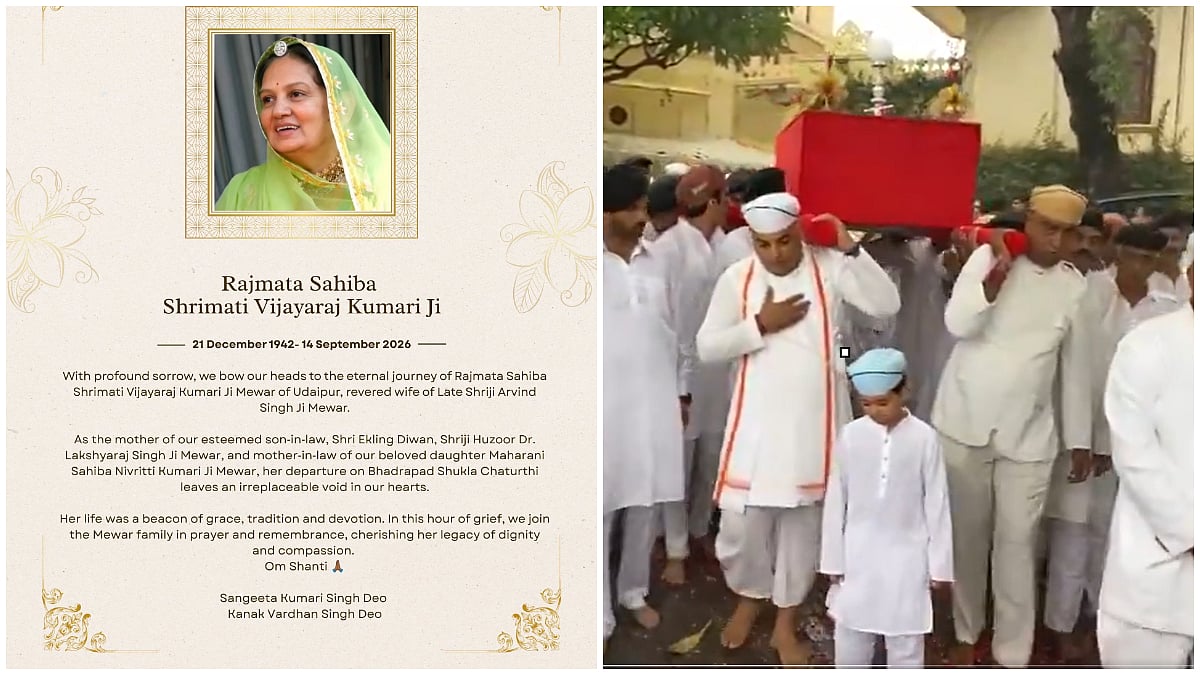
Jaipur, Sep 15: A pall of grief has descended over Udaipur, Rajasthan, and the wider Mewar region following the death of Rajmata Vijayraj Kumari Mewar, a member of the former Mewar royal family. She passed away late on Monday at the age of 83 after a prolonged illness.
Her death has prompted an outpouring of condolences across Udaipur, Mewar and Marwar, with admirers from across India and abroad, social organisations and political leaders paying tribute to her life and legacy. Remembered for her warmth, dignity and commitment to public welfare, Rajmata Vijayraj Kumari made significant contributions to education and social service, particularly in Udaipur.
Her passing marks the end of an era for a figure who remained closely associated with the city's cultural and social identity.
Royal lineage and legacy
Rajmata Vijayraj Kumari belonged to one of India's most distinguished royal lineages. She was born into the former royal family of Kutch in Gujarat and was the younger daughter of Maharaj Fateh Singh of Kutch and granddaughter of the Maharao of Kutch.
Following her marriage, she became a member of the former royal family of Mewar and the wife of the late Arvind Singh Mewar. She was also the mother of Dr Lakshyaraj Singh Mewar, a prominent social worker and educationist who represents the present generation of the Mewar family.
Throughout her life, Rajmata Vijayraj Kumari balanced her family responsibilities with a deep commitment to preserving Mewar's traditions and its longstanding ethos of public service.
Her affectionate demeanour, combined with a strong sense of responsibility, earned her respect both within the royal family and among people across Udaipur.
Contribution to education
Education was among the most enduring aspects of Rajmata Vijayraj Kumari's public life. She received her early education at the Franciscan Convent School in Ooty, an experience that gave her a modern outlook while grounding her in strong values.
After settling in Udaipur, she took a keen interest in expanding access to education and supporting initiatives aimed at women's empowerment.
Her association with Maharana Mewar Public School (MMPS) became particularly significant. During the 1980s, she played an important role in the institution's development and transformation, helping guide it towards a modern, disciplined and quality-focused educational model.
Her contribution to the institution left a lasting impact, with generations of students going on to pursue higher education and professional careers.
For those who knew her closely, education was not simply an institution-building exercise for Rajmata Vijayraj Kumari -- it was a means of creating opportunities and shaping the future of young people.
Final rites and tributes
Following her death, the royal family and the administration have made arrangements for her final rites in accordance with established traditions.
Her funeral procession departed in the morning from Shambhu Niwas Palace in the City Palace complex in Udaipur. A large number of citizens, members of social organisations and dignitaries gathered at the palace to pay their final respects before the procession proceeded to Mahasatiyaji at Ahar, the historic royal cremation ground of the Mewar family.
Her last rites are being performed there in accordance with traditional rituals, with a royal guard of honour.
The scenes surrounding her final journey reflected the deep connection she had built with the people of Udaipur over the decades.
Condolence meetings planned
A series of condolence gatherings, known as Tiye ki Baithak, will be held in memory of Rajmata Vijayraj Kumari Mewar.
According to official information, the meetings will be held daily from September 16 to September 23, between 2:00 p.m. and 3:00 p.m., at Shambhu Niwas Palace in the City Palace complex.
Also Watch:
Rajmata Vijayraj Kumari Mewar's life was shaped by two powerful themes: tradition and service. While she remained a custodian of the heritage and traditions associated with the Mewar family, her work in education and social welfare reflected a forward-looking vision.
For Udaipur, her passing is therefore more than the death of a member of a former royal family. It is the loss of a woman who, over several decades, became part of the city's social and cultural fabric.
(Except for the headline, this article has not been edited by FPJ's editorial team and is auto-generated from an agency feed.)

