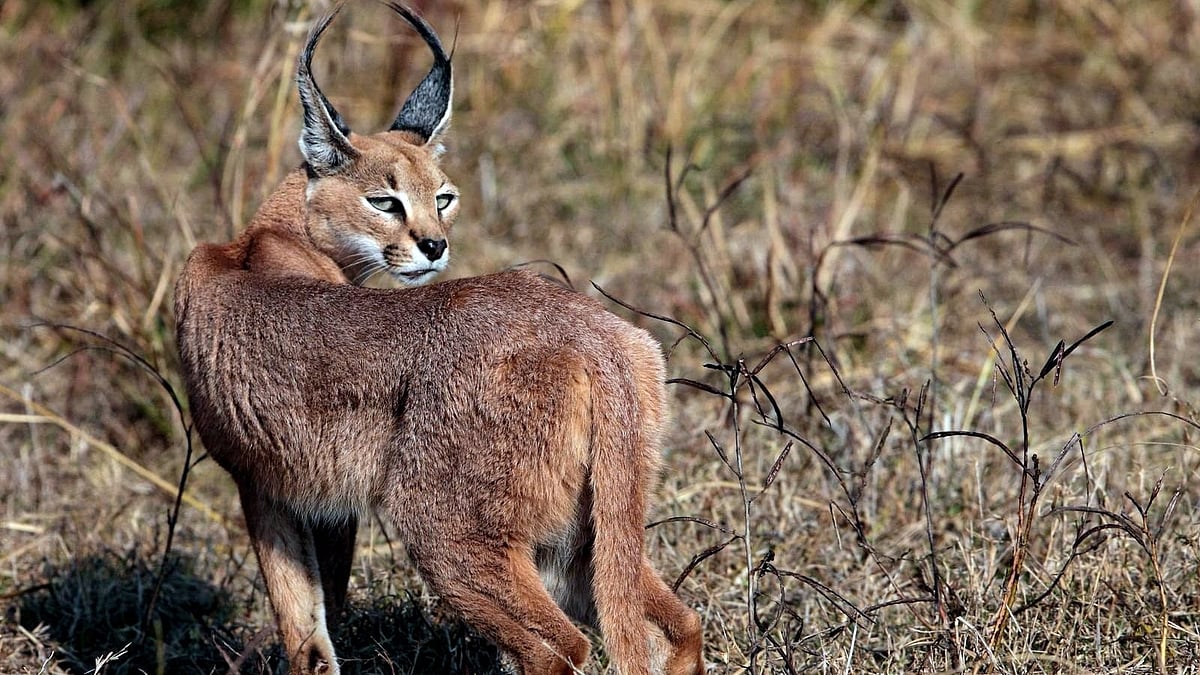
Jaipur: The Rajasthan Forest Department has launched 'Project Caracal' at the Ranthambore Tiger Reserve. Initiated with the objective of conserving the rare species of the Asian Caracal, this project has been allocated an initial budget of ₹89.94 lakh.
The project was launched at a workshop attended by prominent wildlife experts and representatives from various organizations who unanimously stated that the Asian Caracal is one of India's rarest and most elusive wild cats, which is about to go extinct as its population is in continuous decline.
As per officials, the 'Project Caracal' will focus on scientific assessment of the precise Caracal population across the state, identification, and conservation of its habitats in Ranthambhore, Mukundra Hills, Ramgarh Vishdhari, and other significant surrounding areas; strengthening of camera trapping, radio-collaring, and long-term monitoring efforts; and promoting research and engaging local communities in conservation initiatives.
This project will be implemented in collaboration with the Wildlife Institute of India (WII), Salim Ali Centre for Ornithology and Natural History (SACON), and Tiger Watch.
As per reports, the estimated total population of Caracals in India stands at a mere 50, confined primarily to the arid and semi-arid regions of Rajasthan and Gujarat. Between 2001 and 2020, the species' distribution range shrank by 95.95 percent, reducing to just 16,709 square kilometers—a drastic decline when compared to the period between 1948 and 2000.

Also Watch:
Within Rajasthan alone, camera trap surveys conducted in the Ranthambore Tiger Reserve have recorded 35–40 Caracals, whereas just a few years ago, this figure hovered between 18 and 35.
Recently, Caracals were for the first time found in the Mukundra Hills Tiger Reserve and the Ramgarh Vishdhari Tiger Reserve and in the Thar region of Jaisalmer.

