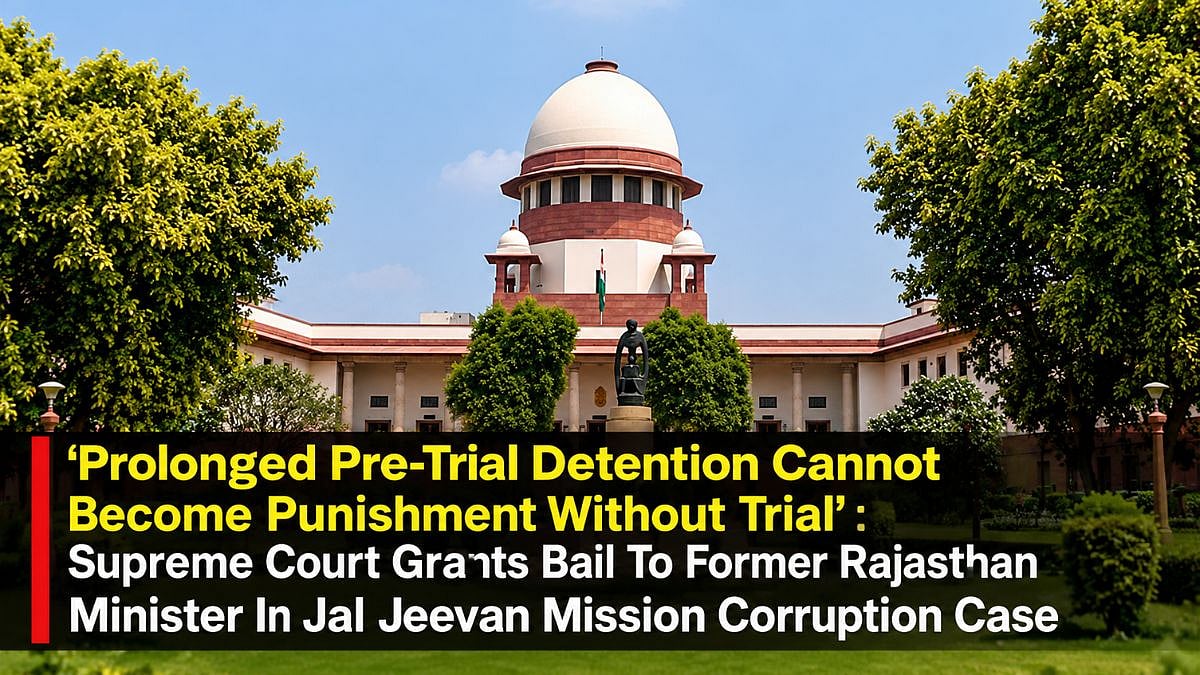
New Delhi, October 22, 2026: The Supreme Court has ruled that prolonged detention before trial cannot become a form of punishment, stressing that the right to personal liberty and a speedy trial must be protected even in cases involving serious allegations of financial irregularities.
A bench of Justices Dipankar Datta and Sheel Nagu made the observation while granting regular bail to former Congress minister Mahesh Chandra Joshi and Mukesh Pathak in a corruption case linked to alleged irregularities in tenders worth hundreds of crores of rupees under the Jal Jeevan Mission in Rajasthan, Live Law reported.
Serious Allegations Cannot Justify Indefinite Detention
The Court said allegations of large-scale financial irregularities and collusion in a public welfare project were serious and required thorough scrutiny. However, it made clear that the seriousness of the allegations alone could not justify keeping a person in custody indefinitely without trial.
“As repeatedly emphasised by this Court, prolonged pre-trial detention cannot be permitted to degenerate into punishment without trial in derogation of an undertrial’s Fundamental Right to personal liberty and speedy trial guaranteed under Article 21 of the Constitution,” the Court observed.
The bench acknowledged that the State was justified in opposing bail in cases involving extensive alleged criminal activity. However, it stressed that courts must consider other factors before deciding whether continued detention is necessary. The ruling reinforces the principle that serious allegations cannot override an undertrial’s constitutional rights.
Evidence Already With Investigators
The Court noted that the investigation against Joshi and Pathak had been completed and chargesheets had been filed. The prosecution’s case was largely based on documents and electronic evidence already in the custody of the investigating agency.
The evidence included tender files, official correspondence, bank statements, forensic reports of seized mobile phones and intercepted conversations. The bench found that neither further custodial interrogation nor recovery was required from the two appellants, substantially reducing concerns about possible tampering with evidence.
Months In Jail, Trial Yet To Begin
The Court also considered the time both appellants had already spent in custody. Joshi, aged about 72, had been in jail since May 7, 2026, for more than five months, while Pathak had remained in continuous custody since February 18, 2026, for nearly eight months.
Despite their prolonged detention, the trial had not begun and charges had not been framed. The Court considered this delay significant, particularly given the large volume of evidence and the number of people involved in the case.
124 Witnesses, 20,000 Pages Of Evidence
The case involves 22 accused persons, three chargesheets, 124 prosecution witnesses and 192 documents running into approximately 20,000 pages. The bench observed that examining such extensive evidence would likely take considerable time.
The investigation into the alleged involvement of some co-accused was also pending, while several others facing arrest warrants remained absconding. These circumstances further indicated that the trial was unlikely to conclude soon, making continued detention a matter of concern.
Bail In Connected Cases Also Considered
The bench noted that Joshi and Pathak had already secured bail in connected proceedings arising from the same allegations. Several co-accused in the present case had also received bail or interim protection.
Considering the completed investigation, the evidence already secured, the time spent in custody and the likely duration of the trial, the Supreme Court concluded that further detention was unnecessary. It also found that any legitimate concerns raised by the prosecution could be addressed through appropriate bail conditions.
“Viewed in the totality of the aforesaid circumstances, we are satisfied that further pre-trial incarceration of the appellants is neither warranted nor necessary, and that any legitimate apprehension of the prosecution can be adequately safeguarded by imposing appropriate conditions,” the Court held.
Also Watch:
The ruling highlights the need to balance the seriousness of corruption allegations with the constitutional rights of those awaiting trial, particularly when proceedings are expected to take a long time.
To get details on exclusive and budget-friendly property deals in Mumbai & surrounding regions, do visit: https://budgetproperties.in/

