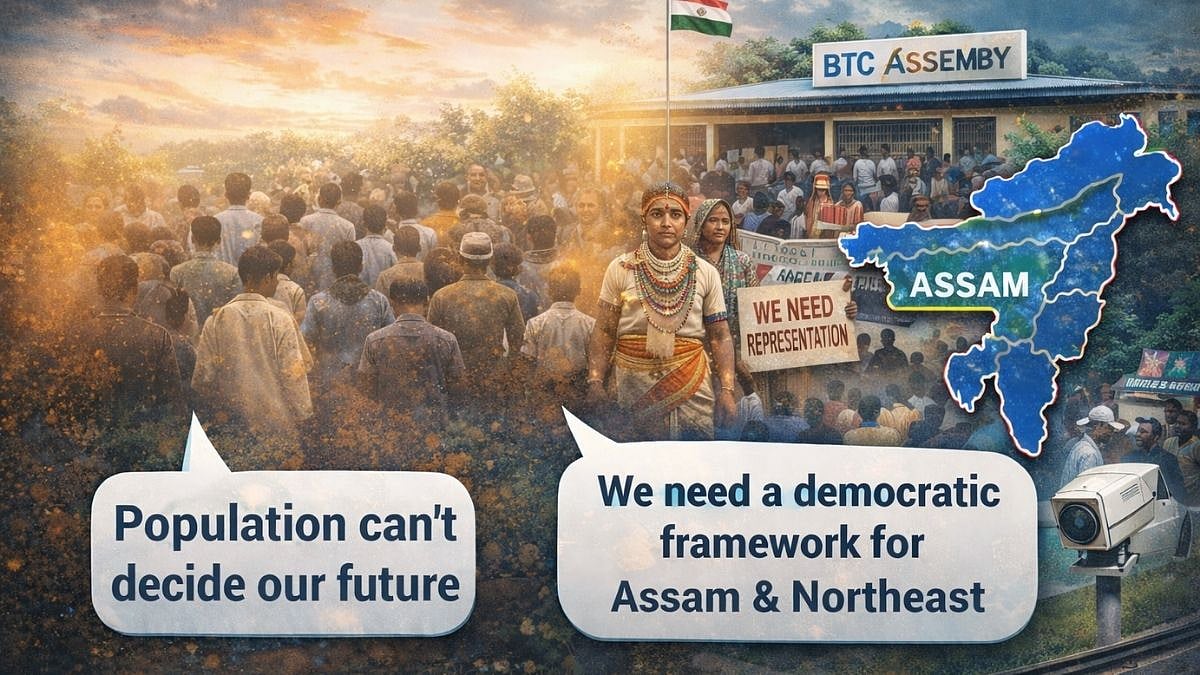
Guwahati, April 18, 2026: Three Bodo Members of Parliament on Saturday made a strong appeal for a region-sensitive approach to constitutional reforms, urging the Centre and all stakeholders to recognise the unique realities of Bodoland, Assam and the wider Northeast.
Call for special democratic framework
In a joint statement, Rajya Sabha MPs Rwngwra Narzary and Pramod Boro, along with Lok Sabha MP Joyanta Basumatary, called for a “special democratic framework” within the national constitutional process, especially in the context of ongoing debates around delimitation and women’s representation.
“We believe this is a historic constitutional moment for India,” they said. “For the Northeast and Bodoland in particular, it is an opportunity to correct long-standing under-representation, address historical imbalances and build a more inclusive federal structure.”
Emphasis on region-specific considerations
Referring to the Constitution (131st Amendment) Bill, the Delimitation Bill and related legislative discussions, the MPs said any national exercise must factor in the region’s distinct social, cultural and geopolitical context.
“I want to make it clear that discussions on delimitation and women’s reservation cannot ignore the Northeast’s unique realities,” one of the MPs said. “We are not a peripheral region. We are a vital civilisational and strategic frontier of the country, and we deserve equal constitutional attention.”
Delimitation as tool for representation
The MPs stressed that delimitation should not be treated as a mere exercise in redrawing boundaries but as a tool to expand democratic participation.
“I see delimitation as a chance to give voice to communities that have historically been unheard,” they said. “If done right, it can strengthen trust, promote peace and ensure fair representation.”
Concerns over under-representation
Highlighting the region’s diversity, they pointed out that nearly 200 communities in the Northeast continue to struggle for adequate political space.
“In many cases, the lack of representation has led to alienation and instability,” they said. “If we are serious about long-term peace and integration, then constitutional reforms must open doors for meaningful participation.”
Opposition to population-only criteria
The MPs cautioned against using population as the sole criterion for delimitation. “Population alone cannot define representation in the Northeast,” they said. “We must consider geography, ethnic diversity, border sensitivities and historical experiences.”
Demand for greater representation in Bodoland
Making a specific case for Bodoland, they said the region, with a population of around 40 lakh and home to 26 communities, requires stronger representation.
“I believe Bodoland should have three Lok Sabha seats and 30 Assembly constituencies,” they said. “Only then can our diversity and ground realities be reflected properly in governance.”
Call for balanced representation in BTC
They also flagged concerns around representation within the Bodoland Territorial Council (BTC), calling for a balanced approach that protects both Scheduled Tribe communities and non-tribal residents.
“I want a system where indigenous rights are protected, but social balance is also maintained,” they said. “Both communities must feel represented and secure.”
Support for women’s reservation with safeguards
On women’s reservation, the MPs welcomed the broader idea but stressed the need for careful implementation.
“I fully support increasing women’s participation in politics,” they said. “Women in the Northeast have always played a strong role in society, and this must translate into political representation. But the framework should expand our voice, not reduce it.”
Proposal to increase seats in smaller states
They suggested increasing Lok Sabha seats in smaller Northeastern states to accommodate women’s reservation without compromising regional representation.
“States like Mizoram, Nagaland and Sikkim currently have just one seat each,” they noted. “I feel they need special attention so that women’s reservation strengthens, rather than weakens, their voice.”
Focus on Sixth Schedule Councils
The MPs also called for greater focus on Sixth Schedule Councils, urging that their autonomy and representation be central to any constitutional reform.
“I believe the institutions of the Northeast must have a seat at the table when decisions about our future are taken,” they said. “We need stronger constitutional safeguards for women and indigenous communities in these areas.”
Pending issues under Bodo Peace Accord
Raising pending issues from the Bodo Peace Accord, 2020, they sought urgent action on key clauses, including expansion of the BTC legislative body and inclusion of villages with significant Bodo populations.
“I feel these are not just administrative matters, but issues linked to peace and trust,” they said. “Delays in implementation can affect the long-term success of the peace process.”
They also pressed for amendments to strengthen the financial and administrative powers of the BTC. “These provisions must be implemented without further delay,” they said.
Also Watch:

Call for inclusive and thoughtful approach
The MPs concluded with a call for a broader, more thoughtful approach to the Northeast.
“I believe the Northeast cannot be governed through mechanical formulas or occasional attention,” they said. “Our diversity, ecological sensitivity and history demand a more compassionate and informed approach.”
They urged all stakeholders to work towards reforms that are inclusive and future-oriented.
“I see this as a moment to heal past exclusions and build stronger trust in the Union,” they said.

