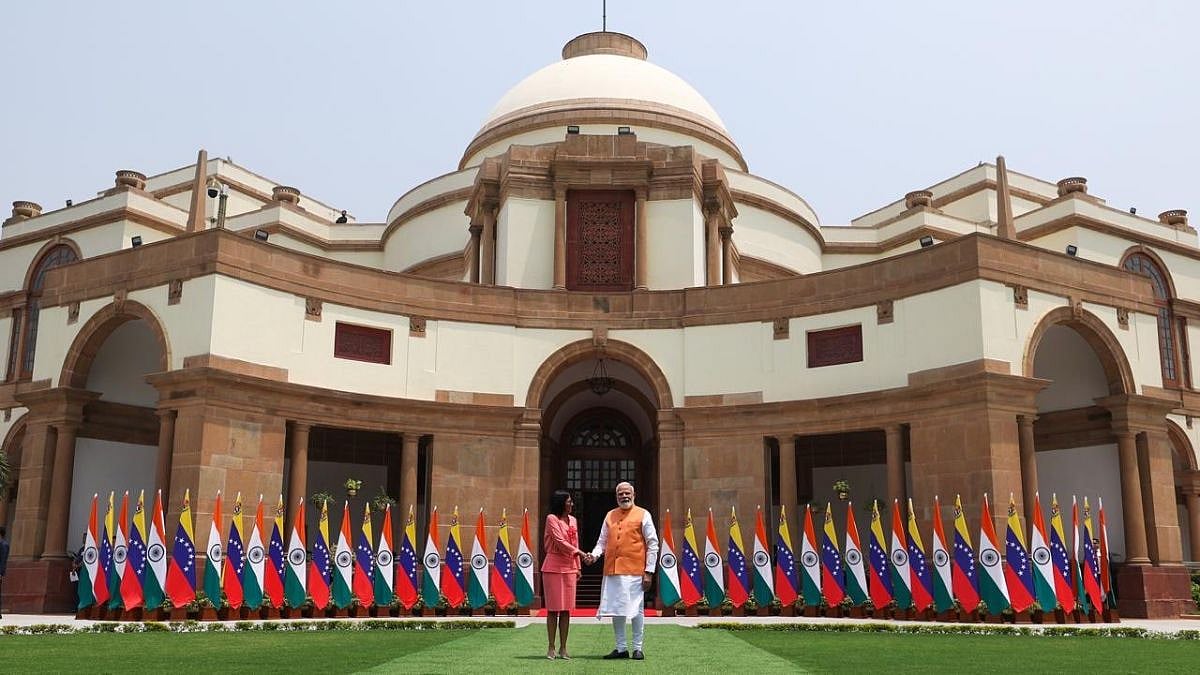
New Delhi: Prime Minister Narendra Modi met Venezuela’s acting President Delcy Rodriguez in New Delhi on Thursday during her bilateral visit to India from June 3 to 7. Rodriguez was originally scheduled to attend the now-postponed International Big Cat Alliance (IBCA) meeting on June 1.
The visit comes amid reports that India is seeking to increase crude oil imports from Venezuela. During their meeting, Modi and Rodriguez discussed a range of issues, including increased investment by Indian companies in Venezuela’s economy. Areas of interest included critical minerals, mining, pharmaceuticals and automobiles.
Addressing a special media briefing, Secretary East Rudrendra Tandon said Rodriguez held official talks with the Prime Minister over a “working lunch”. She also met External Affairs Minister S. Jaishankar and Union Petroleum Minister Hardeep Singh Puri during her visit.
Highlighting the energy dimension of the bilateral relationship, Tandon said Venezuela has emerged as India’s third-largest oil supplier and that “discussions focused on building a stronger energy partnership.''
Referring to developments in the Middle East, the MEA official said the Government of India was “aggressively seeking out new sources of crude oil and energy to ensure India’s energy security. So Venezuela is an opportunity, and it is very much part of our plan.”
However, the collapse of the Venezuelan economy in 2017 and US sanctions imposed on stateowned oil companies in 2019, aimed at pressuring President Nicolas Maduro to cede power, severely affected oil trade. As a result, Venezuelan oil exports to India fell sharply, reaching as low as 1.54 million tonnes in 2025. Energy experts in India see Rodriguez’s visit as a course correction in this regard.

Several issues, however, remain unresolved. Can Indian refineries process Venezuelan oil, given that India has so far relied on Gulf oil, which is of a different kind? Given the physical distance between the two nations, how long will Venezuelan oil take to reach New Delhi?
Another challenge involves restoring confidence among Indian state oil companies. ONGC, which was exposed to the Venezuelan oil industry through its subsidiary ONGC Videsh (OVL), has $500 million pending in dividends from the country. How then did the government plan to incentivise IOCs to go back to investing in Venezuela?

Tandon acknowledged that rebuilding confidence among Indian oil companies would be a challenge. On the issue of pending dividends, he said the matter had come up “several times” during discussions.
“This is very much part of the discussions we are having with Venezuela. Naturally, we do understand it is our money; it is the public sector company's money,” he said. “It is an issue that is there on the table, and they are very sensitive to this issue.”
While both governments appear keen to expand economic and trade ties, the issue of payments remains a concern. US sanctions have restricted activity within Venezuela’s international banking system, making many foreign banks reluctant to process transactions involving the country.

