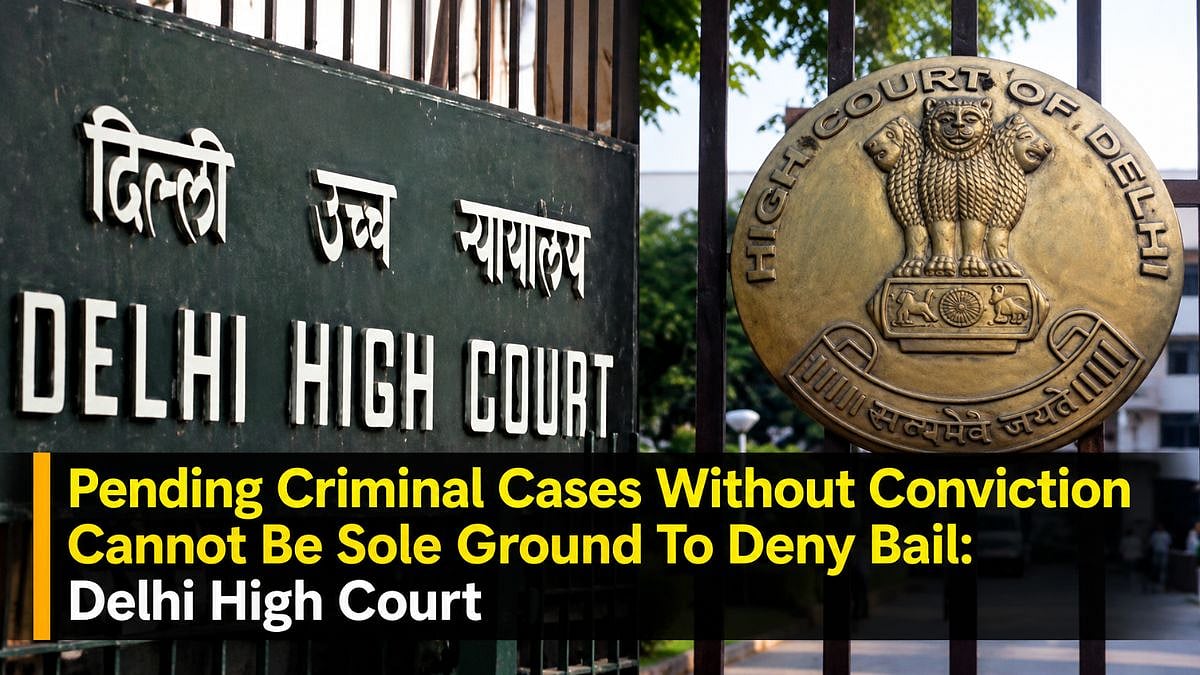
New Delhi, October 22, 2026: The Delhi High Court has ruled that pending criminal cases which have not resulted in a conviction cannot be the sole reason for denying bail if other circumstances favour the person seeking relief.
Justice Sachin Datta made the observation while granting regular bail to a man arrested in an assault case involving offences under the Bharatiya Nyaya Sanhita (BNS) and the Arms Act. The man had been in judicial custody since June 4, 2025, Live Law reported.
Pending Cases Alone Cannot Deny Bail
“The previous involvement of the petitioner in some cases which have not resulted in conviction, cannot, by itself, be a ground to deny bail when the other circumstances of the case otherwise favour the applicant,” the court observed.
The High Court referred to the Supreme Court’s judgment in Prabhakar Tewari v. State of U.P., which held that the seriousness of an alleged offence and the pendency of several criminal cases cannot, on their own, justify refusing bail.
Assault Near Wine Shop Led To Arrest
The case arose from an alleged assault near a wine shop in Delhi’s Nand Nagri area, where four people reportedly attacked the complainant.
According to the prosecution, the petitioner and another person held the complainant while two other suspects assaulted him. One of them allegedly used a knife to inflict injuries.
Petitioner Denied Causing Injuries
During the bail proceedings, the petitioner maintained that he had not caused any injuries to the complainant. He also pointed out that investigators had recovered the knife allegedly used in the attack at the instance of another suspect, not him.
The court considered these submissions and noted that the petitioner had been in custody for approximately 16 months. The investigation was complete, the chargesheet had been filed and charges had already been framed. The case was at the stage of recording prosecution evidence.
Why The Court Granted Bail
The High Court observed that the trial was likely to take time to conclude and that keeping the petitioner in custody would serve no further investigative purpose.
It also noted that the petitioner’s alleged role was different from that of the other suspect who had reportedly used the knife during the assault.
Pre-Trial Detention Should Not Become Punishment
The court emphasised that detention before conviction should not become a form of punishment. Its observations underline the importance of considering the individual circumstances of a case rather than relying solely on a person’s previous involvement in criminal proceedings.
Also Watch:

Taking these factors into account, the High Court granted regular bail to the petitioner on furnishing a personal bond of ₹25,000 with one surety of the same amount.
To get details on exclusive and budget-friendly property deals in Mumbai & surrounding regions, do visit: https://budgetproperties.in/

