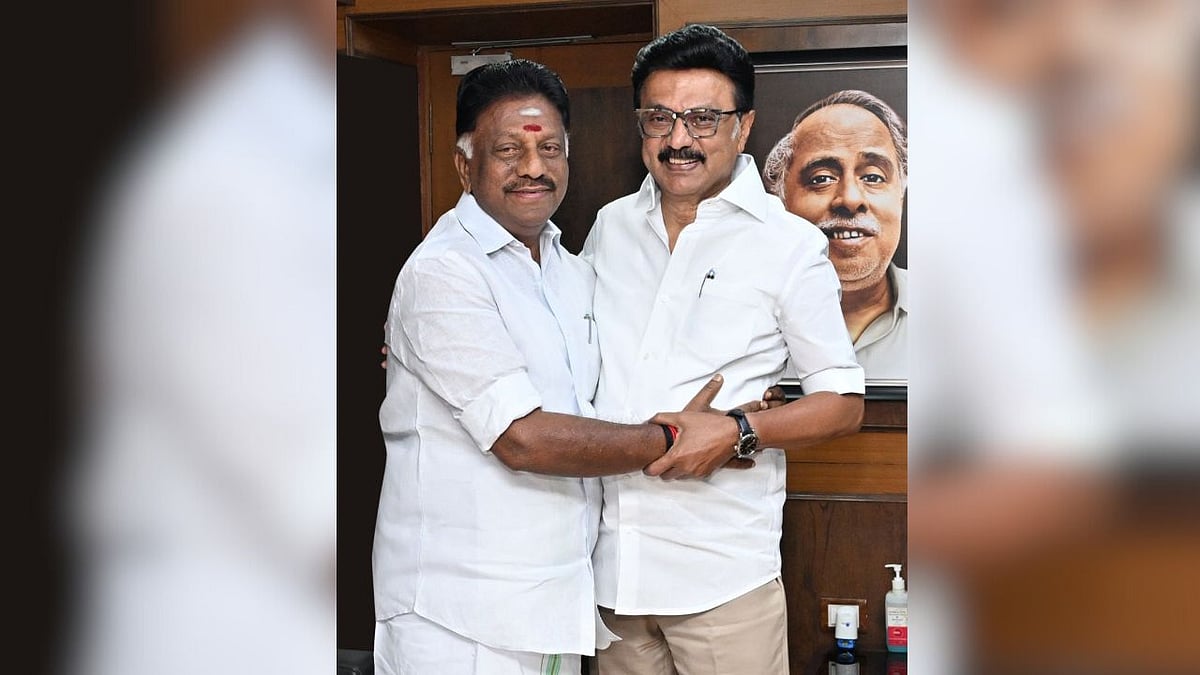
Chennai: Politics does make strange bedfellows. Yet, O Panneerselvam, a three-time former Chief Minister and expelled AIADMK leader, gave up his identity of a Jayalalithaa loyalist, and joined the ruling DMK, which she detested during her lifetime, it did make heads turn on Thursday morning.
OPS Switch Was Not Unexpected
The development was not unexpected as OPS, as he is better known, stood politically isolated and had dropped hints at switching loyalties earlier. But he remained indecisive, a trait that stopped him from emerging in his own right and influenced him to do the bidding of others.
OPS’s entry into the DMK marks the first instance in Tamil Nadu’s political history of a former Chief Minister from the AIADMK crossing over to its principal rival. The move is as symbolic as it is strategic both for the DMK and for the 75-year-old tea stall owner turned politician who has, in recent years, found himself increasingly isolated.
For nearly two decades, his political identity was intertwined with that of Jayalalithaa. Handpicked by her to occupy the Chief Minister’s chair during moments of legal adversity in 2001 and 2014, and again sworn in following her death in December 2016, he earned the sobriquet of a fiercely loyal lieutenant.
Dharma Yudham Against Sasikala Briefly Elevated Him
However, the post-Jayalalithaa churn within the AIADMK steadily eroded his position. His dramatic “dharma yudham” against V K Sasikala, the former aide of Jayalalithaa, in February 2017 briefly projected him as a challenger to entrenched power structures within the party. Yet, the subsequent merger of his faction with that of Edappadi K. Palaniswami diluted that momentum. He became deputy to Palaniswami in the Government.
The dual leadership arrangement — with OPS coordinator and Palaniswami as joint coordinator — eventually collapsed in July 2022, when the AIADMK reverted to a unitary structure. OPS was expelled from the party after opposing the move to elevate Palaniswami as general secretary.
Since then, his political fortunes have steadily waned.
Attempts to challenge his expulsion through legal avenues did not yield tangible gains. Efforts at reconciliation with Palaniswami were rebuffed. The AIADMK leadership made it clear that there was no scope for his return.
BJP's Non-Interference Stance
OPS’s perceived proximity to the BJP initially appeared to offer him an alternative platform. He remained aligned with the BJP-led NDA, contested the 2024 Lok Sabha election from Ramanathapuram, and maintained public warmth towards Prime Minister Narendra Modi and Union Home Minister Amit Shah.
However, the BJP’s position that it would not interfere in the AIADMK’s internal affairs effectively shut the door on any mediated reunion. In recent months, visible signs of distance between OPS and the BJP leadership added to the perception that he had lost all leverage.
With key associates either drifting away or crossing over to rival formations, and with the Assembly election approaching, OPS appeared to be running out of viable political options and he ended up joining the DMK.
For the ruling DMK his nduction offers some potential advantages. He retains pockets of influence in Theni district and parts of southern Tamil Nadu. His presence could help the DMK consolidate support in segments of the Mukkulathor community, particularly in regions where the AIADMK traditionally drew strength.
The DMK has, over the years, accommodated several former AIADMK leaders who went on to carve out space within the party structure. OPS could follow a similar trajectory, though much would depend on how effectively he mobilises support and adapts to a party long portrayed by AIADMK cadres as its ideological adversary.

