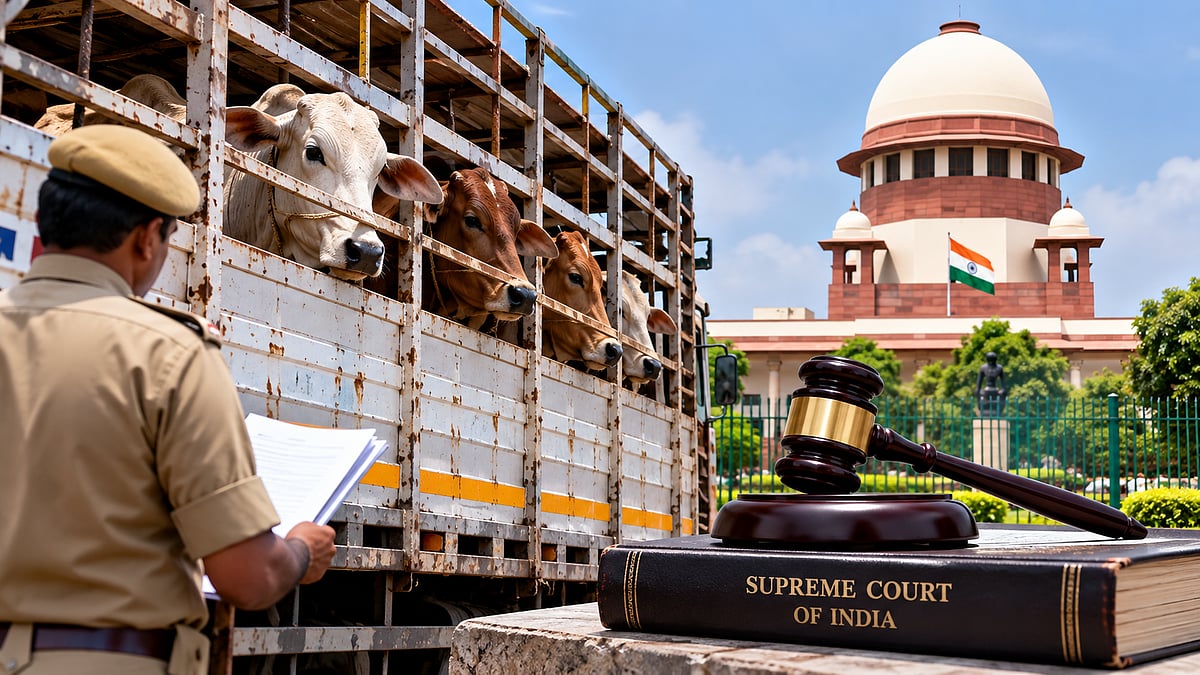
The Supreme Court has held that the absence of transport documents alone cannot lead to a presumption that cattle are being transported for slaughter.
A Bench of Justices JB Pardiwala and K Vinod Chandran made the observation while setting aside the conviction of a man under the Chhattisgarh Agricultural Cattle Preservation Act, 2004. He was among six people convicted in a case involving the transportation of 32 bullocks allegedly for slaughter.
“The mere fact that the transport was not accompanied by any documents cannot lead to a presumption that the transport was for slaughter,” the Court observed, Live Law reports.
32 bullocks seized from truck
According to the prosecution, 32 bullocks were being transported in a truck from Keduwa towards Odisha when a head constable, identified as PW3, intercepted the vehicle after receiving information about the transportation.
The cattle were seized and the truck driver and cleaner were arrested.
Police also intercepted a Bolero travelling ahead of the truck on the allegation that it was escorting the vehicle. Four people travelling in the car, including the appellant, were arrested.
The six were convicted under the Act for violating Section 6 and sentenced to one year of rigorous imprisonment and a fine of ₹1,000 under Section 10.
Lower courts upheld conviction
The Trial Court convicted the six, following which the First Appellate Court and the Revisional Court upheld the conviction.
The High Court subsequently restricted the sentence to the period already undergone. The appellant then moved the Supreme Court, specifically challenging his conviction.

Allowing the appeal, the Supreme Court examined Section 6 read with Section 11 of the Act and held that merely transporting cattle without documents would not create a presumption that they were being taken for slaughter.
Reverse burden applies only after essential ingredients established
The Court held that the reverse burden under Section 11 would apply only when the essential ingredients of the alleged offence had first been established.
It noted that the head constable who seized the cattle had failed to establish that they were being transported for slaughter. Therefore, the absence of documents explaining the purpose of transportation, or the lack of such documents with the truck driver, could not be held against the appellant.
Also Watch:
“Section 6 specifically indicates the offence of transportation of cattle for the purpose of slaughter or knowledge that such cattle are likely to be slaughtered. But for a mere presumption of such intention, by the Head Constable, PW3, there is nothing on record to show that the cattle were carried for slaughter. The reverse presumption provided by Section 11 would apply only if the essential ingredients for alleging the offence are proved before the Trial Court. In which event, the accused has the onus to prove that the transport for slaughter or the slaughter itself was not in violation of the provisions of the Act,” the Court said.
Court considers veterinary testimony
The Supreme Court also gave credence to the testimony of the veterinary doctor and the Gaushala president, who stated before the Court that the seized cattle were fit for agricultural use, including ploughing. The Court consequently allowed the appeal and set aside the appellant’s conviction.

