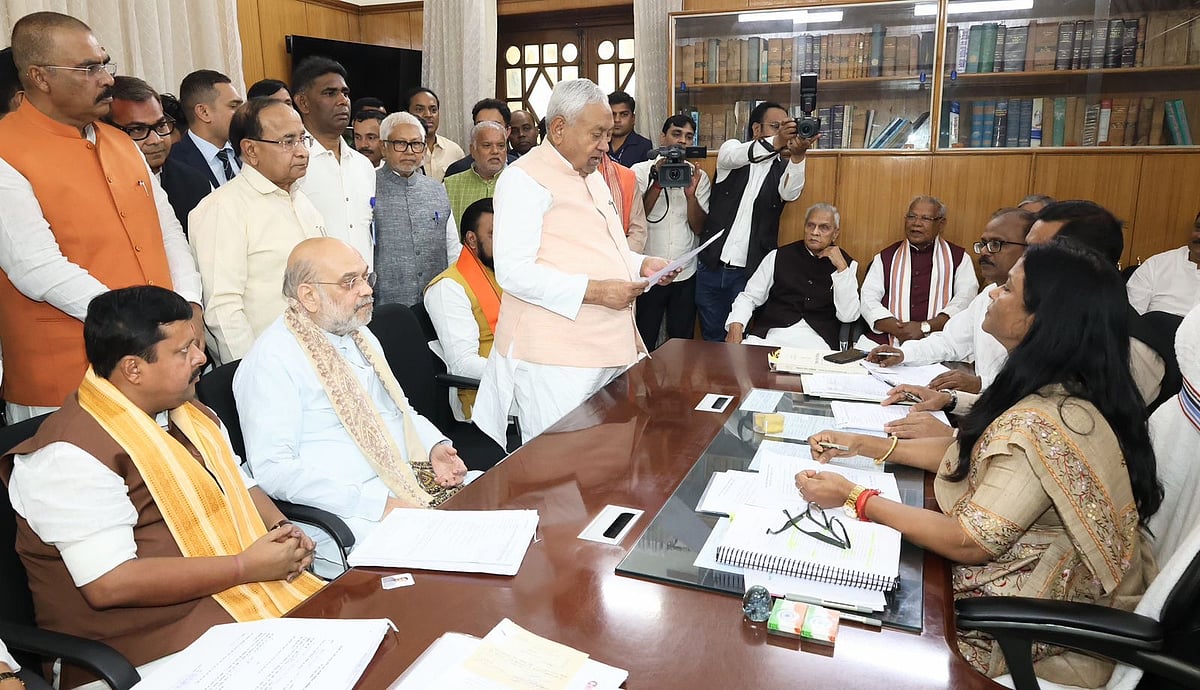
Patna: Bihar Chief Minister Nitish Kumar has opted to move to the Rajya Sabha, paving the way for the installation of a chief minister from the Bharatiya Janata Party (BJP) — a post the saffron party has coveted in the state for nearly two decades.
Though long anticipated, the sudden turn of events has taken political circles by surprise, coming barely four months after Nitish was sworn in for a record tenth term as chief minister. Nitish, who dominated Bihar’s politics for over two decades, filed his nomination on Thursday, clearing the path for his son Nishant Kumar to enter politics and potentially assume the role of deputy chief minister under a BJP chief minister. However, the vacuum created by Nitish Kumar’s departure to Delhi will be difficult for both the Janata Dal (United) and the BJP to fill.
His move has triggered protests among Janata Dal (U) leaders and supporters, many of whom have accused the BJP of sidelining Nitish Kumar despite his mass support among non-Yadav backward castes, extremely backward castes (EBCs), Dalits and Pasmanda (backward) Muslims — social blocs that helped the NDA secure a landslide victory with 202 seats in the state assembly.
“It is nothing short of a coup in Bihar. The BJP leadership, along with a section of JDU leaders loyal to the saffron outfit, have ditched Nitish Kumar and conspired to remove him from the top post unceremoniously,” said JDU leader and former minister Bikram Kunwar.
Seeking to calm ruffled party workers — many of whom had begun protesting outside the chief minister’s residence and elsewhere in the state — Nitish tweeted that he wished to become a Rajya Sabha member so that he could fulfil his desire of having served in both Houses of the state legislature as well as both Houses of Parliament.
Notably, ahead of the 2025 state elections, the BJP had refrained from declaring Nitish as the chief ministerial candidate — unlike previous elections. The party had only stated that the polls would be fought under Nitish Kumar’s leadership and that the chief minister would be chosen after the results. However, the BJP was compelled to reinstate Nitish as chief minister last November after the JDU secured 85 seats, emerging a close second to the BJP in the assembly tally.
While the JDU has demanded that the new chief minister be chosen from within its ranks, it is understood that a compromise formula has been worked out under which the party would get two deputy chief ministerial posts — similar to the arrangement last November when Nitish had two BJP deputy chief ministers. Nitish’s son Nishant is expected to take one of the posts, while senior JDU leader and minister Vijay Kumar Choudhary may be appointed as the other deputy chief minister.
The development has also triggered intense jockeying within the BJP, which emerged as the single largest party in the assembly with 89 MLAs in the November 2025 polls. Other NDA allies — including the Hindustani Awam Morcha (HAM), the Lok Janshakti Party (LJP) led by Chirag Paswan, and Upendra Kushwaha’s Rashtriya Loktantrik Morcha (RLM) — are closely watching the unfolding developments.
Party insiders say incumbent deputy chief minister Samrat Choudhary and Union minister of state for home affairs Nityanand Rai are frontrunners for the top post once Nitish steps down on April 10 after taking oath as a Rajya Sabha member. Former BJP state president Dilip Jaisawal, who belongs to the Vaishya (Kalwar) community and is considered close to Amit Shah, is also being mentioned as a contender. Names from the Dalit community and women leaders are also doing the rounds.
Amid the speculation, the final decision on Nitish’s successor will rest with the BJP’s central leadership, which will weigh caste equations and long-term electoral strategy. Nitish had painstakingly crafted a social coalition of backward castes, EBCs and Mahadalits — a formidable electoral combination that the BJP will have to carefully preserve while choosing the next chief minister.
Also Watch:
Both the JDU and the BJP are likely to find it difficult to fill the void created by Nitish Kumar’s departure. Few leaders in Bihar command the same aura, political acumen and organisational reach that Nitish built over two decades. Despite frequent political flip-flops, he remained adept at navigating shifting alliances and power equations.
It will also be a formidable challenge for Nishant Kumar to sustain the party’s vote bank nurtured by his father. A political novice, he remains largely unfamiliar with the complex social and political dynamics that shape Bihar’s politics.
Meanwhile, the Rashtriya Janata Dal (RJD) has extended an olive branch to Nitish Kumar, offering to support him as chief minister if he breaks away from the BJP and aligns with the RJD, Congress and other constituents of the Mahagathbandhan. According to RJD leader Tejashwi Yadav, Nitish could still form a government with the support of the Mahagathbandhan’s 35 MLAs.
“Nitish Kumar has been hijacked by the BJP leadership and a caucus within the JDU to destroy the party,” Tejashwi alleged.

