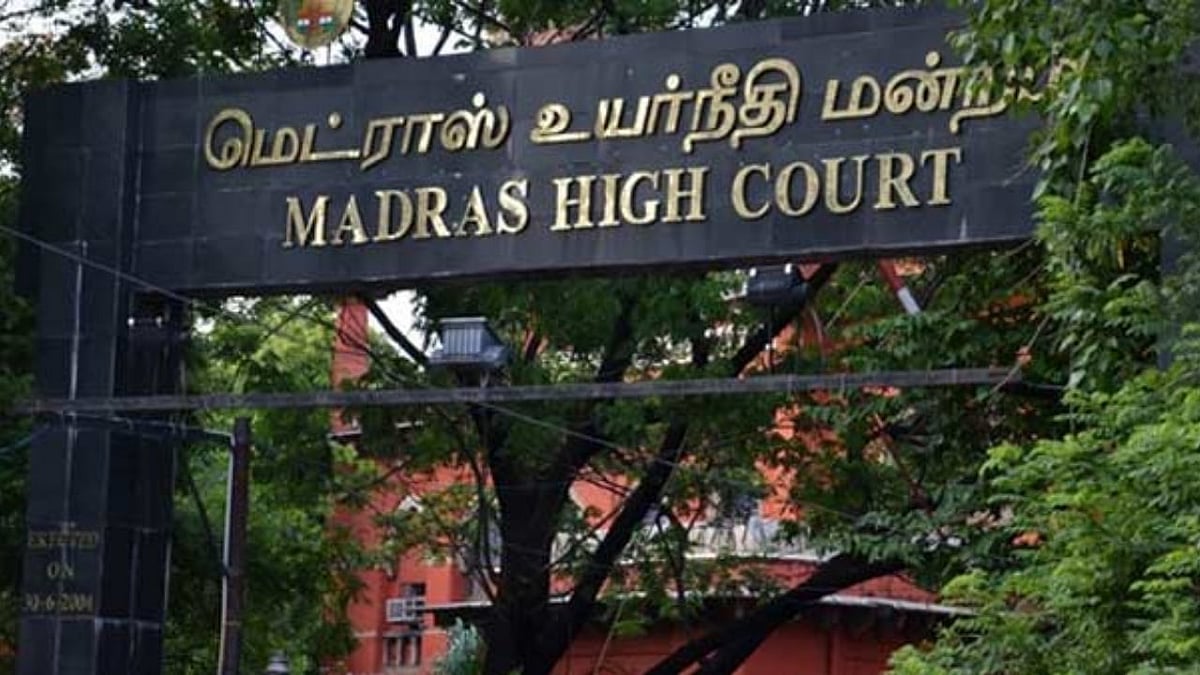
Chennai: The Madras High Court on Tuesday struck down a Tamil Nadu government rule empowering the Director of Geology and Mining to prohibit the transportation of rough stone and aggregates to other States, holding that the State lacks legislative competence to restrict the movement of minerals lawfully excavated under valid mining leases.
A Division Bench comprising Chief Justice Sushrut Arvind Dharmadhikari and Justice G. Arul Murugan declared Rule 3-A of the Tamil Nadu Prevention of Illegal Mining, Transportation and Storage of Minerals and Mineral Dealers' Rules, 2011, unconstitutional and ultra vires the Mines and Minerals (Development and Regulation) Act, 1957 (MMDR Act).
The Bench also quashed the consequential proceedings dated July 27, 2026, through which the Director of Geology and Mining had imposed a three-month ban on transporting rough stone and aggregates to other States, except Puducherry and Karaikal.
State's Powers Under MMDR Act Examined
The court held that Section 23-C of the MMDR Act, under which the State had introduced the impugned provision through a July 9, 2026, Government Order, was intended exclusively to prevent illegal mining, transportation and storage of minerals. It did not authorise the State to regulate the movement of minerals lawfully excavated after obtaining valid leases and paying the prescribed royalty and seigniorage.
Once minerals are lawfully excavated, ownership vests entirely with the lessee, the Bench observed, adding that the State cannot impose restrictions on their transportation beyond its borders by invoking Section 23-C.
Supreme Court Precedent Cited
The court relied heavily on the Supreme Court's 2019 judgment in State of Gujarat vs. Jayeshbhai Kanjibhai Kalathiya, which had held that State governments could not prohibit the inter-State transportation or sale of lawfully mined minerals by framing rules under the MMDR Act. The Supreme Court had also explicitly overruled earlier judgments of the Andhra Pradesh High Court and the Madras High Court that had upheld such regulatory powers.
Rejecting the State's justification that the restriction was necessary to address shortages of rough stone and protect domestic requirements, the Bench said that once the State permitted mining and excavation, banning transportation to other States had no rational nexus with the objectives of the MMDR Act.

Court Cites Constitutional Freedom Of Trade
The judges also held that the restriction violated Part XIII of the Constitution, particularly Article 301, which guarantees freedom of trade, commerce and intercourse throughout India's territory. They pointed out that restrictions on inter-State trade in public interest could be imposed only through constitutionally permissible legislative measures. A State government could not achieve the same objective through delegated rule-making powers.
The Bench, however, clarified that the State could regulate mining activities at the stage of granting leases and adopt reasonable measures concerning maximum vehicle loads, speed and public safety. It could also invoke Section 4-A of the MMDR Act, which provides for premature termination of mining leases on specified grounds, including environmental protection and public safety.
Also Watch:
Writ Petitions Allowed By High Court
Allowing all the writ petitions, the court ordered that there would be no order as to costs.
The common order was pronounced on petitions filed by mining leaseholders and crusher operators challenging the validity of Rule 3-A and the consequential transportation ban.

