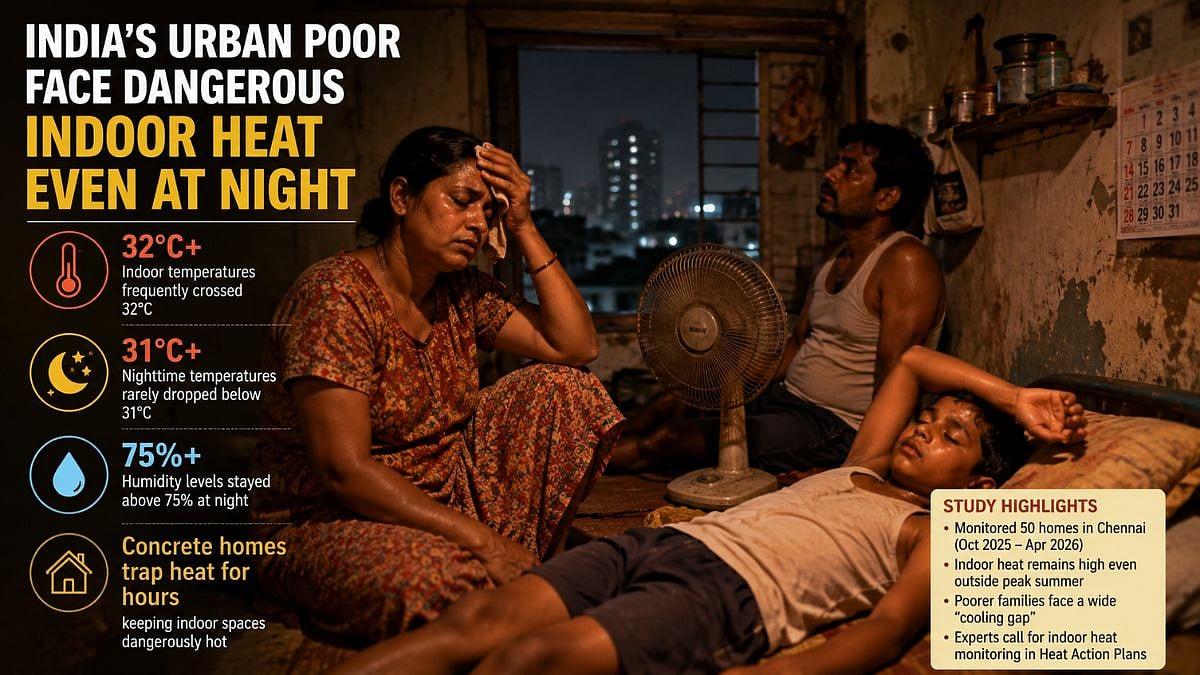
Lucknow, May 16: Residents of low and middle-income households in Indian cities are facing chronic indoor heat exposure, with temperatures inside homes remaining dangerously high even during nighttime and outside the peak summer season, according to a new study conducted in Chennai.
Study highlights prolonged indoor heat exposure
The study, released by Climate Trends during the India Heat Summit 2026, monitored temperature and humidity levels inside 50 homes in Chennai between October 2025 and April 2026.
Researchers found that indoor temperatures frequently crossed 32 degrees Celsius and remained above heat stress thresholds for prolonged periods, exposing residents to months of continuous thermal discomfort.
The findings point to a growing but largely invisible urban crisis in India, where millions living in densely populated concrete homes continue to suffer from trapped indoor heat long after sunset.
Researchers found that nighttime temperatures inside homes rarely dropped below 31 degrees Celsius, even during relatively cooler months. Indoor spaces recorded their highest temperatures between 8 pm and 9 pm as concrete roofs and walls released heat absorbed during the day.
In several homes, temperatures remained above 34 degrees Celsius deep into the night.
Humidity worsens discomfort
The study highlighted that the problem is not limited to heatwaves alone but reflects continuous baseline heat exposure faced by urban residents in Indian cities.
Humidity levels inside homes also stayed consistently above 75 per cent during nighttime hours, worsening discomfort and reducing the body’s ability to cool itself naturally.
Residents reported sleep disruption, exhaustion, and persistent fatigue linked to the prolonged indoor heat.
Addressing the India Heat Summit virtually, Union Minister for New and Renewable Energy Pralhad Joshi said rising temperatures and extreme weather events are affecting cities, villages, and everyday life across the country, with heat stress emerging as one of the defining challenges of the time.
Concrete housing linked to heat retention
The report said reinforced cement concrete structures commonly used in Indian urban housing were a major contributor to indoor heat retention.
While high-income households relied on air conditioners, poorer families depended largely on ceiling fans, creating a stark “cooling gap” between income groups.
Aarti Khosla, founder and director of Climate Trends, said the study underlined the urgent need to recognise nighttime indoor heat as a major public health issue in India.
She said residents were unable to recover from daytime heat exposure because indoor temperatures remained elevated throughout the night.
Experts call for policy changes
The study called for indoor heat monitoring to be integrated into Heat Action Plans across Indian cities.
It recommended subsidised cool roofs, reflective coatings, improved ventilation standards, and climate-responsive building materials to reduce heat exposure in low and middle-income housing.
Also Watch:

India currently has more than 300 Heat Action Plans in place, but none mandate indoor temperature monitoring.
Researchers argued that focusing only on outdoor temperatures fails to capture the real heat burden experienced by millions inside their homes.

