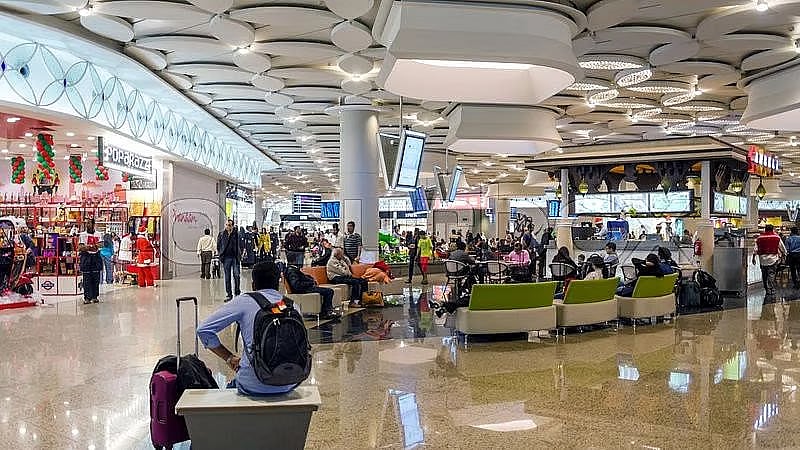
Mumbai: India has cemented its position as the sixth-largest aviation market in the world, carrying 218 million passengers across its skies, revealed the International Air Transport Association's (IATA) latest World Air Transport Statistics (WATS) report. The growth of the country's domestic sector is also highlighted by the Mumbai-Delhi trunk route, which firmly maintains its ranking as one of the top 10 busiest air pathways on Earth.
US leads, Japan grows 9.2%, Vietnam surges 14.8%
The IATA findings were published by compiling comprehensive operational and performance data from over 1,315 participating airlines globally. According to the report, India stood at the sixth largest aviation market with 218.2 million passengers in 2025, reporting a growth of 3.3%. The United States continued as the biggest market with over 890 million passengers in the year, followed by China with 776 million passengers, while Japan saw the highest growth of 9.2%. Dynamic hubs like Vietnam and Kazakhstan surged forward with 14.8% and 40.0% growth.
The Mumbai-Delhi route held its position as one of the ten busiest routes in the world. With 5.5 million passengers travelling between both the hubs in 2025, it stood as the ninth busiest airport pair in the world. According to the IATA database, the global top 10 busiest airport pairs are entirely dominated by domestic connections, primarily within the Asia-Pacific region, occupying nine of the top 10 spots. South Korea’s hyper-dense corridor between Jeju International and Seoul's Gimpo Airport kept the world’s number-one spot with 13.3 million passengers.
Premium travel up 4.5% to 109.7 million globally
On a broader corporate scale, IATA's report tracked a notable 4.5% year-on-year increase in international premium-class travel, including First and Business Class, which hit 109.7 million passengers. Premium fliers now account for 5.5% of all international travelers, with the highest concentration of luxury seating ratios found on routes departing from North America and the Middle East.

To accommodate this booming, high-yield traffic, network carriers are radically altering their fleet selections. Over the last six years, highly efficient long-haul twins have become the preferred choice for international routes. Flight frequencies for the Boeing 787 jumped by 40.8%, while the Airbus A350 saw a massive 117.4% surge in flights compared to 2019 data. Conversely, the quad-engine Airbus A380 continues its gradual retreat from active carrier strategies, operating 24.4% fewer flights than in the pre-pandemic era.
On high-density short-haul networks like Mumbai-Delhi, single-aisle aircraft remain the undisputed workhorses of the industry. The Boeing 737 family led global utilisation with 10.8 million individual flights, followed closely by the Airbus A320 with 8.7 million flights and the longer-range A321 variant with 4.2 million flights.
To get details on exclusive and budget-friendly property deals in Mumbai & surrounding regions, do visit: https://budgetproperties.in/

