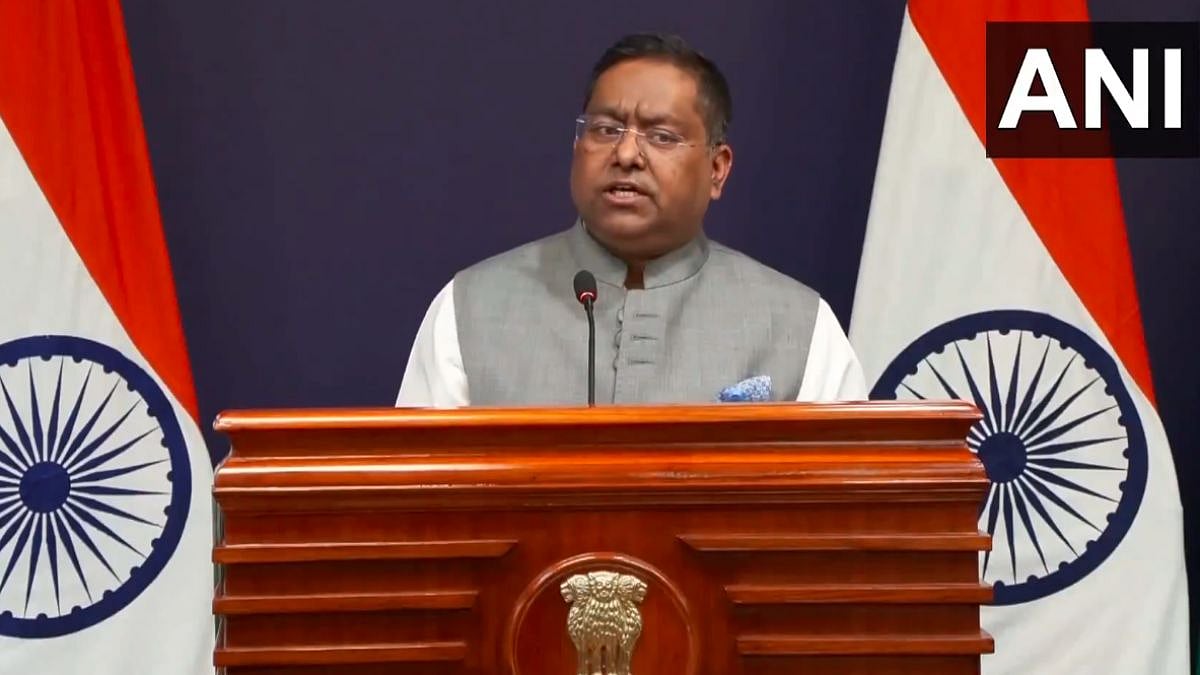
New Delhi: MEA spokesperson Randhir Jaiswal stated that India’s recent vote supporting the UN Security Council Resolution condemning Iran’s attacks on Gulf nations was in line with “several of India’s positions” on the ongoing war between the US and Iran. Asked during an MEA briefing where India stood on the conflict, Jaiswal said. “We have co-sponsored the GCC-led resolution at the UN Security Council. We have 135 countries who have cosponsored this resolution. The resolution reflects several of our positions.”
Understanding the Weight of Co-Sponsoring a UN Resolution
A senior diplomat explained that co-sponsoring a UN resolution means that the member state joins the sponsor in endorsing the draft proposal before it is adopted, thereby signalling strong political support and sometimes even active collaboration on the final text. Asked as to the reasons why New Delhi sought to vote against Iran, he said.
“India needed to send a strong measure of support to the Gulf nations, and the best way to do it was under a multilateral forum so as not to appear as if we were directly criticising Iran.” He added. “This was necessary given that Jaishankar is holding talks with Aragchi at the same time.”
India's engagement with Iran has increased as the war has continued. Jaiswal revealed that External Affairs Minister Jaishankar has held talks with the Iranian foreign minister Abbas Araghchi in recent days. “The external affairs minister and the foreign minister of Iran have had three conversations in recent days and the last one discussed issues pertaining to safety of shipping and energy security. Beyond that it would be premature for me to say anything.”
India Ensures Safety of 9,000 Nationals Residing in Iran
The MEA spokesperson also stated that the government had successfully managed to relocate or bring many of the Indian nationals living in Iran home. “We have 9,000 Indian nationals living in Iran. Following the advisory we issued on 14th January and 23rd February, several Indian nationals left the country and reached home. We have recently shifted several Indian nationals who were based in Tehran to other safer locations and cities in the country.” He added. “We are also assisting Indian nationals who wish to travel to Armenia and Azerbaijan and from there to takecommercial flights to return home. We are also assisting them with visas and land border crossings.”
The MEA spokesperson also stated that Prime Minister Modi was personally reaching out to all stakeholders. “The Prime Minister has spoken to several leaders in the Gulf after the conflict started. In these conversations, he has stressed on the need for dialogue and diplomacy so that peace can return soon. He has also underlined the need to avoid civilian casualties and has focussed on the priority for the safety of civilians.” He added. “He (Prime Minister Modi) has also in several cases condemned the violation of sovereignty and territorial integrity of states.”
Jaiswal also responded to criticism by some senior Indian diplomats that India had waited several days before signing the condolence book condemning the assassination of Ayatollah Ali Khamenei and that a minister or prime minister should have done so. Responding to the first criticism he said. “Foreign Secretary (Vikram Misri) signed the condolence book at the Iranian embassy on behalf of the Government of India. He did so on March 5, the first day of the opening of the book. It would do well for commentators to first update themselves on important matters before they choose to speak in public. Such ill-informed comments are best avoided.”
Jaiswal did not respond to the question as to why the external affairs minister or the prime minister had not gone.
India Expresses Grief Over US Bombing of Iranian Girls' School
The MEA spokesperson was also asked as to what was India’s response to the bombing of an Iranian girl’s school by the US. He replied. “We have issued several statements on the ongoing conflict. We have underlined the need to prioritise the safety of all civilians. We regret the precious lives lost and express our grief in this regard.”
India cosponsored the Bahrain-led resolution along with over 130 nations, including Australia, Austria, Bangladesh, Bhutan, Canada, Egypt, France, Germany, Greece, Italy, Japan, Kuwait, Malaysia, Maldives, Myanmar, New Zealand, Norway, Oman, Pakistan, Qatar, Saudi Arabia, Singapore, Spain, Ukraine, United Arab Emirates, United Kingdom, United States, Yemen and Zambia, PTI adds.
The resolution, which had a total of 135 cosponsors, reiterated its strong support for the territorial integrity, sovereignty and political independence of Bahrain, Kuwait, Oman, Qatar, Saudi Arabia, the United Arab Emirates and Jordan.
It condemned in the “strongest terms the egregious attacks” by Iran against the territories of Bahrain, Kuwait, Oman, Qatar, Saudi Arabia, the United Arab Emirates and Jordan and determined that such acts constitute a breach of international law and are a serious threat to international peace and security.
It demanded immediate cessation of all attacks by Iran against the GCC countries and Jordan and that Tehran “immediately and unconditionally” cease from any provocation or threats to neighbouring states, including the use of proxies.
Affirming Right of Nations to Defend Vessels in Critical Routes
It reaffirmed that the exercise of navigational rights and freedoms by merchant and commercial vessels, in accordance with international law, must be respected, particularly around critical maritime routes, and takes note of the right of Member States, in accordance with international law, to “defend their vessels from attacks and provocations, including those that undermine navigational rights and freedoms”.
The resolution condemned any actions or threats by Iran aimed at closing, obstructing, or otherwise interfering with international navigation through the Strait of Hormuz, or threatening maritime security in the Bab Al Mandab.
