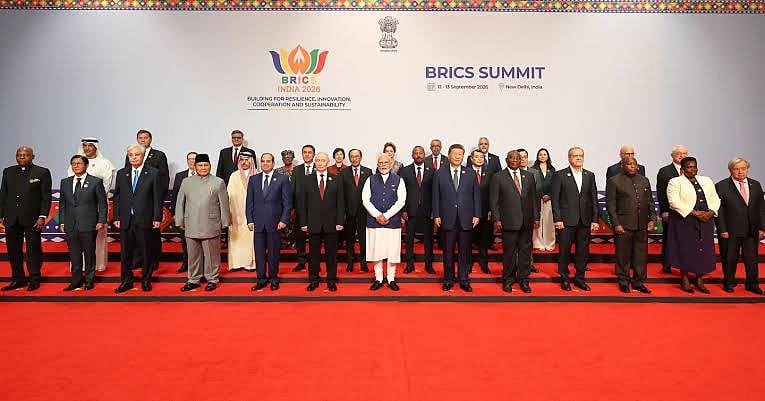
India scored a major diplomatic victory by securing a joint declaration on the first day of the BRICS Summit on Saturday. Indian officials said the declaration was not achieved without behind-the-scenes diplomacy, as New Delhi sought to bridge the expected divide between Iran and the UAE.
While the UAE sought to name Iran over attacks on Gulf territory, Iran wanted a mention of US-Israeli attacks.
Former ambassador Talmiz Ahmad said work on the draft could have started six months earlier.
“What typically happens is that the Foreign Ministry sets up ‘drafting groups’, which means that various bodies are responsible. The West Asia team would have been involved in drafting the language on Palestine, while economic elements of the draft would have been under the Economic Ministry, with inputs from the Commerce Ministry,” he said.
How The BRICS Draft Was Prepared
Diplomats said the Foreign Secretary would then sit with the other secretaries, and a workable draft of the proposed resolution would be finalised, with questions of structure, language and India's concerns incorporated into the draft statement.
Diplomats pointed out that the SCO joint statement in Bishkek had helped provide a structure for the BRICS statement, where themes of global governance, stress on international law, global security, and economic and financial issues were laid out.
It had also demonstrated that the declaration could go through without naming countries.
“India’s G20 Declaration in 2023 went through because Russia and China were not named, while the BRICS Foreign Ministerial meeting collapsed because both Iran and the UAE wanted to name names,” a senior diplomat said.
He added, “In the SCO, no nation-states were mentioned, and the BRICS followed the new formulation. The US is not named, and Israel is asked to withdraw from Lebanon, a formulation everyone can live with, as Israel is the occupying force here.”
From Working Group To Sherpa Meet
The draft created by the working group then moves forward to the BRICS Sherpa meet. Usually, 90% to 95% of the draft text is agreed upon before it goes to the Foreign Ministerial level.
Diplomats said India, as the chair, would have prepared what are known as “squirrel paragraphs”. These are paragraphs scribbled on the side of the draft that suggest alternative language should another country have a problem with the original wording.
The draft is then circulated to officials from other countries, who share their own suggestions and sometimes indicate that they would need approval from their foreign minister.
In India’s case, this would be with regard to its core interests. Language on Jammu and Kashmir, for instance, would need approval from the Foreign Secretary or the minister.
Balancing Palestine, Israel And India's Interests
The BRICS declaration is surprising in its specific language on Palestine, given India’s close relations with Israel.
Also, if the joint text had already been approved, why did Indian officials spend their time shuttling between Iran and the UAE to secure final approval on the draft?
Diplomats contend that, with regard to multilateral statements, states need to think a little differently.
As Ambassador Ahmad said, “India had to bear in mind that it is the chair and it had to bear in mind the interests of its members, and so the language on Palestine was passed.”
“India also does not usually oppose language in the draft unless it affects its core interests. In the SCO statement in Bishkek, for instance, we are not mentioned among the number of countries who support the BRI, and in this statement no mention of de-dollarisation is made,” he added.
Why India Shuttled Between Iran And UAE
Asked why Indian officials were running back and forth between Iran and the UAE, Ambassador Ahmad clarified that this was normal practice in text drafting.
“Changes in multilateral documents are made right up to the last minute,” he said.
Language issues could also play a part, as the text would have to be translated into other languages.
“Also, don’t forget, at 45 pages this is the longest BRICS statement that we have had till now,” Ahmad said.

