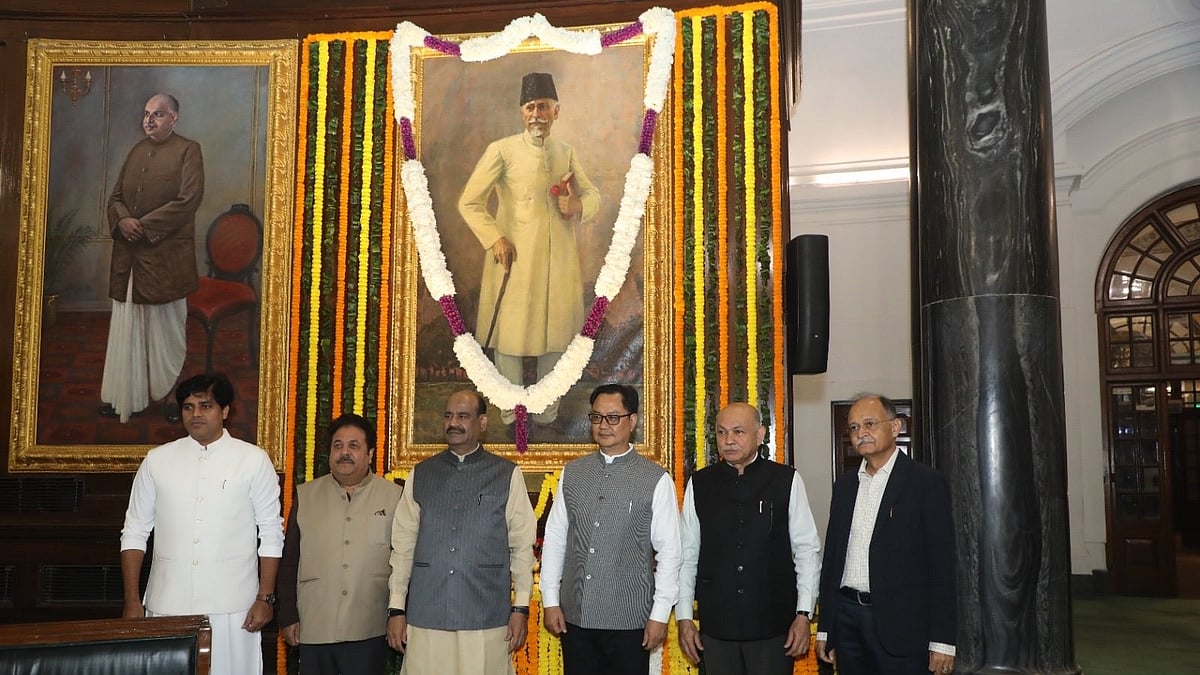
New Delhi, Nov 11: Lok Sabha Speaker Om Birla, Union Parliamentary Affairs Minister Kiren Rijiju, Congress MP Imran Pratapgarhi and several other prominent leaders on Wednesday paid floral tributes to Maulana Abul Kalam Azad on his birth anniversary at the Central Hall of Samvidhan Sadan.
Remembering the freedom fighter and India's first Education Minister, Birla described Azad as a distinguished educationist, scholar and a key figure in the country's freedom movement.
In a post on social media, the Lok Sabha Speaker said, "Heartfelt tributes on the birth anniversary of 'Bharat Ratna' Maulana Abul Kalam Azad, a valiant warrior of the freedom struggle, a great educationist and independent India's first Education Minister."
"Today, floral tributes were offered in the Central Hall of the Constitution House to commemorate his unparalleled contribution to nation-building, education and social harmony. His ideas and ideals will forever continue to light the nation's path," Birla added.
Azad's Early Life And Legacy
Born on November 11, 1888, in Mecca, Azad came from a family of distinguished Islamic scholars. His father, Maulana Khairuddin, was a Bengali Muslim of Afghan origin, while his mother was Arab. His forefathers had migrated from Herat in present-day Afghanistan during the Mughal period.
A prominent leader of India's freedom struggle, Azad was also a renowned scholar, poet and journalist. He was proficient in several languages, including Arabic, English, Urdu, Hindi, Persian and Bengali.
Following Independence, Azad became the country's first Education Minister in Prime Minister Jawaharlal Nehru's Cabinet, serving from 1947 until he died in 1958.
Azad died of a stroke on February 22, 1958, and in recognition of his contribution to the nation, he was posthumously awarded the Bharat Ratna in 1992.

Vision For Universal Education
Azad played a significant role in shaping India's post-Independence education policy, advocating universal and compulsory basic education for all children. He maintained that access to elementary education was the birthright of every citizen and argued that financial constraints should not prevent the expansion of primary education.
His educational vision also included adult education, improvements in secondary and higher education, expansion of technical and scientific learning, and the promotion of arts, literature and cultural activities.
During his tenure, he supported the expansion of public investment in education and the development of institutions that would strengthen India's scientific and academic capabilities.
Also Watch:
Building India's Premier Educational Institutions
Among his major contributions was the establishment of the first Indian Institute of Technology at Kharagpur in 1951. He also played a key role in setting up the University Grants Commission in 1953, which became a statutory body in 1956 to coordinate university education and maintain academic standards.
Azad also supported the expansion of the Indian Institute of Science in Bengaluru and encouraged research in the natural sciences and humanities. To strengthen teacher training and educational research, he helped establish the Central Institute of Education at Delhi University.
His contribution to building India's education system and promoting scientific research continues to be recognised as an important part of the country's post-Independence nation-building efforts.
Level up your brain the fun way. Play daily games and quizzes on FPJ Smart!
(Except for the headline, this article has not been edited by FPJ's editorial team and is auto-generated from an agency feed.)

