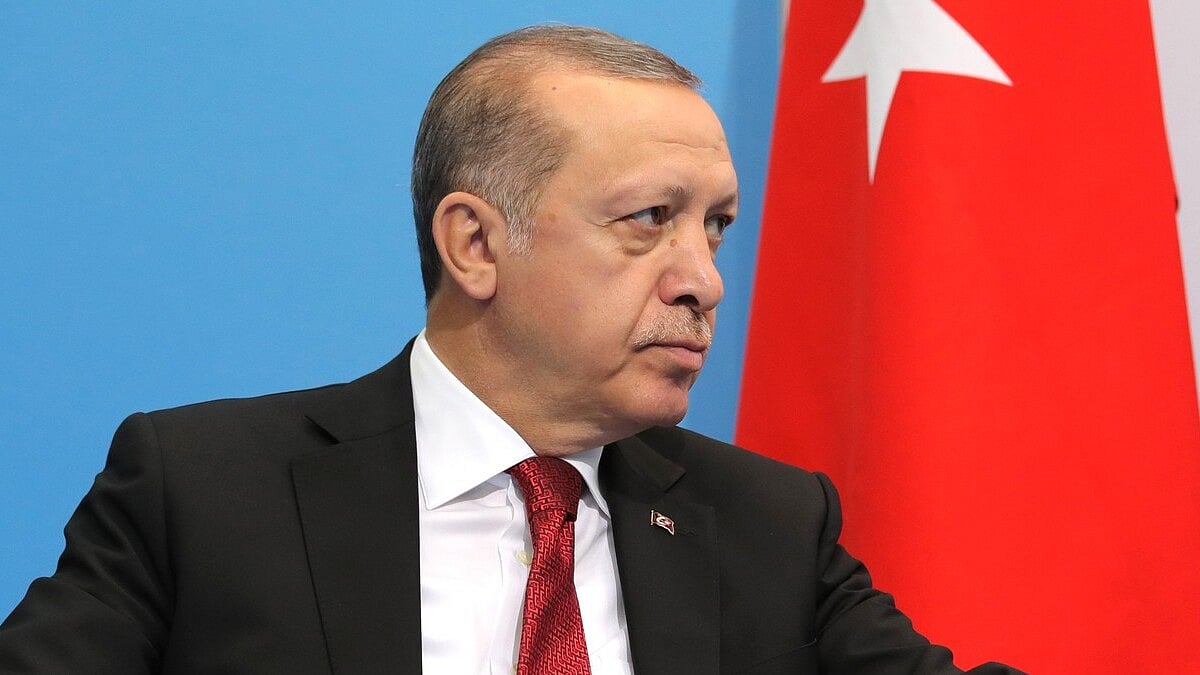
Much like a seasonal flu that flares up every autumn, President Recep Tayyip Erdogan’s references to Kashmir follow a predictable annual cycle. Almost like clockwork, as world leaders gather in New York for the United Nations General Assembly every September, Erdogan delivers his familiar rhetoric on the Kashmir issue.
This year was no exception. At the 81st Session on Tuesday, Erdogan once again called for all regional disputes, including Kashmir, to be resolved under the framework of the UN Charter and relevant resolutions.
It arrives as a recurring diplomatic ailment—annoying, persistent and entirely expected—serving less as a genuine effort to resolve a regional issue and more as a recurring political ritual for an international audience.
Playing to the domestic audiences
The root cause of this recurring political fever lies in Erdodan’s domestic and ideological motivations. By projecting himself as the champion of distressed Muslim populations worldwide—from Gaza to Kashmir—he attempts to re-establish Turkey as the preeminent leader of the Sunni Muslim ummah.
This posturing is designed to appeal directly to his conservative electoral base at home, offering a distraction during periods of domestic economic strain and reinforcing his vision of a modern neo-Ottoman foreign policy.
Erdogan's references to Kashmir have primarily been made during annual UNGA addresses and joint parliamentary/bilateral sessions in Pakistan.
A recurring diplomatic strain
The diplomatic tension between India and Turkey over Kashmir unfolded across several key milestones, beginning at the 74th Session of the UN General Assembly in 2019.
Shortly after India revoked Article 370, Erdogan made his most aggressive statement on the matter claiming that millions of people in Kashmir were under blockade, an assertion that prompted Prime Minister Narendra Modi to cancel a planned trip to Ankara and scale back defence ties.
The following year, during a February 2020 official visit to Islamabad, Erdogan addressed a joint session of Pakistan’s parliament and compared the struggle of Kashmiris to Turkey’s World War I resistance against foreign domination, triggering a formal diplomatic protest from India.
Later that year at the 75th UN General Assembly in 2020, he addressed the forum via a pre-recorded statement describing Kashmir as a "burning issue" and calling for a resolution in accordance with UN resolutions.
Erdogan continued to keep the focus on Kashmir at subsequent UN General Assembly sessions.
In 2021 at the 76th Session, he referred to Kashmir as an "ongoing problem for 74 years" and stated that any solution must reflect the aspirations of Kashmiris.
At the 77th Session in 2022, he expressed regret that peace had not been established between India and Pakistan after 75 years, voicing his hope for permanent peace in the region. By the 78th Session in 2023, he reiterated his call for direct dialogue between India and Pakistan within UN frameworks.
Following heightened regional tensions earlier in the year, he stated at the 80th Session in 2025 that the Kashmir issue should be resolved through dialogue based on UN resolutions.
Geopolitical rivalry for Islamic leadership
Erdogan’s international rhetoric on Kashmir serves as a direct counterweight to traditional power centres in West Asia, particularly Saudi Arabia and the United Arab Emirates. As Gulf monarchies have deepened their diplomatic, trade and strategic relations with India, they have increasingly muted their criticism of New Delhi's policies in Jammu and Kashmir.
Erdogan deliberately exploits this political vacuum to challenge Saudi dominance within institutions like the Organisation of Islamic Cooperation (OIC), framing Turkey—alongside allies like Pakistan—as a more resolute defender of Islamic causes.
The Pakistan factor
Like a virus that thrives in specific environments, Erdogan’s rhetoric is nurtured by Turkey’s deep strategic alliance with Pakistan. Ankara provides diplomatic backing on Kashmir to secure valuable defence export markets—such as naval corvettes and combat drones—and to guarantee Islamabad's support on Ankara’s own vulnerabilities, notably Cyprus and maritime disputes in the Aegean.

