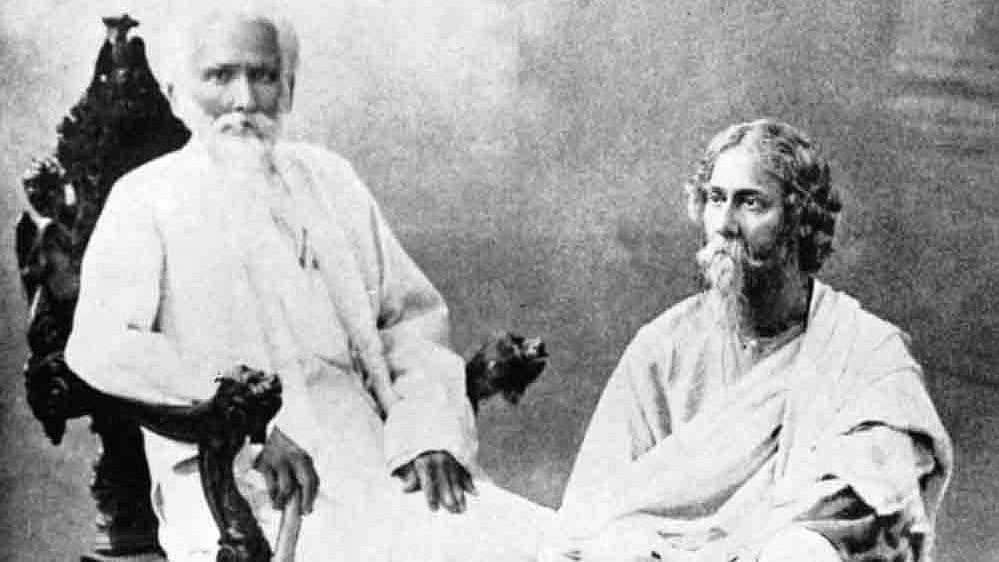
An Indian philosopher, translator, poet, mathematician, and music composer, Dwijendranath Tagore was born on March 11, 1840 and passed away on January 19, 1926.
Early life
Dwijendranath Tagore, born on March 11, 1840, was raised by his father Debendranath Tagore, a leading figure in the Hindu reform movement called Brahmo Samaj. His education was primarily provided by a tutor, although he did attend St. Paul's School and Hindu College in Kolkata. His brother, Satyendranath Tagore, was very close to him, despite their differing views on traditional reforms - Dwijendranath was a devoted follower, while Satyendranath advocated for a new, modern society. In 1861, his younger brother Rabindranath Tagore, a renowned poet and Nobel laureate, was born.
Career
Published in 1875, Dwijendranath Tagore's first collection of poetry, Swapnaprayan, follows the journey of a young man traveling the world and is celebrated as one of the most significant works in Bengali literature due to the various rhythmic styles used throughout. During the time when he began writing poetry, he was greatly influenced by the works of Michael Madhusudan Dutta.
Aside from translating the Upanishads into Bengali, Dwijendranath also translated the Brahmo Dharma Grantha, a prayer book from the Brahmo Samaj. He was instrumental in the founding of the Biddvajan-Samagam in addition to the National Society, and his favorite book was the Bhagavadgita.
Dwijendranath's philosophical works include Adwaita Mater Samalochana and Aryadharma O Boudhya Dharmer Ghat-Protighat, and he served as editor of Tattwabodhini Patrika for over 20 years while also founding the Hitabadi. In 1897 to 1900, he was the president of the Bangiya Sahitya Parishad, and he invented both Bengali shorthand and notation.
Between 1866 and 1871, he acted as the secretary of the Adi Brahmo Samaj. Dwijendranath's literary works include Bhratrbhab, Tattvabidya, Sonar Kathi Rupar Kathi, Aryami ebang Sahebiana, Advaitamater Samalochana, Brahmajnan O Brahmasadhana, and Prabandhamala. Additionally, he wrote numerous devotional and patriotic songs.
In last years of his life
In the final two decades of his life, Dwijendranath lived in Santiniketan, where he received countless visitors seeking to meet him.
He died on January 19, 1926 at Santiniketan.