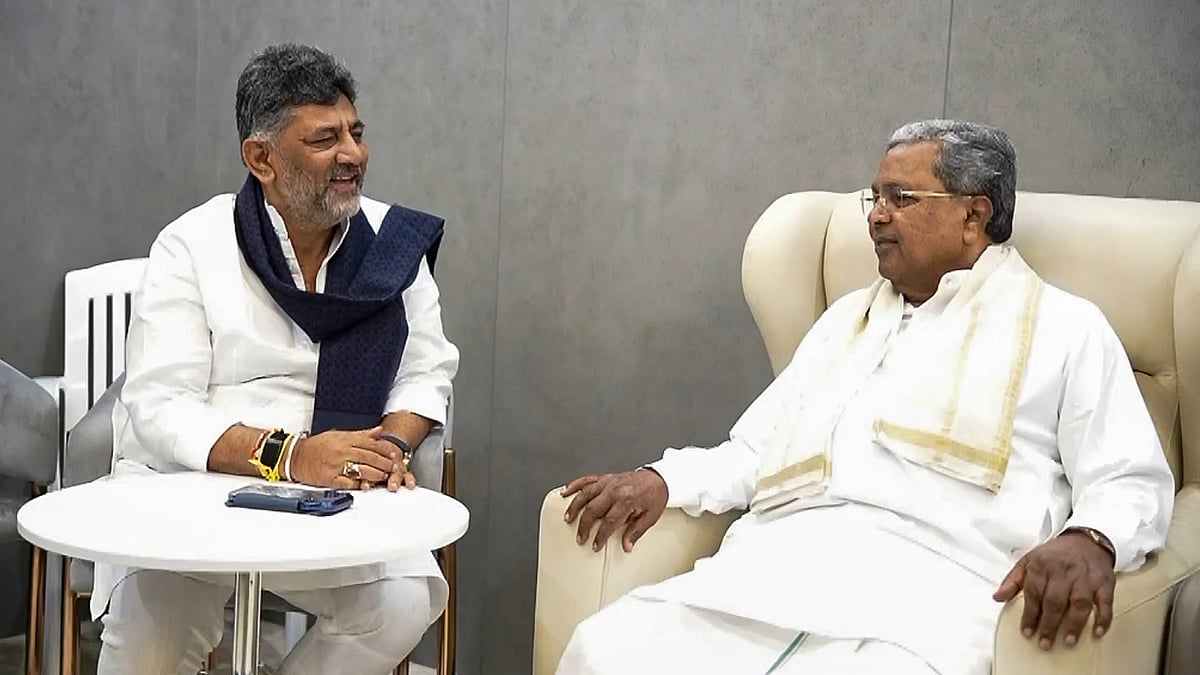
Vidhana Soudha, in Bengaluru, will soon have a new name as the chief minister of Karnataka. The upcoming transition of the chief ministership to DK Shivakumar marks a major turning point in state politics. While this move honours internal power-sharing agreements, it fundamentally rewires the state's social and political architecture. As a powerhouse leader, the new chief minister will inherit a complex web of immediate challenges, most notably balancing the historically volatile Lingayat-Vokkaliga rivalry while preventing the erosion of the party's core support bases.
The Congress-led government under outgoing chief minister Siddaramaiah in Karnataka has so far maintained a precarious balancing act between substantial social welfare commitments and long-term fiscal stability, while simultaneously handling sharp intra-party dynamics, aggressive opposition pushback and a delicate shifting of leadership.
Immediate challenges for the new chief minister
While Shivakumar is highly renowned as an elite organisational strategist and political troubleshooter, transitioning from a backroom operator to the singular face of a complex state presents distinct hurdles. His primary challenge involves continuing the deep, emotional grassroots connection with the minorities, backward classes and Dalits coalition known as AHINDA.
He must work doubly hard to prove his government will remain equally accommodative to these marginalised groups. Shivakumar must also tread through the enduring influence of his predecessor, whose loyalists could trigger destabilising undercurrents if they feel sidelined. Furthermore, the new leader carries significant legal and investigative baggage from central agencies, providing the opposition alliance with potent ammunition to question his moral authority while he simultaneously attempts to solve the state's Rs 60,000 crore annual welfare funding dilemma.
Cost of five guarantee schemes
The central debate surrounding the state’s economy centres on the massive financial commitments of the five guarantee schemes, which include Gruha Lakshmi for women, Gruha Jyothi for free electricity and Shakti for free bus travel. While these programmes act as crucial social safety nets for millions, they have significantly rewired the fiscal architecture of the state and placed immense pressure on resource mobilisation.
The total debt is steadily climbing toward Rs 8,00,00 crore, with fresh annual borrowings projected to hover between Rs 1.2 lakh crore and Rs1.3 lakh crore. This surge in borrowing has trapped the administration in a cycle of committed expenditure, where rapidly increasing interest payments consume a massive chunk of annual revenues and leave drastically reduced fiscal space for critical capital investments like roads, metro extensions and irrigation infrastructure.
Revenue constraints and federal tussles
Compounding these spending commitments are significant revenue shortfalls and structural disputes with the central government. Even though the state remains a premier economic powerhouse and ranks second nationally in gross GST collections, it faces a tight squeeze due to decelerations in real estate registrations and a net GST shortfall of roughly Rs18,500 crore.
This has pushed total liabilities right against the ceiling of 25 per cent of GSDP permitted under the fiscal responsibility and budget management framework. Furthermore, the government has repeatedly criticised the Central government for systematic neglect in tax devolution, noting that the state's share in the central divisible pool dropped from 4.71 per cent under the 14th Finance Commission to 3.64 per cent under the 15th Finance Commission.
The state leadership continues to allege that the Centre is withholding over Rs11,000 crore in sanctioned funds including critical allocations for the Upper Bhadra irrigation project.
Balancing the Lingayat and Vokkaliga tussle
Political power in the state has historically swung between the land-owning, numerically dominant Lingayats of North and Central Karnataka and the Vokkaligas of the Old Mysuru southern region. The ascension of a Vokkaliga chief minister naturally pleases the southern belt but risks alienating the Lingayats and consolidating their votes entirely behind the opposition.
To counter this, the leadership is likely to implement a multiple deputy chief minister formula to ensure structural representation for all major voting blocs. Elevating prominent Lingayat leaders to these critical slots signals that their community retains a major hand on the steering wheel of the state, while additional deputy positions for Scheduled Tribe, Dalit or Muslim faces protect the vulnerable AHINDA flank. AHINDA is a socio-political term and movement in Karnataka. It is a Kannada acronym for Alpasankhyataru (minorities), HINdulidavaru (backward classes) and DAlitaru (dalits and adivasis)
Structural adjustments and regional appeasement
Achieving a sustainable equilibrium requires broader structural adjustments within the party organisation and a deliberate recalibration of state spending. To balance the immense concentration of power, the chief minister is expected to relinquish his dual grip on the party organisation by handing the state Congress presidency to a non-Vokkaliga leader, potentially an influential face from North Karnataka or an operational backward-class leader.
Furthermore, because the new leadership's core strength is geographically concentrated in the south, the government must aggressively cater to the northern districts. This requires ensuring that major infrastructure budgets, high-profile cabinet portfolios like home, finance or public works, and vital state-level leadership roles are disproportionately distributed to Lingayat and backward-class legislators.
Through these meticulous manoeuvers, the government would like to maintain a technically stable fiscal deficit within the legal threshold of roughly 2.9 per cent of GSDP while transforming a regional strongman into a pan-state statesman.

