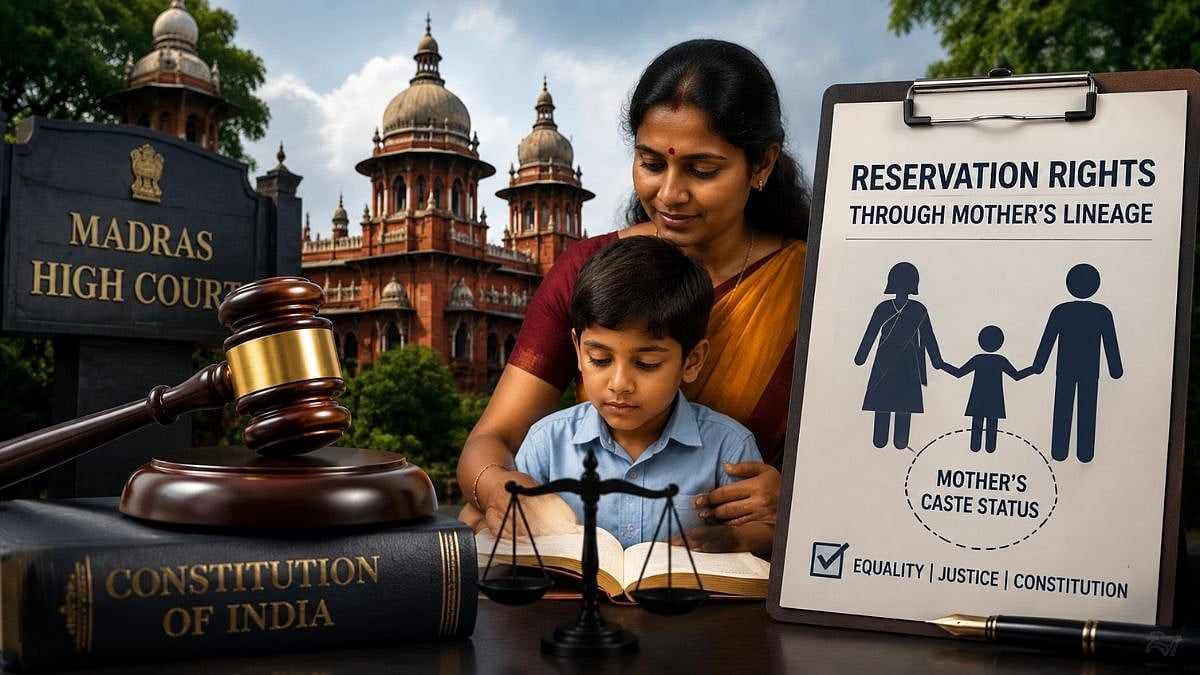
Puducherry, September 1, 2026: The Madras High Court has rejected the Puducherry Government’s stand that a child’s caste origin for issuing a community certificate can be determined only through the father’s nativity.
The court held that children can claim reservation benefits through their mother’s caste status if they were brought up in that community and faced the same social disadvantages.
Justice Bharatha Chakravarthy criticised the government’s policy, observing that reservation is based on the social disadvantage, stigma and hardships faced by a person, and not whether the caste identity is traced through the father or the mother, Live Law reports.
Court Challenges Patriarchal Approach
The court said there could be no justification for a system that recognises caste identity through the father but denies the same benefit when the mother belongs to the notified community. It observed that such an approach reflected a patriarchal mindset and was inconsistent with the constitutional guarantees of equality.
“It is not that the Government of Puducherry requires both parents to be from Puducherry. It is considered fair when a male marries a woman from another state, and the child is born in Puducherry and lives there; the benefit of reservation is granted. If only the female marries a person from another state, even if the male comes and lives in Puducherry and the child is born and brought up in the caste of the mother and the surroundings, the benefit is denied,” the court said.
The court rejected the government’s argument that India being a patriarchal society meant caste should be traced only through the father unless there was a specific statutory provision allowing inheritance through the mother.
It noted that Articles 14, 15 and 16 of the Constitution did not permit society to continue with patriarchal assumptions. The court said the belief that lineage could only be patriarchal because women take the domicile of men was a stereotype created by a misogynistic social structure.
Social Disadvantage Is The Test
The court said the traditional belief that “vamsam” or lineage could only be patriarchal was no longer valid, especially after legal changes that gave women equal property rights. It observed that even if the government’s argument was based on earlier principles of Hindu Law, those concepts had changed with women being recognised as coparceners with equal proprietary rights.
The court was hearing a batch of petitions filed by people who were either denied community certificates or issued certificates under the “Migrant category” because their fathers had migrated from other states, mostly neighbouring districts of Tamil Nadu.
In all these cases, the mothers were natives of Puducherry and held community certificates showing their origin status as Scheduled Caste (SC), Most Backward Class (MBC) or Other Backward Class (OBC). The petitioners argued that they were entitled to claim reservation benefits in education and employment under the Union Territory administration.
The main question before the court was whether a person could claim SC, MBC or OBC status based solely on the mother’s nativity when the father, though belonging to the same caste, was a migrant from another state.
Puducherry’s Migrant Argument Rejected
The Puducherry Government had denied the benefits, arguing that SC status could be claimed only in the state of origin and not in a migrant state. It relied on a communication issued by the Government of India in July 2025, which stated that in the absence of a statutory law, a person would generally inherit caste status from the father and not the mother.
However, the communication also clarified that in cases involving single mothers or widowed mothers, a community certificate could be issued if the child was brought up in the surroundings of the notified community to which the mother belonged.
The petitioners challenged the government’s stand, arguing that it violated Articles 14, 15 and 16 of the Constitution as it discriminated on the basis of sex. They also contended that neither Article 341 nor The Constitution (Puducherry) Scheduled Castes Order, 1964, stated that SC status could only be claimed through the father.
After examining earlier Supreme Court judgments, the Madras High Court said that while the father’s caste is normally considered, the final test is whether the child was raised in the community and experienced the same deprivation, humiliation, indignities and disadvantages associated with it.
Mother’s Caste Can Determine Eligibility
The court said the difficulties faced by the child, rather than the parent through whom the claim is made, should be the deciding factor. It held that social reality and lived experience must be given importance while determining eligibility for reservation.
The court therefore set aside the orders of the authorities and directed them to issue community certificates to the petitioners under SC, MBC or OBC categories with their native resident (origin) status based on their mothers’ nativity.
Also Watch:

The court also held that the petitioners would be entitled to reservation benefits in education and employment for courses and posts under the Union Territory administration, along with other benefits applicable to their respective communities.
To get details on exclusive and budget-friendly property deals in Mumbai & surrounding regions, do visit: https://budgetproperties.in/

