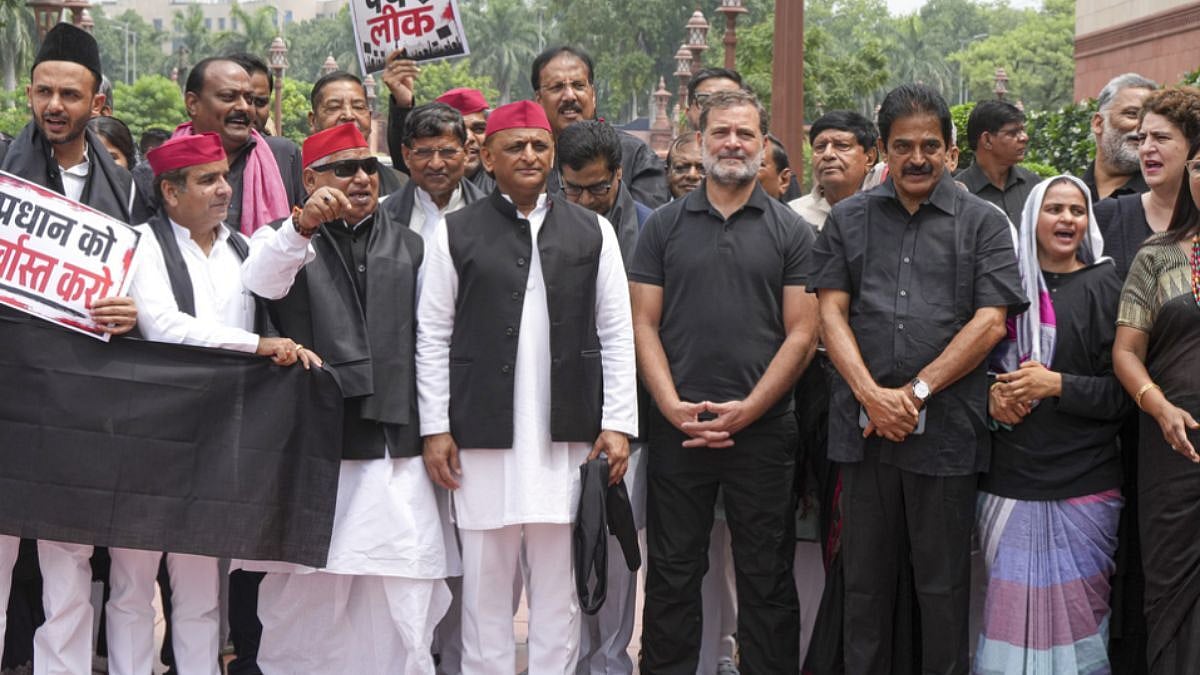
When Opposition Members of Parliament arrived on the Parliament premises clad in head-to-toe black, they were tapping into a centuries-old political strategy. Demonstrating in solid dark attire, whether on street corners or inside legislative halls, bridges the gap between personal grief and public defiance.
Click here for NEET-UG paper leak protests LIVE updates
Addressing reporters outside Parliament, Congress MP Pawan Khera stated that the collective attire served as a direct mark of protest against what has been done to the students of this country in New Delhi, protesting against the insistence on Union Education Minister Dharmendra Pradhan continuing in his position and protesting against the way the government has responded to student unrest. By donning black, Opposition lawmakers brought the ongoing outrage of student groups in the capital directly into the heart of the legislature.
Reasons behind wearing black
Historically associated with bereavement, black is adopted to signal public mourning over systemic failures, institutional injustice or young lives disrupted by policy decisions. It transforms personal sorrow into a stark political statement.
By stripping away individual style, brand status and socioeconomic cues, matching black attire creates a singular visual block. This projects the message that the collective cause outweighs the individual, creating a unified wall of non-compliance.
In street protests, most notably seen in Black Bloc tactics, uniform black clothing and face coverings obscure identifying features. This practical measure frustrates digital surveillance systems and facial recognition technology, shielding participants from targeted retaliation.
Black attire in global movements
Hong Kong's anti-extradition demonstrations (2019–20)
During massive pro-democracy protests, millions of Hong Kong citizens wore black shirts, dark face masks and umbrellas. While representing solemn resistance, the black clothing was fundamentally operational as it protected demonstrators from omnipresent AI-driven facial recognition software and public surveillance networks.
Poland's Czarny Protest (2016)
Roughly 100,000 Polish women participated in Czarny Protest (Black Monday) to strike against a proposed absolute ban on abortion. The sea of solid black attire signified both mourning for women's potential health rights and a stark visual display of nationwide non-compliance.
Emergence of the Black Bloc in West Germany (1970s–1980s)
Originating within West Germany's Autonomen anti-nuclear and anti-eviction movements, activists dressed in head-to-toe black clothes, ski masks and helmets. This tactic, dubbed the Black Bloc, aimed to present a uniform front that made singling out individual protesters impossible for law enforcement.
Black Panther Party (1960s–1970s)
In US, the Black Panther Party for Self-Defense adopted a distinctive uniform of black leather jackets and black berets. This deliberate aesthetic moved away from mourning, projecting strength, organisational discipline and militant resistance against police brutality.
Black Sash Movement (1955–1956)
In South Africa, anti-Apartheid women activists wore a black sash draped over one shoulder during silent vigils outside government buildings, symbolising continuous mourning for the death of the nation's democratic constitution.
Echoes of black in poetry and resistance anthems
The choice to wear black as an emblem of outrage and solidarity with struggling youth finds deep resonance in literature and music.
Johnny Cash famously captured this exact motivation in his 1971 protest song, Man in Black, explaining why he eschewed bright colours for dark clothing on stage:
Ah, I'd love to wear a rainbow every day
And tell the world that everything's okay
But I'll try to carry off a little darkness on my back
Until things are brighter, I'm the Man In Black
By wearing black into Parliament, the Opposition MPs tap into this enduring tradition, transforming a simple colour into a a shield of solidarity and an unyielding demand for accountability.

